Question
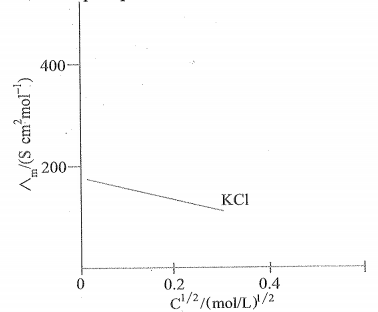
What is limiting molar conductivity ? Explain relation between molar conductivity and concentration of solution with strong electrolyte.
Answer

→ "When the concentration of solution approaches zero, the molar conductivity is known as limiting molar conductivity and is represented by the symbol $\wedge_m^0$
→ Electrolytes which is completely ionize is known as strong electrolyte.
e.g. $KCl , NaCl , MgCl _2, CaCl _2, NaNO _3, KNO _3$ etc.
→ For strong electrolytes, $\wedge_{ m }$increases slowly with dilution and can be represented by the equation : $
\wedge_{ m }=\Lambda^0{ }_{ m }- Ac ^{\frac{1}{2}}
$
→ It can be seen that if we plot $\wedge_{ m }$ against $c ^{\frac{1}{2}}$, we obtain a straight line with intercept equal to $\wedge^0{ }_{ m }$ and slope equal to - A .
Image
→ The value of the constant A for a given solvent and temperature depends on the type of electrolyte.
→ Thus, $NaCl , CaCl _2, MgSO _4$ are known as 1-1, 2-1 and 2-2 electrolytes respectively. Al electrolytes of a particular type have the same value for 'A'.

Need a full question paper?

Generate a complete, print-ready paper with questions like this in minutes — across 16+ boards, with answer keys.

Start Generating Free

Similar questions

What are vitamin compounds? Give primary information about vitamin compounds.
Write the name and draw the structure of each of the following complex:
  1. $\text{[Co(NH}_{3})_{4}\text{(H}_{2}\text{O})_{2}]\text{Cl}_{3}$
  2. $\text{[Pt(NH}_{3})_{4}]\text{[NiCl}_{4}]$
An organic compound $'A\ ’$ having molecular formula $\ce{C_3H_6}$ on treatment with aqueous $\ce{H_2SO4}$ gives $'B\ ’$ which on treatment with $\ce{HCl/ ZnCl_2}$ gives $'C\ ’.$ The compound $C$ on treatment with ethanolic $\ce{KOH}$ gives back the compound $'A\ ’.$ Identify the compounds $A, B, C.$
For M2+/M and M3+/M2+ systems the $E ^{\circ}$ values for some metals are as follows : 
$\begin{array}{llll} Cr ^{2+} / Cr & -0.9 V & Cr ^3 / Cr ^{2+} & -0.4 V \\ Mn ^{2+} / Mn & -1.2 V & Mn ^{3+} / Mn ^{2+} & +1.5 V \\ Fe ^{2+} / Fe & -0.4 V & Fe ^{3+} / Fe ^{2+} & +0.8 V\end{array}$
Use this data to comment upon :
(i) the stability of Fe3+ in acid solution are compared to that of Cr3+or Mn3+ and
(ii) the case with which iron can be oxidised as compared to a similar process for either chromium or manganese metal.
Among the isomeric alkanes of molecular formula $\ce{C_5H_{12}},$ identify the one that on photochemical chlorination yields,
  1. A single monochloride.
  2. Three isomeric monochlorides.
  3. Four isomeric monochlorides.
An organic compound gives hydrogen on reacting with sodium metal. It also gives iodofom test and the end product of its oxidation is ethanoic acid. Name the compound and give the equation of these reactions.
A $4\%$ solution$(w/ w)$ of sucrose $(M = 342g\ mol^{-1})$ in water has a freezing point of $271.15K.$ Calculate the freezing point of $5\%$ glucose $(M = 180g\ mol^{-1})$ in water.
$($Given: Freezing point of pure water $= 273.15K)$
How will you distinguish between the following pairs of compounds:
Benzyl chloride and chlorobenzene.
Explain the bromination of Aniline. State what is done if Mono substituted derivative of aniline is to be formed by this process.
Write down the electronic configuration of :
(a) $Cr ^{3+}$$\quad$(b) $Cu ^{+}$$\quad$(c) $Co ^{2+}$$\quad$(d) $M n ^{ 2 + }$
(e) $P m ^{ 3 + }$$\quad$(f) $Ce ^{ 4 +}$$\quad$(g) $Lu ^{2+}$$\quad$(h) $Th ^{4+}$.