Question
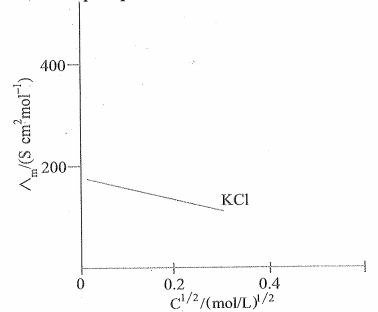
What is limiting molar conductivity ? Explain relation between molar conductivity and concentration of solution with strong electrolyte.
Answer

→ "When the concentration of solution approaches zero, the molar conductivity is known as limiting molar conductivity and is represented by the symbol $\wedge_m^0$
→ Electrolytes which is completely ionize is known as strong electrolyte.
e.g. $KCl , NaCl , MgCl _2, CaCl _2, NaNO _3, KNO _3$ etc.
→ For strong electrolytes, $\wedge_{ m }$increases slowly with dilution and can be represented by the equation : $
\wedge_{ m }=\Lambda^0{ }_{ m }- Ac ^{\frac{1}{2}}
$
→ It can be seen that if we plot $\wedge_{ m }$ against $c ^{\frac{1}{2}}$, we obtain a straight line with intercept equal to $\wedge^0{ }_{ m }$ and slope equal to - A .
Image
→ The value of the constant A for a given solvent and temperature depends on the type of electrolyte.
→ Thus, $NaCl , CaCl _2, MgSO _4$ are known as 1-1, 2-1 and 2-2 electrolytes respectively. Al electrolytes of a particular type have the same value for 'A'.

Need a full question paper?

Generate a complete, print-ready paper with questions like this in minutes — across 16+ boards, with answer keys.

Start Generating Free