Question
What is Malus Law ?

Answer

Malus Law : When a beam of completely plane polarised light from a polariser is observed through an analyser it is found that the intensity of light emerging out of the analyser varies as the analyser is rotated in its own plane about the direction of incident beam. In 1809, Ε.Ν. Malus discovered that when a beam of completely plane polarised light from a polariser is passed through an analyser, then the intensity of the light beam emerging out of the analyser varies directly as the square of the cosine of the angle between the transmission directions of polariser and analyser.
This statement is known as the law of Malus.
Mathematically this law can be expressed as follows :
$I = I _0 \cos ^2 \phi$
where I0 = Intensity of the plane polarised light falling on the analyser.
I = Intensity of light emerging out of the analyser.
$\phi$ = Angle between the polarising directions of polariser and analyser i.e., the angle between the plane of transmission of polariser and analyser.

Need a full question paper?

Generate a complete, print-ready paper with questions like this in minutes — across 16+ boards, with answer keys.
Start Generating Free

Similar questions

Explain the shortcomings of Bohr's Theory.
A light ray is incident at an angle of 45° with the normal to a $\sqrt{2}\text{cm}$ thick plate $(\mu = 2.0)$. Find the shift in the path of the light as it emerges out from the plate.
Write relation between $B , H , I , \chi$ and $\mu$.
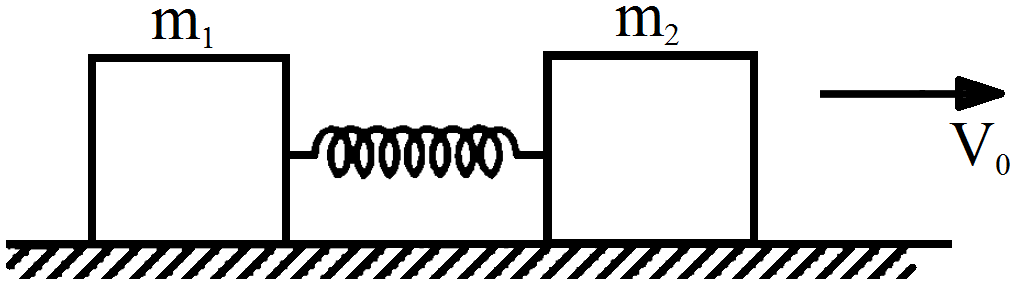
Two blocks of masses $m_1$ and $m_2$ are connected by a spring of spring constant $k.$ The block of mass $m_2$ is given a sharp impulse so that it acquires a velocity $v_0$ towards right. Find
  1. The velocity of the centre of mass.
  2. The maximum elongation that the spring will suffer.
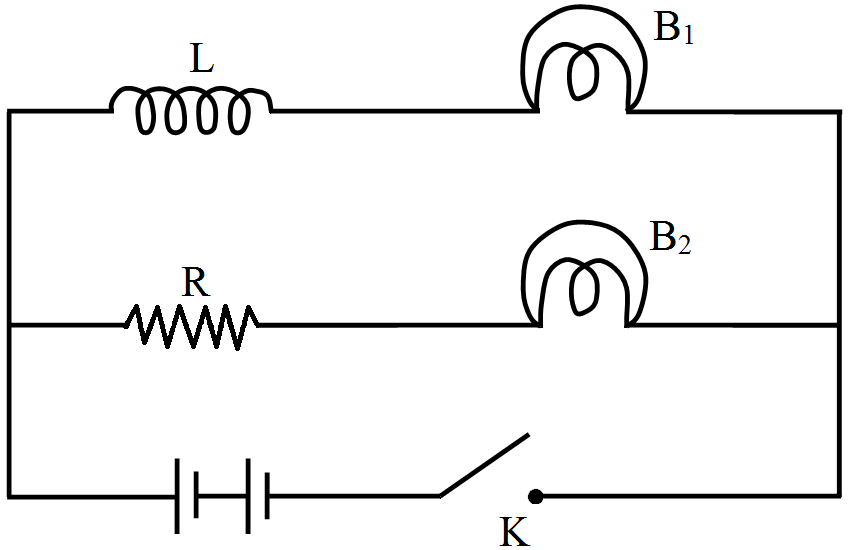
In the given circuit, the value of resistance effect of the coil $L$ is exactly equal to the resistance $R.$ Bulbs $B_1$ and $B_2$ are exactly identical. Answer the following questions based on above information:
  1. Which one of the two bulbs lights up earlier, when key $K$ is closed and why?
  2. What will be the comparative brightness of the two bulbs after sometime if the key $K$ is kept closed and why?
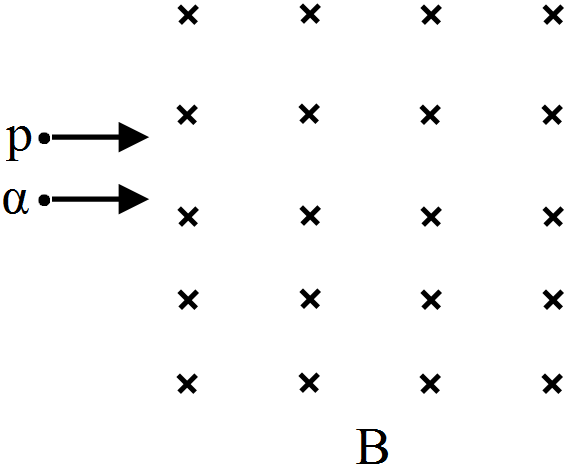
An $\alpha$-particle and a proton moving with the same speed enter the same magnetic field region at right angles to the direction of the field. Show the trajectories followed by the two particles in the region of the magnetic field. Find the ratio of the radii of the circular paths which the two particles may describe.
A short magnet is moved along the axis of a conducting loop. Show that the loop repels the magnet if the magnet is approaching the loop and attracts the magnet if it is going away from the loop.
The equation of a travelling sound wave is $\text{y}=6.0\sin(600\text{t}-1.8\text{x})$ where y is measured in $10^{-5}m$, t in second and x in metre.
  1. Find the ratio of the displacement amplitude of the particles to the wavelength of the wave.
  2. Find the ratio of the velocity amplitude of the particles to the wave speed.
Does a nucleus lose mass when it suffers gamma decay?
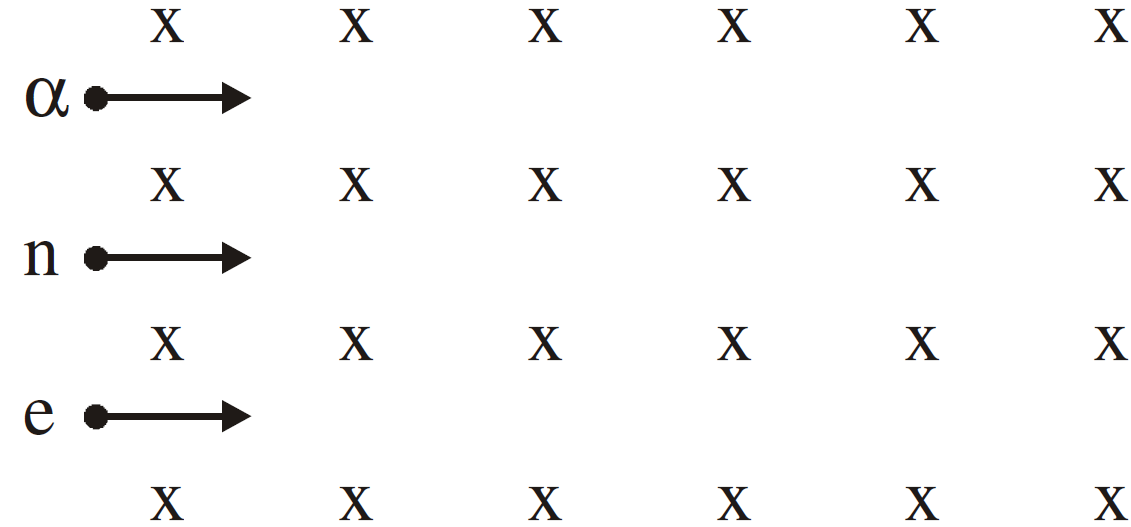
Write the expression for the magnetic force acting on a charged particle moving with velocity n in the presence of magnetic field B. A neutron, an electron and an alpha particle moving with equal velocities, enter a uniform magnetic field going into the plane of the paper as shown. Trace their paths in the field and justify your answer.