Questions

3 Marks Question

Take a timed test

7 questions · self-marked practice — reveal the answer and mark yourself.

Question 13 Marks
State Brewster's law. Value of Brewster's angle for light of different colours is different for a transparent medium. Give reasons.
Answer
Brewster's Law : According to this law the refractive index of a transparent medium 'n' is given by :
$ n=\tan i_{p} $
(where $ i_p $ = angle of polarisation or Brewster's angle)
⇒ $ i_{p}=\tan^{-1} n $ ... (1)
According to Cauchy's formula refractive index $n$ is given by:
$ n=A+\frac{B}{\lambda^{2}} $ ... (2)
where A, B are constants for a given medium.
For light of different colours wavelength $ \lambda $ will be different. Hence on the basis of equation (2) value of refractive index $n$ will be different for light of different colours and therefore on the basis of equation (1) value of Brewster's angle will be different for light of different colours.
View full question & answer
Question 23 Marks
Explain the following giving reasons :
(i) When monochromatic light is incident and surface separating two media, the reflected and refracted light both have the same frequency as the incident frequency.
(ii) When light travels from a rarer medium to a denser medium, the speed decreases. Does this decrease in speed imply a reduction in the energy carried by the wave?
(iii) In the wave picture of light intensity of light is determined by the square of the amplitude of the curve. What determines the intensity in the photon picture of light ?
Answer
(i) Since frequency is the characteristic of light source only and does not depend upon medium hence when monochromatic light is incident on a surface separating two media, the reflected and refracted light both have the same frequency.
(ii) In traversing light from a rarer medium to a denser medium speed decreases due to decrease in wavelength of light. But energy carried by the wave depends upon the amplitude of the wave only and not on speed. Hence decrease is speed does not imply a reduction in the energy carried by the wave.
(iii) In photon picture of light the intensity of light is determined by the number of photons emitted per second by the source of light.
View full question & answer
Question 33 Marks
Write characteristics of Laser rays.
Answer
Characteristics of Laser rays :
(i) These are highly coherent rays.
(ii) These are unidirectional.
(iii) Intensity and power of these rays are very much.
(iv) The main characteristic of these rays is that these rays spread very less on conversing a long distance.
(v) Band width of laser rays is very less.
(vi) The rays can be superimposed with other rays of different wavelength to form waves of new light waves.
(vii) These rays can be changed from one colour into another.
(viii) These rays are monochromatic.
View full question & answer
Question 43 Marks
What is Malus Law ?
Answer
Malus Law : When a beam of completely plane polarised light from a polariser is observed through an analyser it is found that the intensity of light emerging out of the analyser varies as the analyser is rotated in its own plane about the direction of incident beam. In 1809, Ε.Ν. Malus discovered that when a beam of completely plane polarised light from a polariser is passed through an analyser, then the intensity of the light beam emerging out of the analyser varies directly as the square of the cosine of the angle between the transmission directions of polariser and analyser.
This statement is known as the law of Malus.
Mathematically this law can be expressed as follows :
$I = I _0 \cos ^2 \phi$
where I0 = Intensity of the plane polarised light falling on the analyser.
I = Intensity of light emerging out of the analyser.
$\phi$ = Angle between the polarising directions of polariser and analyser i.e., the angle between the plane of transmission of polariser and analyser.
View full question & answer
Question 53 Marks
What do you mean by resolving limit of a telescope ? What will be the resolving limit of a telescope whose objective has aperture of 5 m if the wavelength of the light is 5000 Å ?
Answer
Resolving limit of a telescope : The smallest separation (linear or angular) between two point objects at which they appear just separated when seen by the telescope is called the resolving limit of the telescope. It is given by the formula :
$ RL=1.22 \lambda/d $
Solution of Numerical :
Given: $ d=5 $ m and $ \lambda=5000 \text{ Å}=5\times10^{-7} \text{ m} $
Resolving limit of the telescope :
$ RL=\frac{1.22\lambda}{d}=\frac{1.22\times(5\times10^{-7} \text{ m})}{5\text{ m}} $
$ =1.22\times10^{-7} \text{ radian} $
View full question & answer
Question 63 Marks
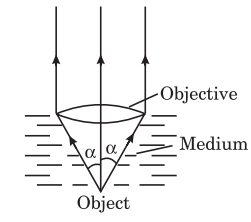
Define resolving power of a microscope. Write its formula. How will it be affected when
(i) the wavelength of incident light decreases and
(ii) the aperture of the objective decreases ?
View full question & answer
Question 73 Marks
What is interference of light? Give one example of interference in our daily life.
Answer
When two waves of light having same frequency and same ampliitude propagate in a medium simultaneously in the same direction then due to their superposition the resultant intensity in the region of superposition is, in general, different from the sum of intensities due to each wave separately. This modification in the distribution of intensity of light in region of superposition is called interference. In the region of superposition there are certain points at which waves superimpose in such a way that resultant intensity is greater than the sum of intensities due to separate waves. Interference at such points is called constructive interference. At other points in the region of superposition the resultant intensity is less than the sum of intensities due to separate waves and interference at these points is called as destructive interference.
In our daily life colour in this films (soap bubbles) is an example of interference of light.
View full question & answer