Question
What is meant by chromosomal mutation?

Answer

A change in the structure and/ or number of chromosomes in an organism, is called chromosomal mutation.

Need a full question paper?

Generate a complete, print-ready paper with questions like this in minutes — across 16+ boards, with answer keys.

Start Generating Free

Similar questions

Read the following and answer any four questions from (i) to (v) given below:
Medical termination of pregnancy is termination of pregnancy before the fetus become viable. To reduce the incidence of illegal abortion and consequent maternal mortality, MTP Amendment Act, 2017 was enacted by the government of India. About 40-50 million MTPs are done in a year all over the world.
  1. Abortion can be safely done for about ______ weeks of pregnancy.
  1. 4
  2. 12
  3. 8-10
  4. 15-18
  1. How is MTP helpful in decreasing human population?
  1. By aborting normal female fetus.
  2. By aborting normal female fetus.
  3. By getting rid of unwanted pregnancies.
  4. None of these.
  1. Select an incorrect statement for MTP.
  1. Second trimester abortions are more risky than first trimester.
  2. It is being misused to abort normal female fetus.
  3. It helps to get rid of unwanted pregnancies.
  4. Child detected with congenital heart disease cannot be aborted.
  1. MTP was legalised by Government of India in:
  1. 1971
  2. 1982
  3. 1973
  4. 1991
  1. Assertion: MTPs are safe during first trimester of pregnancy.
Reason: After first trimester, fetus become intimately associated with the maternal tissues.
  1. Both assertion and reason are true, and reason is the correct explanation of assertion.
  2. Both assertion and reason are true, but reason is not the correct explanation of assertion.
  3. Assertion is true, but reason is false.
  4. Both assertion and reason are false.
Column AColumn B
(1) Sir Edward Sharpey Schafer(a) Chemically synthesized DNA sequence of insulin
(2) Hakura(b) Discovery of insulin
(3) Gilbert and Villokomaroff(c) PCR
(4) K. Mullis (d) Insulin production using r-DNA technology
Read the following and answer any four questions from (i) to (v) given below:
A 23 year old Sahil has been diagnosed with an infection of reproductive tract caused by bacteria. He complains about burning sensation during urination, pus-containing discharge and pain around genitalia. This infection has incubation period of 2-5 days but can be cured.
  1. From which disease is Sahil suffering?
  1. Chlamydiasis.
  2. Herpes.
  3. Gonorrhoea.
  4. Syphilis.
  1. Which among the following reproductive tract infections is transmitted by bacteria?
  1. Trichomoniasis.
  2. Chancroid.
  3. Genital warts.
  4. Both (a) and (b).
  1. Which mode of treatment would be useful for Sahil?
  1. Cryosurgery.
  2. Use of Podophyllum preparation.
  3. Use of antibiotic ampicillin.
  4. It cannot be treated.
  1. What technique was used to diagnose Sahil's disease?
  1. Gram staining of discharge and culture.
  2. ELISA Test.
  3. Antibody detection.
  4. Antigen test.
  1. Find the odd one out.
  1. Treponema pallidum.
  2. Neisseria gonorrhoeae.
  3. Haernophilus ducreyi.
  4. Trichomonas vaginalis.
Read the following and answer any four questions from (i) to (v) given below:
In today's world, more than 25% of human population is suffering from hunger and malnutrition. Scientists have developed techniques where microbes are grown on industrial scale as a source of good protein which can be grown from waste water, animal manure and even sewage. Single cell proteins are such products. TI1e biomass or protein is extracted from pure or mixed cultures of algae, yeasts, fungi or bacteria. These are a very good source of food for human consumption.
  1. Why the name single cell protein is applied?
  1. It contains only one type of protein.
  2. It is obtained from unicellular edible microbes.
  3. It contains only one type of microorganism.
  4. All of these.
  1. Which of the following is considered under single cell protein?
  1. Algae.
  2. Fungi.
  3. Cyanobacteria.
  4. All of these.
  1. Microorganisms can be a useful food resource for increasing human population because:
  1. These are easy to harvest.
  2. These can grow in water system.
  3. They have a high rate of multiplication thus producing huge biomass.
  4. They have high level of nucleic acid.
  1. Single cell protein can be grown from:
  1. Waste water.
  2. Animal manure.
  3. Sewage.
  4. All of these.
  1. Assertion: Production of single cell protein reduces pollution.
Reason: Single cell protein can be grown from waste water and even sewage.
  1. Both assertion and reason are true and reason is the correct explanation of assertion.
  2. Both assertion and reason are true but reason is not the correct explanation of assertion.
  3. Assertion is true but reason is false.
  4. Both assertion and reason are false.
Column A (Scientist)Column B (Theory)
(1) Munch(a) Proton transport theory
(2) Bohem(b) Pressure flow theory
(3) J. Pristley(c) Capillary theory
(4) Levitt(d) Root Pressure theory
Read the following and answer any four questions from (i) to (v) given below:
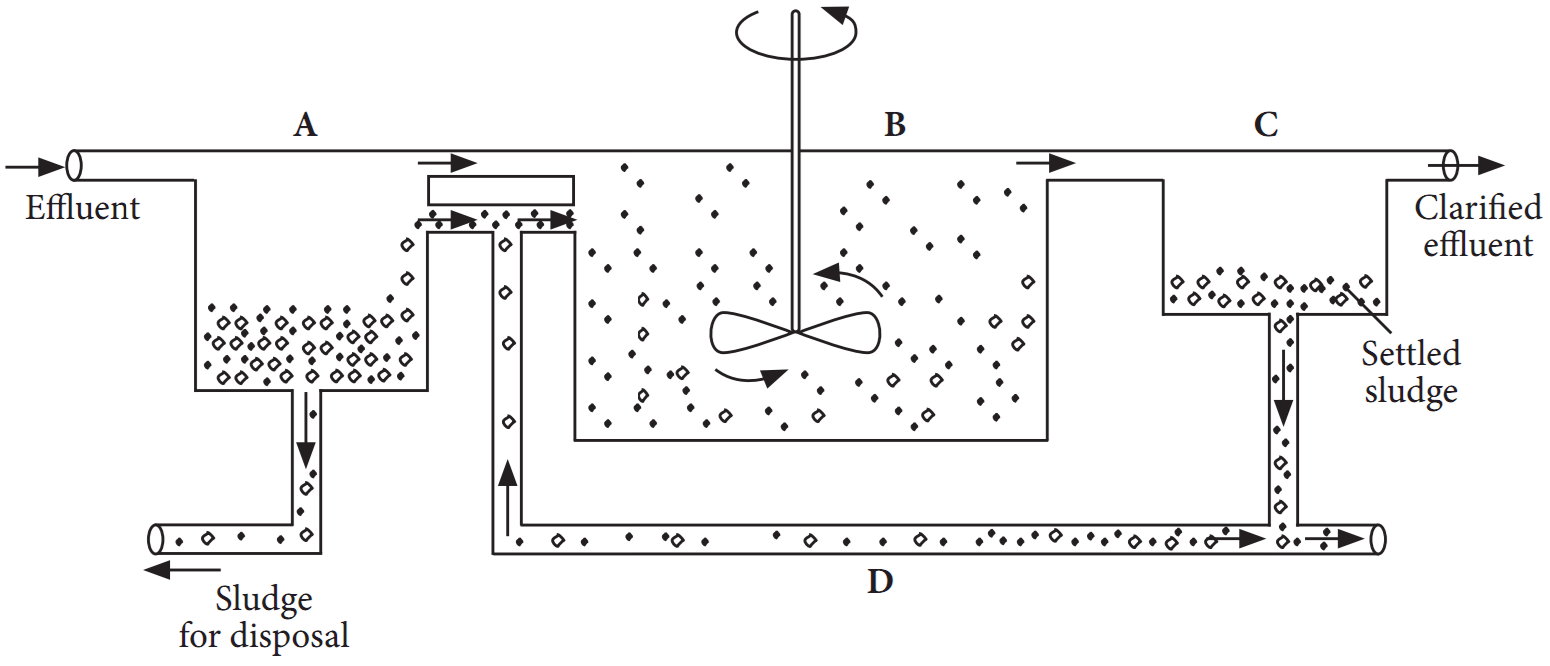
Saurin, a M.Sc student, get an assignment on sewage treatment plant (STP) to study the microbial load. After visiting such plant in his locality, he makes a simplified diagram of the STP for his project. Study the diagram given below and answer the following questions.
  1. In the diagram 'A' denotes:
  1. Aeration tank.
  2. Primary settling tank.
  3. Secondary settling tank.
  4. Sludge digester.
  1. Which of the following is incorrect regarding the sludge released from A?
  1. It is formed after primary treatment.
  2. It does not require aeration.
  3. It possesses floes of decomposer microbes.
  4. It is used in landfills.
  1. A large number of aerobic heterotrophic microbes grow in:
  1. A
  2. B
  3. C
  4. Both (a) and (b).
  1. What is denoted by 'D' in the given diagram?
  1. Primary sludge.
  2. Primary effluent.
  3. Activated sludge.
  4. Secondary effluent.
  1. Assertion: The colloided and finely suspended matter of sewage form aggregates which are called floes.
Reason: Floes contain masses of bacteria, slime and fungal filaments.
  1. Both assertion and reason are true and reason is the correct explanation of assertion.
  2. Both assertion and reason are true but reason is not the correct explanation of assertion.
  3. Assertion is true but reason is false.
  4. Both assertion and reason are false.
Read the following and answer any four questions from (i) to (v) given below:
Oogenesis is the process of formation of ovum in ovaries. It consists of three phases : multiplication, growth and maturation. Oogenesis is controlled by hormones GnRH, LH, FSH. GnRH secreted by the hypothalamus stimulates the anterior lobe of pituitary gland to secrete LH and FSH.
  1. What is the function of hormone FSH?
  1. It inhibits the formation of estrogen.
  2. It induces the release of secondary oocyte.
  3. It stimulates the growth of Graafian follicles.
  4. It causes ovulation.
  1. Which hormone induces the rupture of the mature Graafian follicle?
  1. Follicle stimulating hormone.
  2. Gonadotropin releasing hormone.
  3. Progesterone.
  4. Luteinising hormone.
  1. Which cell division is involved in the formation of secondary oocyte?
  1. Mitosis.
  2. Meiosis I.
  3. Amitosis.
  4. Meiosis II.
  1. Identify the function(s) of LH.
  1. Release of secondary oocyte from Graafian follicle.
  2. Stimulates corpus luteum to secrete progesterone.
  3. Stimulates estrogen formation.
  4. Promotes development of egg to form secondary oocyte.
  1. (A) and (B) only.
  2. (B) and (C) only.
  3. (A), (C) and (D) only.
  4. (B) only.
  1. Assertion: The increase in progesterone level exerts positive feedback on GnRH.
Reason: The rising level of progesterone stimulate production of FSH and LH.
  1. Both assertion and reason are true, and reason is the correct explanation of assertion.
  2. Both assertion and reason are true, but reason is not the correct explanation of assertion.
  3. Assertion is true, but reason is false.
  4. Both assertion and reason are false.
How is a transgenic tobacco plant protected against Meloidogyne incognita? Explain the procedure.
Read the following and answer any four questions from (i) to (v) given below:
Growth of a population with time shows specific and predictable patterns. Two types of growth pattern of population are exponential and logistic growth. When resources in the habitat are unlimited each species has the ability to realise fully its innate potential to grow in number. Then the population grows in exponential fashion. When the resources are limited growth curve shows an initial slow rate and then it accelerates and finally slows giving the growth curve which is sigmoid.
  1. Which of the following statement is incorrect?
  1. Exponential growth occurs in organism such as lemmings.
  2. Logistic growth is more realistic.
  3. Exponential growth has two phases lag and log.
  4. ln logistic growth, population passes well beyond the carrying capacity of ecosystem.
  1. Which of the following equations correctly represents the exponential population growth curve?
  1. $\text{dN}/\text{dt}=\text{rN}$
  2. $\text{dN}/\text{dt}=\text{rN}\Big(\frac{\text{K-N}}{\text{K}}\Big)$
  3. $\text{N}_\text{t}=\text{N}_\text{o}\text{e}^\text{rt}$
  4. Both (a) and (c).
  1. Which of the following equations correctly represents Verhulst-Pearl logistic growth?
  1. $\text{dN}/\text{dt}=\text{rN}\Big(\frac{\text{K-N}}{\text{K}}\Big)$
  2. $\text{dN}/\text{dt}=\frac{\text{rN}}{\text{K}}$
  3. $\text{dN}/\text{dt}=\frac{\text{N}(\text{K}-\text{N})}{\text{K}}$
  4. $\text{dN}/\text{dt}=\frac{\text{r}(\text{K}-\text{N})}{\text{K}}$
  1. The population growth is generally described by the following equation:
$\frac{\text{dN}}{\text{dt}}=\text{rN}\Big(\frac{\text{K}-\text{N}}{\text{K}}\Big)$

What does 'r' represent in the given equation?
  1. Population density at time 't'.
  2. Intrinsic rate of natural increase.
  3. Carrying capacity.
  4. The base of natural logarithm.
  1. Study the population growth curves (A and B) in the given graph and select the incorrect option.
  1. Curve 'A: shows exponential growth, represented by equation $\frac{\text{dN}}{\text{dt}}=\text{rN}$.
  2. Curve 'B' shows logistic growth, represented by equation $\frac{\text{dN}}{\text{dt}}=\text{rN}\Big(\frac{\text{K}-\text{N}}{\text{K}}\Big)$
  3. Exponential growth curve is considered as more realistic than the logistic growth curve.
  4. Curve 'A' can also be represented by equation $\text{N}_\text{t}=\text{N}_\text{o}\text{e}^\text{rt}$.
Read the following and answer any four questions from (i) to (v) given below:
Ginkgo tree has been saved from extinction by selective breeding followed by channeling into trade of nature lovers. This is an ex-situ conservation, where endangered species are protected from all adverse factors. Offspring produced in captive breeding are released in natural habitat for acclimatisation.
  1. What is the significance of offsite collections?
  1. Restock depleted populations.
  2. Protection of endangered species.
  3. Reintroduce species in wild.
  4. All of these.
  1. Which of the following is not an ex-situ conservation?
  1. Wetlands
  2. Orchards
  3. Aquaria
  4. Botanical gardens.
  1. Select the incorrect statements for ex-situ conservation.
  1. It is conservation of species outside their natural habitats.
  2. Endangered species are kept under human supervision and provided all the essentials.
  3. The species population recovers in natural environment.
  4. Both (b) and (c).
  1. Conditions maintained in seed banks for orthodox seeds are:
  1. Low moisture content.
  2. Anaerobic conditions.
  3. Low temperature.
  4. All of these.
  1. Assertion: Animal species which have become extinct in wild continue to be maintained in zoological parks.
Reason: Captive breeding is the conservation of those cases where these is no realistic chance of in-situ survival.
  1. Both assertion and reason are true and reason is the correct explanation of assertion.
  2. Both assertion and reason are true but reason is not the correct explanation of assertion.
  3. Assertion is true but reason is false.
  4. Both assertion and reason are false.