Question
  1. What is meant by ecological succession? How does it occur? Explain.
  2. Differentiate between Primary and Secondary succession.

Answer

  1. The gradual and fairly predictable change in the species composition of a given area = 1. During succession some species colonise an area and their populations become more numerous, where as population of other species decline and even disappear = 1 + 1 = 2.
  2.  
 
Primary Succession
Secondary Succession
1.
It occurs in an area which has been bare from the beginning.
It occurs in an area which has been denuded recently.
2.
Soil is absent at the time of beginning of primary succession.
Soil is present in the area where secondary succession begins.
3.
Takes a long time for completion.
Takes less time for completion.

Need a full question paper?

Generate a complete, print-ready paper with questions like this in minutes — across 16+ boards, with answer keys.

Start Generating Free

Similar questions

Show that Darwin's natural selection is based on theoretical factual observations, with an example for each.
State the three principles of Mendel’s law of inheritance.
The following is the illustration of the sequence of ovarian events (a-i) in a human female.

Name the ovarian hormone and the pituitary hormone that have caused the above mentioned event.

If a population growing exponentially double in size in 3 years, what is the intrinsic rate of increase (r) of the population?
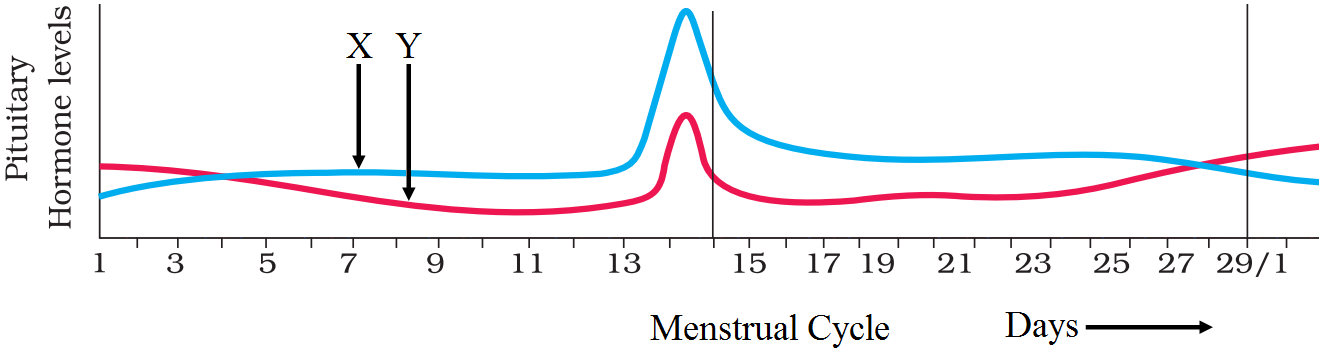
Study the graph given below and answer the questions that follow:

Name the hormones ‘X’ and ‘Y’.

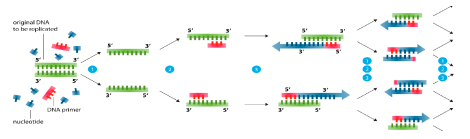
Polymerase chain reaction (PCR) is a laboratory technique used to amplify DNA sequences. The method involves using short DNA sequences called primers to select the portion of the genome to be amplified. The temperature of the sample is repeatedly raised and lowered to help a DNA replication enzyme copy the target DNA sequence. The technique can produce a billion copies of the target sequence in just a few hours.
Image
i. List the three steps involved in Polymerase Chain Reaction (PCR).
ii. Name the source organism of Taq polymerase.
iii. Explain the specific role of this enzyme in PCR.
If a desired gene is identified in an organism for some experiments, explain the process of the following:
  1. Cutting this desired gene at specific location.
  2. Synthesis of multiple copies of this desired gene.
What is mutualism? Describe any four examples.
Write the differences in following-
(a) Humoral Immunity and cell mediated Immunity.
(b) Innate Immunity and acquired Immunity
(c) Antigens and antibody
(d) T-lymphocytes and B-lymphocytes
Malarial parasite ‘Plasmodium’ completes its life cycle in two hosts. Draw its complete life cycle and explain various stages it follows throughout its life.