Question
What is meant by hybridisation of atomic orbitals? Describe the shapes of $sp, sp^2 , sp^3$ hybrid orbitals.
Answer

Hybridization is defined as an intermixing of a set of atomic orbitals of slightly different energies, thereby forming a new set of orbitals having equivalent energies and shapes.
For example, one 2s-orbital hybridizes with two 2p-orbitals of carbon to form three new $0sp^2$ hybrid orbitals.
These hybrid orbitals have minimum repulsion between their electron pairs and thus, are more stable. Hybridization helps indicate the geometry of the molecule.
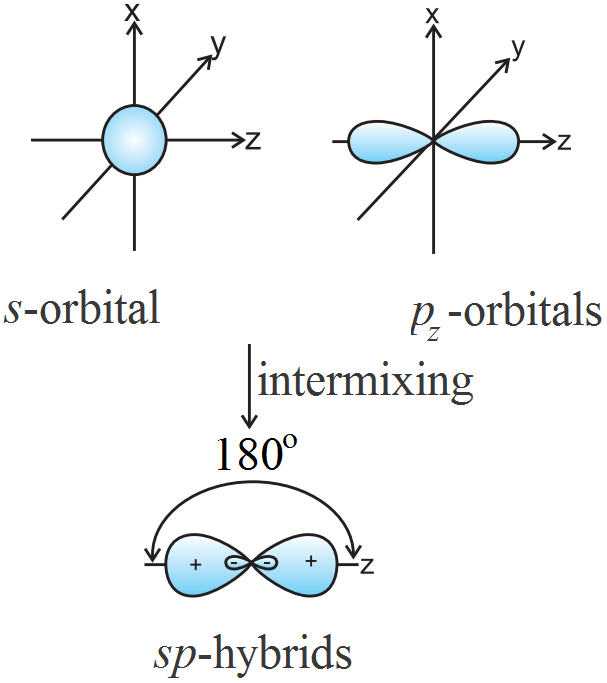
Shape of sp hybrid orbitals: sp hybrid orbitals have a linear shape. They are formed by the intermixing of s and p orbitals as:

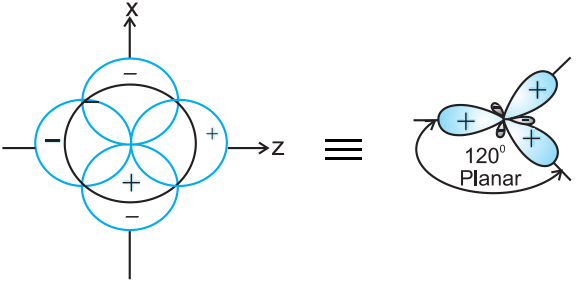
Shape of $sp^2$ hybrid orbitals:
$sp^2$ hybrid orbitals are formed as a result of the intermixing of one s-orbital and two 2p-orbitals. The hybrid orbitals are oriented in a trigonal planar arrangement as:

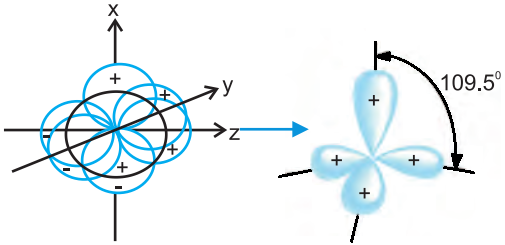
Shape of $sp^3$ hybrid orbitals:
Four $sp^3$ hybrid orbitals are formed by intermixing one s-orbital with three p-orbitals. The four $sp^3$ hybrid orbitals are arranged in the form of a tetrahedron as:

Need a full question paper?

Generate a complete, print-ready paper with questions like this in minutes — across 16+ boards, with answer keys.

Start Generating Free

Similar questions

Write the expression for the equilibrium constant, $K _{ C }$ for each of the following reactions:
a. $2 NOCl ( g ) \rightleftharpoons 2 NO ( g )+ Cl _2(g)$
b. $2 Cu \left( NO _3\right)_2(s) \rightleftharpoons 2 CuO ( s )+4 NO _2(g)+ O _2(g)$
c. $CH _3 COOC _2 H _5( aq )+ H _2 O ( l ) \rightleftharpoons CH _3 COOH ( aq )+ C _2 H _5 OH ( aq )$
d. $Fe ^{3+}( aq )+3 OH ^{-}( aq ) \rightleftharpoons Fe ( OH )_3(s)$
e. $I _2(s)+5 F_2 \rightleftharpoons 2 IF _5$
Match the correct atomic radius with the element.
 
Element
 
Atomic radius
i.
Be
A.
74
ii.
C
B.
88
iii.
O
C.
111
iv.
B
D.
77
v.
N
E.
66
Explain why cation are smaller and anions larger in radii than their parent atoms?
What is Bond Enthalpy? Discuss in detail.
Attempt any five of the following:
i. What is hydrogenation?
ii. Why do the $C - C$ bonds rather than $C - H$ bonds break during cracking of alkanes?
iii. Which conformation of ethane is more stable?
iv. What happens when 2-bromobutane is being treated with KOH (alcoholic)?
v. Identify the structure of A and B;
Image
vi. How will you separate propene from propyne?
vii. Why is t-butyl bromide more reactive towards $S _{ N } 1$ reaction as compared to n-butyl bromide?
A welding fuel gas contains carbon and hydrogen only. Burning a small sample of it in oxygen gives 3.38g carbon dioxide, 0.690 g of water and no other products. A volume of 10.0L (measured at STP) of this welding gas is found to weigh 11.6g. Calculate.
  1. Empirical formula.
  2. Molar mass of the gas.
  3. Molecular formula.
The ejection of the photoelectron from the silver metal in the photoelectric effect experiment can be stopped by applying the voltage of $0.35V$ when the radiation $256.7nm$ is used. Calculate the work function for silver metal.
When an alkali metal dissolves in liquid ammonia the solution can acquire different colours. Explain the reasons for this type of colour change.
The longest wavelength doublet absorption transition is observed at $589$ and $589.6nm$. Calcualte the frequency of each transition and energy difference between two excited states.
The solubility product of $Al ( OH )_3$ is $2.7 \times 10^{-11}$. Calculate its solubility in $gL ^{-1}$ and also find out pH of this solution. (Atomic mass of $Al =27 u$ ).