Question
What is meant by the term bond order? Calculate the bond order of : $\text{N}_2,\text{O}_2,\text{O}_2^+$ and $\text{O}_2^-$

Answer

Bond order of a molecule or an ion is a measure of the strength or stability of the bond. Numerically, it is half of the difference between number of electrons in bonding $(N_b)$ and in anti-bonding $(N_a)$ molecular orbitals. Bond order $=\frac{1}{2}(\text{N}_\text{b}-\text{N}_\text{a})$ If B.O. is zero or negative, the bond is highly unstable, i.e. the molecule does not exist. Higher bond order means high bond dissociation energy and greater stability. Greater the bond order, lesser is the bond length. M.O. configuration of $N_2$: $\text{KK}\sigma(2\text{s})^2\sigma^*(2\text{s})^2\pi(2\text{p}_\text{x})^2=\pi(2\text{p}_\text{y})\sigma(2\text{p}_\text{z})$ Bond order $=\frac{1}{2}(8-2)=3$ Thus, nitrogen molecule has three bonds, one sigma and two pi. the molecule is diamagnetic.M.O. comfiguration $O_2$​​​​​​​:
$\text{KK}\sigma (2\text{s})^2\sigma^*(2s)^2\sigma(2\text{p}_\text{x})^2=\pi(2\text{p}_\text{y})^2$
thus, nitrogen molecule has three bonds, one sigma and two pi. the molecule is diamagnetic.$\text{KK}\sigma (2\text{s})^2\sigma^*(2\text{s})^2\sigma(2\text{p}_\text{z})^2\pi(2\text{p}_\text{x})^2$ $=\pi(2\text{p}_\text{y})^2\pi^*(2\text{p}_\text{x})^1=\pi^*(2\text{p}_\text{y})^1$
[Note : $\sigma(2\text{p}_\text{z})$ is filled first and then $\pi(2\text{p}_\text{x})$and $\pi(2\text{p}_\text{y})$molecular orbitals are filled.] Bond order$=\frac{(8-4)}{2}=2$The oxygen molrcule has two bonds (one sigma and one pi). The molecule is paramagnetic.
$\text{KK}\sigma(2\text{s})^2\sigma^*(2\text{s})^2\sigma(2\text{p}_\text{z})^2\pi(2\text{p}_\text{x})^2=\pi(2\text{p}_\text{y})^2\pi^*(2\text{p}_\text{x})^1$ Bond order $=\frac{8-3}{2}=2.5$ M.O. configuration of $\text{O}_2^-$: $\text{KK}\sigma(2\text{s})^2\sigma^*(2\text{s})^2\sigma(2\text{p}_\text{z})^2\pi(2\text{p}_\text{x})^2$ $=\pi(2\text{p}_\text{y})^2\pi^*(2\text{p}_\text{x})^2=\pi^*(2\text{p}_\text{y})^1$ Bond order $\frac{(8-5)}{2}=1.5$

Need a full question paper?

Generate a complete, print-ready paper with questions like this in minutes — across 16+ boards, with answer keys.

Start Generating Free

Similar questions

Write down the products of ozonolysis of 1,2-dimethylbenzene (o-xylene). How does the result support Kekulé structure for benzene?
Match the following prefixes with their multiples:
 
Prefix
Multiples
(i)
micro
$10^6$
(ii)
deca
$10^9$
(iii)
mega
$10^{-6}$
(iv)
giga
$10^{-15}$
(v)
femto
$10$
What is overlapping of atomic orbitals? How many types are there? Discuss in detail.
At a certain temperature and total pressure of $10^5 ~Pa$, iodine vapour contains 40% by volume of I atoms $\text{I}_2\text{(g)}\rightleftharpoons2\text{I}\text{(g)}$ Calculate Kp for the equilibrium.
1. Will $CCl _4$ give a white precipitate of AgCl on heating it with $AgNO _3$ ?
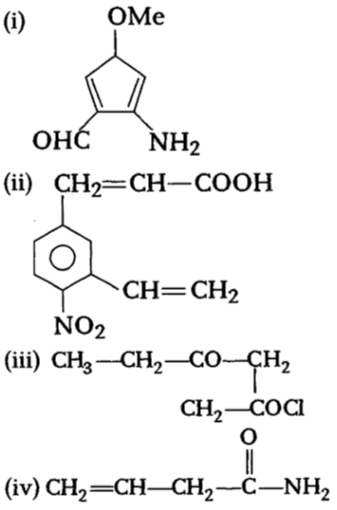
2. Identify the functional groups present in the following compounds.
Image
Discuss the principle and method of softening of hard water by synthetic ionexchange resins.
  1. A sample of salt has the following percentage composition
Fe = 36.76%, S = 21.11 % and O = 42.14%
Calculate the empirical formula of the compound
  1. What happens if the compound is heated? Write the balanced chemical equation.
  1. The energy associated with Bohr's first orbit is $-2.18 \times 10^{-18}J atom^{-1}$. What is the energy associated with fifth orbit?
  2. The work function for Caesium atom is $1.9 eV$.
Calculate the threshold wavelength.
[Given: $1 eV = 1.6 × 10⁻¹⁹J$]
  1. How many subshells are associated with $n = 4$?
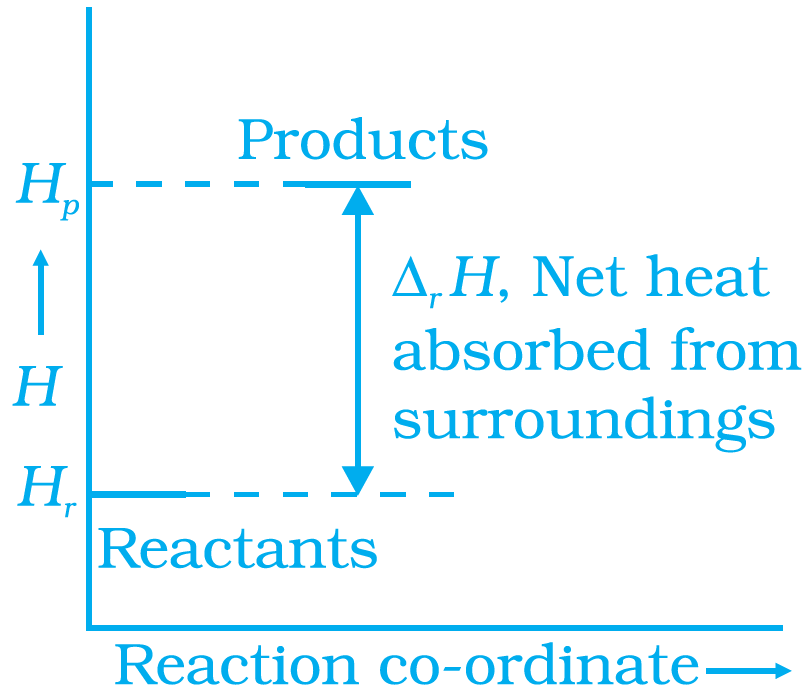
Enthalpy diagram for a particular reaction is given in Fig. Is it possible to decide spontaneity of a reaction from given diagram. Explain.
1. Why is nitric acid added to sodium extract before adding silver nitrate for testing halogens?
2. How does
i. an electron withdrawing group (EWG) and
ii. an electron donating group (EDG) influence the acid strength of carboxylic end?