Question
What is modulation?

Answer

The signals in communication system (e.g. music, speech etc.) are low frequency signals and cannot be transmitted over large distances. In order to transmit the signal to large distances, it is superimposed on a high frequency wave (called carrier wave). This process is called modulation.

Need a full question paper?

Generate a complete, print-ready paper with questions like this in minutes — across 16+ boards, with answer keys.
Start Generating Free

Similar questions

A metal sphere cools from $80^{\circ} C$ to $60^{\circ}\ C$ in $6\ min$ . How much time with it take to cool from $60^{\circ}\ C$ to $40^{\circ}\ C$ if the room temperature is $30^{\circ}\ C$ ?
An object is travelling in a horizontal circle with uniform speed. At $t=0$, the velocity is given by $\overrightarrow{ u }=20 \hat{ i }+35 \hat{ j } \ km / s$. After one minute the velocity becomes $\overrightarrow{ v }=-20 \hat{ i }-35 \hat{ j }$. What is the magnitude of the acceleration?
Define coefficient of thermal conductivity. Derive its expression.
A transmitting antenna at the top of a tower has a height $32\ m$ and that of the receiving antenna is $50\ m$. What is the maximum distance between them for satisfactory communication in line of sight mode? Given radius of Earth is $6.4 \times 10^6 m$.
distinguish between:
Conservative and non-conservative forces
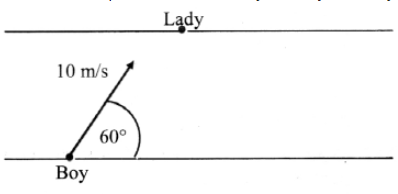
A lady dropped her wallet in the parking lot of a super market. A boy picked the wallet up and ran towards the lady. He set off at $60^\circ$ to the verge, heading towards the lady with a speed of $10 \ m s^{-1},$ as shown in the diagram.
Find the component of velocity of boy directly across the parking strip.
Image
A satellite orbits around the Earth at a height equal to $R$ of the Earth. Find its period. $(R = 6.4 \times 10^6 m, g = 9.8 \ m/s^2)$
Why light waves travel in vacuum whereas sound wave cannot?
Define unit vector and give its physical significance.
In olden days, while laying the rails for trains, small gaps used to be left between the rail sections to allow for thermal expansion. Suppose the rails are laid at room temperature $27 ^\circ\ C$. If maximum temperature in the region is $45 ^\circ\ C$ and the length of each rail section is $10\ m$, what should be the gap left given that $\alpha = 1.2 \times 10^{-5} K^{-1}$​​​​​​​ for the material of the rail section?