Question
What is monetary policy? State any three instruments of monetary policy.

Answer

Monetary policy refers to the policies and instruments through which the central bank controls the supply of money and credit. These instruments of monetary policy can be broadly classified into the following two categories.
  1. Qualitative Instruments.
  2. Quantitative Instruments.
The three instruments of monetary policy include:
  1. Moral Suasion: A persuasion technique followed by the central bank to pressurise the commercial banks to abide by the monetary policy is termed as moral suasion. This involves meetings, seminars, speeches and discussions, which explains the present economic scenario and thereby persuading the commercial banks to adapt the changes needed. In other words, this is an unofficial monetary policy that exercises the power of talk.
  2. Direct Action: The central bank can also take direct action against those commercial banks who do not abide by its directives and policy changes. In this case, the central bank may directly refuse any grant of further funds to such banks.
  3. Cash reserve ratio (CRR): It refers to the minimum proportion of the total deposits that the commercial banks has to maintain with the central bank in form of reserves. 
    An increase in the CRR, would mean that banks would be required to keep a greater portion in form of deposits with the central bank. This implies that the commercial banks are left with lesser amount of funds to lend out. Hence, the lending capacity of the banks reduces, leading to fall in the money supply. On the contrary, a fall in CRR will lead to an increase in the money supply.

Need a full question paper?

Generate a complete, print-ready paper with questions like this in minutes — across 16+ boards, with answer keys.
Start Generating Free

Similar questions

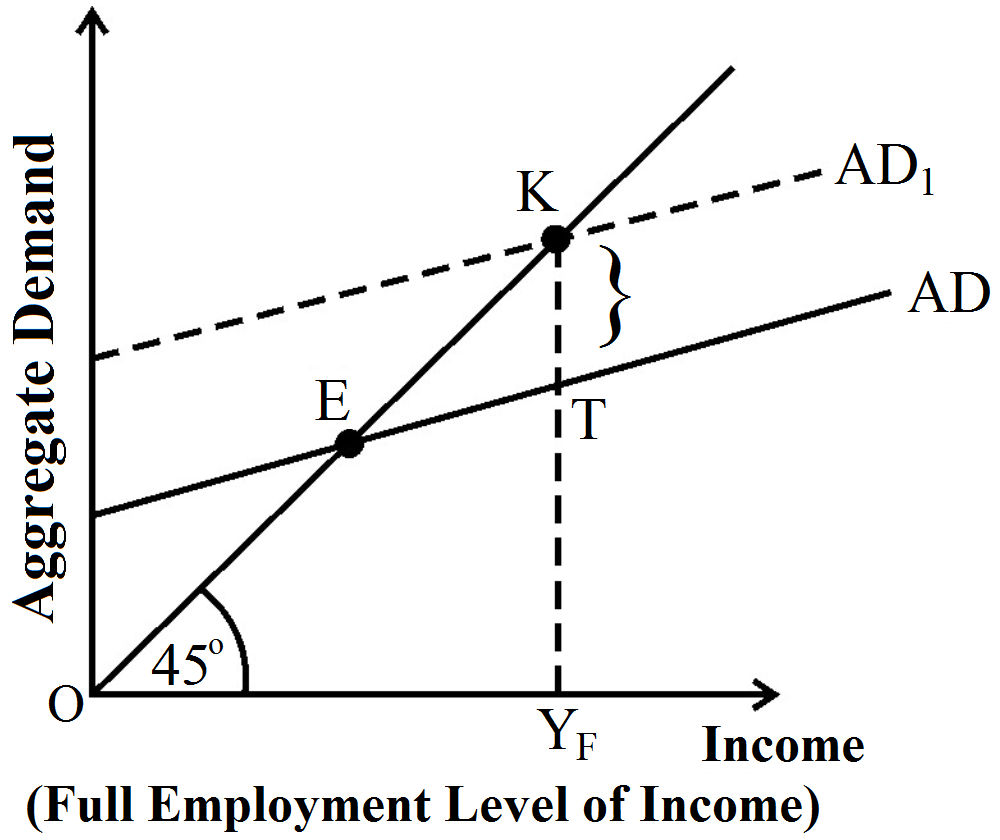
In the given figure, what does the gap ‘KT’ represent? State any two fiscal measures to correct the situation.
Give meaning of money. Explain the ‘store of value’ function of money.
Giving reasons, categorise the following into direct of tax and indirect tax:
  1. Corporation tax.
  2. Sales tax.
  3. Wealth tax.
  4. Service tax.
Distinguish between:
  1. Capital expenditure and Revenue expenditure
  2. Fiscal deficit and Primary deficit
Explain 'Government's Bank' function of Central Bank.OR
Explain 'banker to the government' function of the Central Bank.
Explain the national income determination in an economy using saving and investment approach. Use diagram.
Explain the’acceptance of deposits’function of commercial banks.
There are only two producing sectors $A$ and $B$ in an economy. Calculate:
  1. Gross value added at market price by each sector.
  2. National Income.
S. No.
 
(₹in crores)
$(i)$
Net factor income from abroad.
$20$
$(ii)$
Sales by $A$.
$1,000$
$(iii)$
Sales by $B.$
$2,000$
$(iv)$
Change in stock of $B.$
$(-)200$
$(v)$
Closing Stock of $A.$
$50$
$(vi)$
Opening stock of $A.$
$100$
$(vii)$
Consumption of fixed capital by $A$ and $B.$
$180$
$
(viii)$
Indirect taxes paid by $A$ and $B$
$120$
$(ix)$
Purchase of raw materials etc. by $A.$
$500$
$(x)$
Purchase of raw materials etc. by $B.$
$600$
$(xi)$
Exports by $B.$
$70$
Would the central bank need to intervene in a managed floating system? Explain why.
Differentiate between Gross Domestic Product at Market Price and Net National Product at Factor Cost.