Question
What is natural frequency of a system ? What is resonance? - Explain using a simple example.
###
What is resonance ? Explain using an appropriate example.

Answer

→Natural Frequency : "When a system capable of oscillating is given some initial displacement from its equilibrium position and left free, it begins to oscillate. Thus the oscillations performed by the system in the absence of any type of resistive forces are known as natural (free) oscillations."
If such a system is driven by an energy source at a frequency that is near the natural frequency, the amplitude of the oscillations is found to be large. This phenomenon is known as resonance.
→Example : A familiar example of this phenomenon is a child on a swing. The swing has a natural frequency for swinging back and forth like a pendulum. If the child pulls on the rope at regular intervals and the frequency of the pulls is almost the same as frequency of swinging, the amplitude of the swinging will be large.
Need a full question paper?

Generate a complete, print-ready paper with questions like this in minutes — across 16+ boards, with answer keys.

Start Generating Free

Similar questions

Explain in brief about emission spectrum and absorption spectrum.
An extended object is placed at a distance of 5.0cm from a convex lens of focal length 8.0cm.
  1. Draw the ray diagram (to the scale) to locate the image and from this, measure the distance of the image from the lens.
  2. Find the position of the image from the lens formula and see how close the drawing is to the correct result.
A filter transmits only the radiation of wavelength greater than $440\ nm.$ Radiation from a hydrogen$-$discharge tube goes through such a filter and is incident on a metal of work function $2.0eV.$ Find the stopping potential which can stop the photoelectrons.
A power transmission line feeds input power at $2300V$ to a stepdown transformer with its primary windings having $4000$ turns. What should be the number of turns in the secondary in order to get output power at $230 V?$
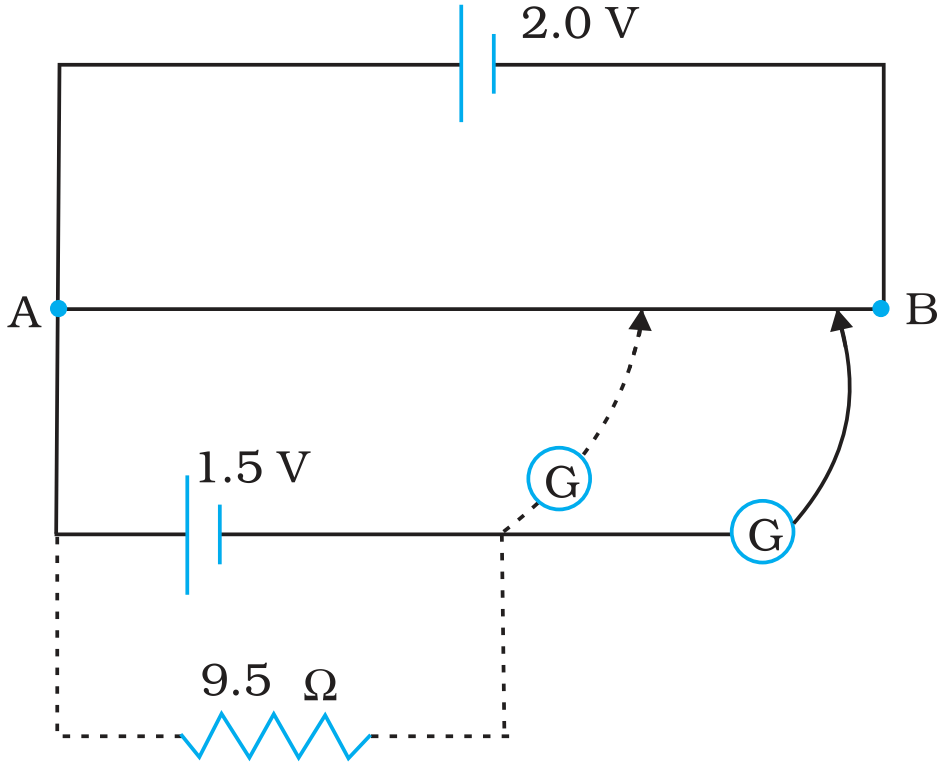
Figure shows a $2.0 V$ potentiometer used for the determination of internal resistance of a $1.5 V$ cell. The balance point of the cell in open circuit is $76.3 \ cm.$ When a resistor of $9.5\ \Omega$ is used in the external circuit of the cell, the balance point shifts to $64.8 \ cm$ length of the potentiometer wire. Determine the internal resistance of the cell.
Two wires A and B are made up of same material. Their areas of cross-section is same and ratio of their lengths is $2: 1$. If same potential difference is applied across the ends of lengths of each wire, then what will be the ratio of current flowing in the two wires?
Work function of aluminium is 4.2eV. If two photons, each of energy 2.5eV, are incident on its surface, will the emission of electrons take place? Justify your answer.
Three charges $-q, Q$ and $-q$ are situated at equal distances in a straight line. If the total potential energy of the system of all three charges is zero, then what will be the value of ratio $Q : q$ ?
Explain threshold frequency.
A beam of light consisting of two wavelengths $, 4000 \mathring A$ and $6000 \mathring A ,$ is used to obtain interference fringes in a Young’s double $-$ slit experiment. What is the least distance from the central maximum where the dark fringe is obtained?