Question
What is nuclear binding energy?

Answer

Nuclear binding energy : When nuclear particles interact under nuclear forces, then work is done by the system through strong nuclear interaction and the system attains a bound state. The energy that is released in this process to achieve this bound state is obtained through mass defect. This is nuclear binding energy. The total binding energy of any nucleus depends on the number of nucleons present and the value of per-nucleon binding energy $\left(\frac{\Delta E }{ A }\right)$ represents the stability of the nucleus.
Therefore, Per nucleon binding energy
$=\frac{\text { Binding energy }}{\text { Mass number }}$
$=\frac{\Delta E}{A}=\frac{(\Delta m) c^2}{A} \text { joule }$
If mass is expressed as a.m.u. then binding energy
$=(\Delta m) \times 931 MeV$
Per nucleon binding energy
$=(\Delta m) \times 931 MeV$
Per nucleon binding energy
$=\frac{(\Delta m) \times 931}{A} MeV / \text { nucleon }$

Need a full question paper?

Generate a complete, print-ready paper with questions like this in minutes — across 16+ boards, with answer keys.
Start Generating Free

Similar questions

Draw a circuit diagram of a C.E. transistor amplifier. Briefly, explain its working and write the expression for (i) current gain, (ii) voltage gain of the amplifier.
An illuminated object and a screen are placed 90 cm apart. Determine the focal length and nature of the lens required to produce a clear image on the screen, twice the size of the object.
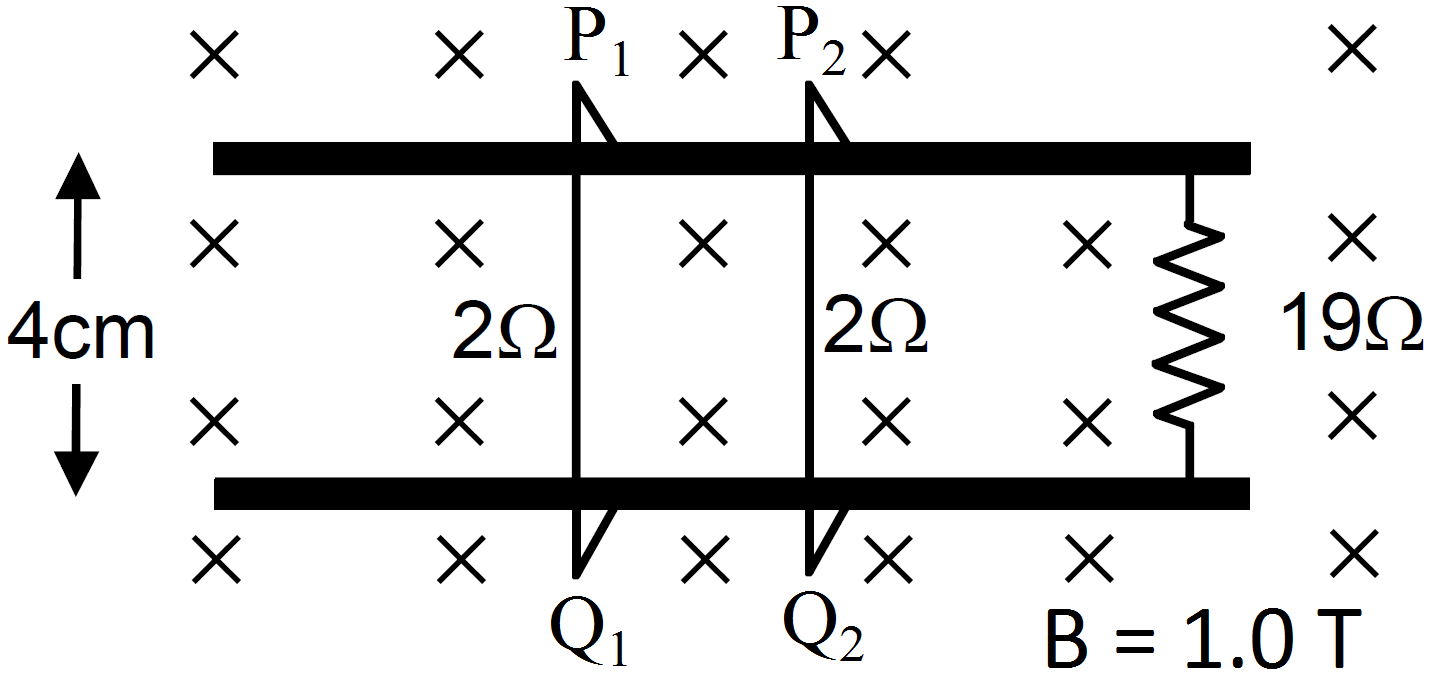
Consider the situation shown in figure. The wires $P_1Q_1$ and $P_2Q_2$ are made to slide on the rails with the same speed 5cm/s. Find the electric current in the $19\Omega$ resistor if:
  1. Both the wires move towards right.
  2. If $P_1Q_1$ moves towards left but $P_2Q_2$ moves towards right.
Suppose an attractive nuclear force acts between two protons which may be written as $\text{F}=\text{Ce}^{-\text{kr}}/\text{r}^2.$
  1. Write down the dimensional formulae and appropriate SI units of C and k.
  2. Suppose that $k = 1$ fermi$^{-1}$ and that the repulsive electric force between the protons is just balanced by the attractive nuclear force when the separation is 5 fermi. Find the value of C.
Find the ratio of the linear momenta of two particles of masses 1.0kg and 4.0kg if their kinetic energies are equal.
Even though an electric field E exerts a force qE on a charged particle yet the electric field of an EM wave does not contribute to the radiation pressure (but transfers energy). Explain.
Consider a head-on collision between two particles of masses $m_1$ and $m_2$. The initial speeds of the particles are $u_1$ and $u_2$ in the same direction. The collision starts 2 at t = 0 and the particles interact for a time interval $\triangle\text{t}.$ During the collision, the speed of the first particle varies as.$\text{v}(\text{t})=\text{u}_1+\frac{\text{t}}{\triangle\text{t}}(\text{v}_1-\text{u}_1).$
Find the speed of the second particle as a function of time during the collision.
  1. Draw a ray diagram depicting the formation of the image by an astronomical telescope in normal adjustment.
  2. You are given the following three lenses. Which two lenses will you use as an eyepiece and as an objective to construct an astronomical telescope? Give reason.
Lenses Power (D) Aperture (cm)
$L_1$ 3 8
$L_2$ 6 1
$L_3​​​​​​​$ 10 1
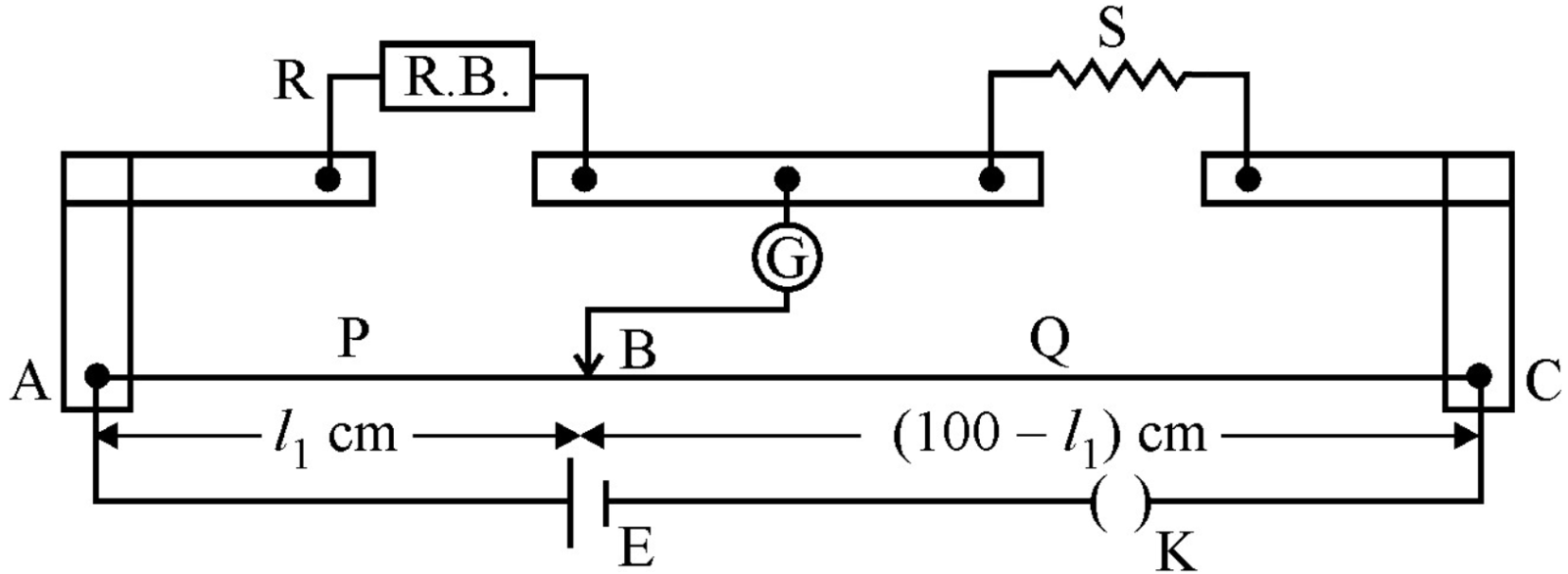
What is end error in a metre bridge? How is it overcome? The resistances in the two arms of the metre bridge are $\text{R}=5\Omega$ and S respectively. When the resistance S is shunted with an equal resistance, the new balance length found to be 1.5 $l_1$, where $l_1$ is the initial balancing length. Calculate the value of S.
The magnetic field B inside a long solenoid, carrying a current of 5.00A, is $3.14 \times 10^{-2}T.$ Find the number of turns per unit length of the solenoid.