Draw a circuit diagram of a C.E. transistor amplifier. Briefly, explain its working and write the expression for (i) current gain, (ii) voltage gain of the amplifier.
CBSE OUTSIDE DELHI - SET 3 DEHRADUN 2015
Download our app for free and get started
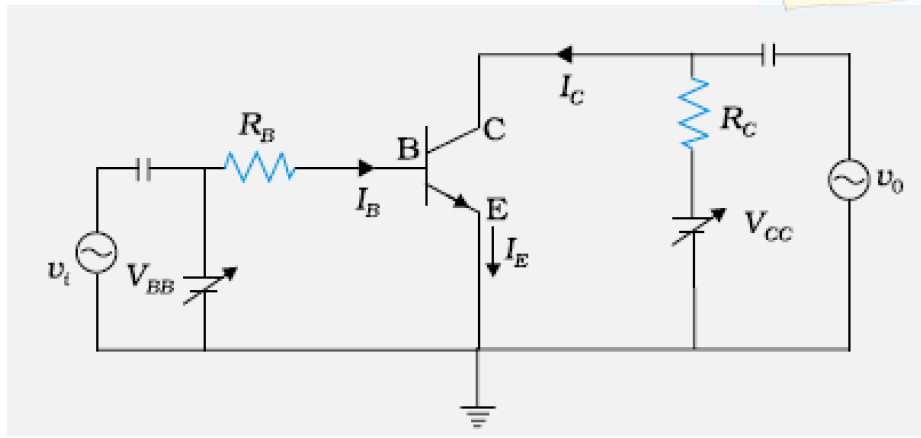
The input signal, connected between the emitter and base, along with the forward bias, causes corresponding large changes in output voltage across R.
Current gain $\beta_{ac} = \bigg|\frac{\Delta\text{I}_{c}}{\Delta\text{I}_{B}}\bigg|$
Voltage gain $\text{V}_{Gain} = \frac{\Delta\text{V}_{o}}{\Delta\text{V}_{I}}.$

Download our appand get started for free
Experience the future of education. Simply download our apps or reach out to us for more information. Let's shape the future of learning together!No signup needed.*
Similar Questions
- 1What is the power dissipated in an ac circuit in which voltage and current are given by $\text{V}=230\sin(\omega\text{t}+\frac{\pi}{2})$ and $\text{I}=10\sin\omega\text{t}?$View Solution
- 2The figure shows a series LCR circuit with L = 5.0 H, C = 80 $\mu$F, R = 40 W connected to a variable frequency 240V source. CalculateView Solution
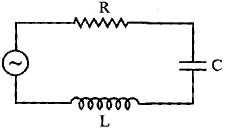
- The angular frequency of the source which drives the circuit at resonance.
- The current at the resonating frequency.
- The rms potential drop across the capacitor at resonance.
- 3View SolutionSuppose the frequency of the source in the previous example can be varied. (a) What is the frequency of the source at which resonance occurs? (b) Calculate the impedance, the current, and the power dissipated at the resonant condition.
- 4View SolutionState the principle of a cyclotron. Show that the time period of revolution of particles in a cyclotron is independent of their speeds. Why is this property necessary for the operation of a cyclotron?
- 5View Solution
Given below are two electric circuits A and B.
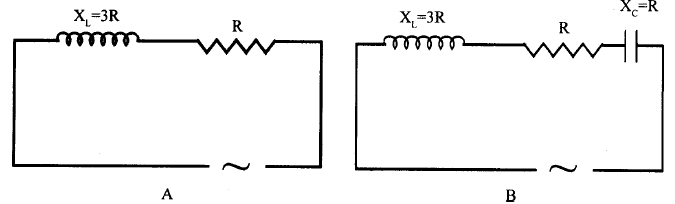
Calculate the ratio of power factor of the circuit B to the power factor of circuit A. - 6Use Bohr's postulates hydrogen atom to deduce the expression for the kinetic energy (K.E.) of the electron revolving in the $\mathrm{n}^{\text {th }}$ orbit and show that, K.E. $\frac{\mathrm{e}^2}{8 \pi \varepsilon_0 e_n}$, where $r_n$ is the radius of the $n^{\text {th }}$ orbit. How is the orbit. How is the potential energy in the orbit related to the orbital radius orbit related to the orbital radius $r_n$ ?View Solution
- 7View SolutionState Ampere's circuital law. Use this law to find magnetic field due to straight infinite current carrying wire. How are the magnetic field lines different from the electrostatic field lines?
- 8View Solution
- A screen is placed at a distance of 100 cm from an object. The image of the object is formed on the screen by a convex lens for two different locations of the lens separated by 20 cm. Calculate the focal length of the lens used.
- A converging lens is kept coaxially in contact with a diverging lens - both the lenses being of equal focal length. What is the focal length of the combination?
- 9A series LCR circuit is connected across an a.c. source of variable angular frequency $' \omega'$. Plot a graph showing variation of current ‘i’ as a function of $' \omega'$ for two resistances $R_1$ and $R2 (R_1 > R_2).$View Solution
Answer the following questions using this graph:- In which case is the resonance sharper and why?
- In which case is the power dissipation more and why?
- 10View SolutionAn inductor 200 mH, capacitor 500 µF, resistor 10Ω are connected in series with a100 V, variable frequency a.c. source. Calculate the
- Frequency at which the power factor of the circuit is unity.
- Current amplitude at this frequency.
- Q-factor.