Question
What is nuclear fission? Give one example and write its nuclear reaction.

Answer

Nuclear fission is the process in which a heavy nucleus is splits into two light nuclei nearly of the same size by bombarding it with slow neutrons.

When uranium with Z = 92 is bombarded with neutron, it splits into two fragments namely barium (Z = 56) and krypton (Z = 36) and a large amount of energy is released which appears due to decrease in the mass

$\ce {^235_92 U + ^1_0n -> (^236_92U) -> ^144_56Ba + ^89_36Kr + 3^1_0n + Energy}$

Need a full question paper?

Generate a complete, print-ready paper with questions like this in minutes — across 16+ boards, with answer keys.
Start Generating Free

Similar questions

What is an ‘electric fuse’? State its two characteristics of electric fuse.
Give an experiment to verify the principle of moments.
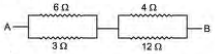
(i) (a) Find the equivalent resistance between A and B .
(b) State whether the resistivity of a wire changes with the change in the thickness of the wire.
(ii) (a) Write down differences between resistance and specific resistance.
(b) What does the slope of a V-I graph for a conductor represent.
(c) A corrent of 0.2 A flows through a conductor of resistance $4.5 \Omega$ Calculate the p.d. at the ends of the conductor.
Image
(iii) (a) Derive an expression for the current (I), when $n$ cells each of emf (E) and the internal resistance ( $r$ ) are connected in series to an external resistance $R$.
(b) State two conditions necessary to have maximum current in the external circuit when the cells are connected in series.
$200 g$ of ice at $0^{\circ} C$ converts into water at $0^{\circ} C$ in 1 minute when heat is supplied to it at a constant rate. In how much time, $200 g$ of water at $0^{\circ} C$ will change to $20^{\circ} C$ ? Take specific latent heat of ice $=336 Jg ^{-1}$.
A mass m1 of a substance of specific heat capacity c1 at temperature t1 is mixed with a mass m2
of other substance of specific heat capacity c2 at a lower temperature t2. Deduce the expression
for the temperature of the mixture. State the assumption made, if any.
(i) 50 g of ice at $0^{\circ} C$ is added to 300 g of a liquid at $30^{\circ} C$. What will be the final temperature of the mixture when all the ice has melted? The specific heat capacity of the liquid is $2.65 Jg ^{-19} C ^{-1}$ while that of water is $4.2 Jg ^{-1}{ }^{\circ} C ^{-1}$. Specific latent heat of fision of ice $=336 Jg ^{-1}$.
(ii) A metal drill of power 500 W , drills a bole in a metal cube of mass 0.25 kg in 6.5 s . If the specific heat capacity of metal cube is $130 Jkg ^{-1}{ }^{\circ} C ^{-1}$, calculate
(a) Energy generated by the drill in ls.
(b) Energy generated by the drill in 6.5 s.
(c) If $t^{\circ} C$ is the rise in temperature, state the amount of heat energy absorbed by metal cube in terms of $t$.
(d) Write down an equation and calculate the value of t .
(iii) Explain the following
(a) Water is used in hot water bottles for fomentation purposes.
(b) A wise farmer always waters his fields in the evening, if there is a forecast for frost.
(c) The specific heat of fusion of lead is $27 Jg ^{-1}$. What do you understand from the statement?
Copy the given diagram of a transformer and complete it. Name the parts A and B. Name the part you have drawn to complete the diagram. What is the material of this part? Is this transformer a step-up or step-down? Give reason.
Why does the sun appear red at sunrises and sunset?
Suppose there are three resistors $A, B$, and $C$ having resistances $r_1, r_2$, and $r_3$ respectively. If $R$ represents their equivalent resistance, establish the following relation $\frac{1}{ R }=\frac{1}{ r _1}+\frac{1}{ r _2}+\frac{1}{ r _3}$,when joined in parallel.
 

A piece of ice of mass $40 g$ is added to $200 g$ of water at $50^{\circ} C$ Calculate the final temperature of water when all the ice has melted. Specific heat capacity of water = $4200 Jkg ^{-1} K ^{-1}$, and specific latent heat of fusion of ice $=$ $336 \times 10^3 Jkg ^{-1}$.