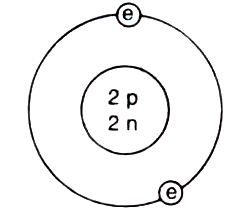
$\rightarrow 0.2 a.m.u. = 0.2 \times 1.66 \times 10^{-27} kg$
$\triangle m = 0.332 \triangle 10^{-27} kg$
$E = 0.332 \times 10^{-27} kg \times (3 \times 10^8)^2$
$E = 2.988 \times 10^{-11} J$
$E = `(2.998 xx 10^-11 "J")/(1.3 xx 10^-13)`$
17 questions · timed · auto-graded
It is controlled by absorbing some of the neutrons emitted in the fission process by means of moderators like graphite, heavy water, etc. then the energy obtained in fission can be utilized for the constructive purposes
(b) State the approximate value of energy released in the reaction mentioned in part (a).
(c) Give reason for the release of energy stated in part (b).
$\ce{\underset{\text{(helium isotope)}}{^3_2He} + \underset{\text{(deuterium)}}{^2_1H} -> \underset{\text{(helium) }}{^4_2He}} + \underset{\text{(proton)}}{^1_1H} + 18.3 \text{MeV}$
In all three deuterium nuclei fuse to form a helium nucleus with a release of 21·6 MeV energy.
When two deuterium nuclei $\ce {^2_1H}$ fuse , nucleus of helium isotope $\ce {^3_2He}$ is formed and 3·3 MeV energy is released. This helium isotope again gets fused with one deuterium nucleus to form a helium nucleus $\ce {^4_2He}$ and 18·3 MeV of energy is released in this process.
Nuclear fission is the process in which a heavy nucleus is splits into two light nuclei nearly of the same size by bombarding it with slow neutrons.
When uranium with Z = 92 is bombarded with neutron, it splits into two fragments namely barium (Z = 56) and krypton (Z = 36) and a large amount of energy is released which appears due to decrease in the mass
$\ce {^235_92 U + ^1_0n -> (^236_92U) -> ^144_56Ba + ^89_36Kr + 3^1_0n + Energy}$
| Radioactive decay | Nuclear Fission |
| It is a self process. | It does not occur by itself. Neutrons are bombarded on a heavy nucleus. |
| The nucleus emits either the a or b particles with the emission of energy in form of g rays which is not very large. | A tremendous amount of energy is released when a heavy nucleus is bombarded with neutrons and the nucleus splits in two nearly equal fragments. |
| The rate of radioactive decay cannot be controlled. | The rate of nuclear fission can be controlled. |
Atomic number = Z - 4
Mass number = A - 8
After emitting a beta particle
Atomic number = Z - 4 + 1
mass number = A - 8
Final atomic number = 85
85 = Z - 4 + 1
Z = 88
Final mss number 222
222 = A - 8
A = 230
The following changes occur when an atom emits
An alpha particle: atomic number decreases by 2 and mass number decreases by 4.
Example: $\ce{^238_92 U -> ^234_90 Th + ^4_2 He}$
A beta particle: atomic number increases by one, but mass number does not change.
Example: $\ce{^14_6 C -> ^14_7 N + ^0_-1 β}$
Gamma particle: it does not change anything in the nucleus, the energy of the nucleus decreases.
number does not change.
Example: $\ce{^A_Z X^* -> ^A_Z X + γ}$
After emitting an alpha particle the daughter element occupies two places to the left of the parent element in the periodic table.
Reason: If a parent nucleus X becomes a new daughter nucleus Y as a result of -decay, then the -decay can be represented as:
$\ce{\underset{\text{parent nucleus}}{^A_Z X} ->[Alpha decay] \underset{\text{Daughter nucleus}}{^{A-4}_{z-2}Y} + \underset{\text{α-particle}}{^4_2 He}}$
Thus, the resulting nucleus has an atomic number equal to (Z-2). Hence, it shifts two places to the left of the parent element in the periodic table.
(b) After emitting a β
-particle, the daughter element occupies one place to the right of the parent element in the periodic table.
Reason: If a parent nucleus X becomes a new daughter nucleus Y as a result of -decay, then the -decay can be represented as:
$\ce{\underset{\text{parent nucleus}}{^A_Z X} ->[β particle] \underset{\text{Daughter nucleus}}{^{A}_{z+1}Y} + \underset{\text{β-particle}}{^0_-1e}}$
Thus, the resulting nucleus has an atomic number equal to (Z+1). Hence, it shifts one place to the right of the parent element in the periodic table.
(c) After emitting -radiation, the element occupies the same position in the periodic table.
Reason: If a parent nucleus X becomes a new daughter nucleus Y as a result of -decay, then the -decay can be represented as:
$\ce{\underset{\text{parent nucleus}}{^A_Z X} ->[γ particle] \underset{\text{Daughter nucleus}}{^{A}_{z}Y} + \underset{\text{γ-particle}}{γ}}$
Thus, the resulting nucleus has atomic number equal to Z. Hence, it occupies the same position as the parent element in the periodic table.
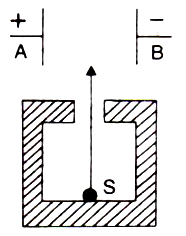
If a radioactive nucleus P with mass number A and atomic number Z emits a beta particle to form a daughter nucleus Q with mass number A and atomic number Z+1, then the change can be represented as follows:
$\ce{^A_Z P ->[β particle]} $ $\ce {^A_{z+1} Q} + {^0_{-1} e} $
(a) Atomic number 'Z' is not conserved. It is increased by 1.
(b) Mass number A is conserved.
| Property | α - particle | β - particle | γ - particle |
| Nature | Stream of positively charged particles, i.e. helium nuclei | Stream of negatively charged particles, i.e. energetic electrons. | Highly energetic electromagnetic radiation. |
| Charge | Positive charge (Two times that of a proton) $= + 3.2 x 10^{-19} C (or +2e)$ | Negative charge $= - 1.6 x 10^{-19} C (or -e)$ | No charge |
| Mass | Four times the mass of proton i.e., $6.68 x 10^{-27} kg$ | Equal to the mass of electron, i.e. $9.1 x 10^{-31} kg$ | No mass (Rest mass is zero) |
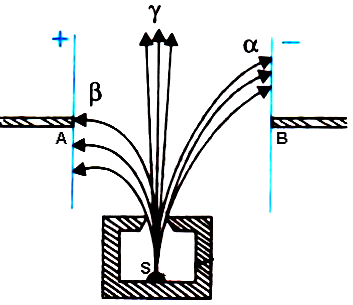
| Effect of electric field | Less deflected | More deflected than alpha particles but in direction opposite to those of α particles | Unaffected |


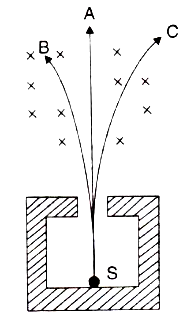
Radiations labeled A, B and C are γ , α and β respectively.
Radiation labeled A is gamma radiation because they have no charge and hence under action of magnetic field they go undeflected.
Radiation B is alpha radiation because its mass is large and it would be deflected less in comparison to beta radiation. The direction of deflection is given by Fleming's left hand rule. Also directions of deflection of alpha and beta radiations are opposite as they have opposite charge.