Question
What is parallel combination of cells?

Answer

Such a combination of cells in which like terminals of all cells are joined together is known as parallel combination of cells.

Need a full question paper?

Generate a complete, print-ready paper with questions like this in minutes — across 16+ boards, with answer keys.
Start Generating Free

Similar questions

Two Polaroids are placed with their optic axis perpendicular to each other. One of them is rotated through 45°, what is the intensity of light emerging from the second Polaroid if I0 is the intensity of unpolarised light?
Answer the following questions:
The earth’s magnetic field varies from point to point in space. Does it also change with time? If so, on what time scale does it change appreciably?
A resistance R is connected across a cell of emf ε and internal resistance r. A potentiometer now measures the potential difference between the terminals of the cell as V. Write the expression for 'r' in terms of ε, V and R.
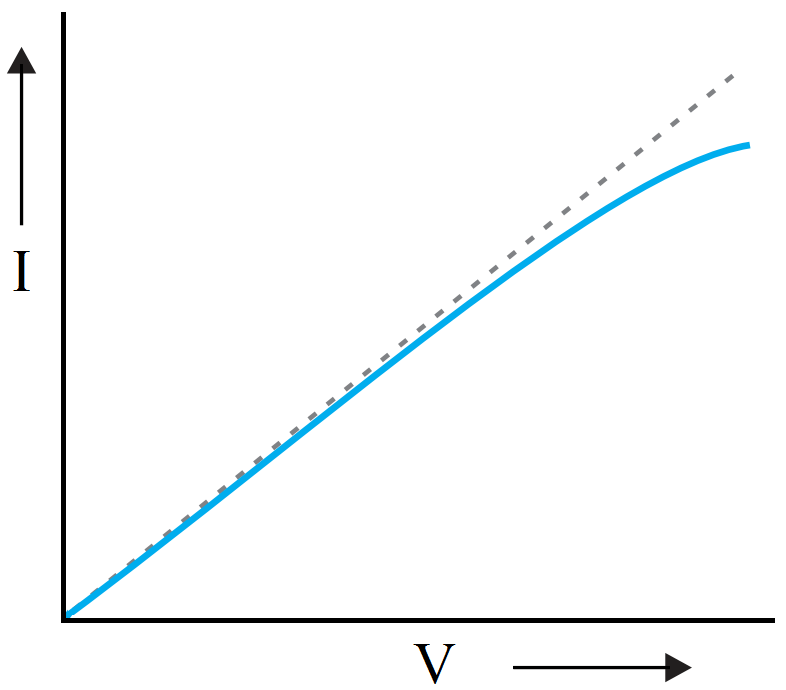
The I-V characteristics of a resistor are observed to deviate from a straight line for higher values of current as shown in the adjoining figure why?

If peak value of alternating current is Io, then what is the magnitude of (a) rms value of current and (b) average value of current?
What is the direction of a current carrying solenoid when suspended freely in earth's horizontal plane?
One alpha rays beam is incident along positive direction of + X-axis. It experiences a force along + Y-axis due to magnetic field. What is the direction of magnetic field?
What is the nature of effective forces in the nucleus?
Cathode rays constitute a stream of:
  1. Electrons
  2. Protons
  3. Positive ions
  4. Negative ions.
Magnetic scalar potential is defined as

$\text{U}(\overrightarrow{\text{r}_2})-\text{U}(\overrightarrow{\text{r}_1})=-\int\limits^{\vec{\text{r}}_2}_{\vec{\text{r}_1}} \vec{\text{B}}.\text{d}\vec{\text{l}}.$

Apply this equation to a closed curve enclosing a long atraicht wire. The RHS of the above equation is then $-{\mu}_\text{o} \text{ i}$ by Ampere's law. We see that $\text{U}(\vec{\text{r}_2})\neq\text{U}(\vec{\text{r}_1})$ even when $\vec{\text{r}_2}=\vec{\text{r}_1}.$Can we have a magnetic acalar potential in this case?