Question
What is polymerisation? Define the terms 'addition polymerisation' and Give one example.

Answer

Get the step-by-step solution for this question inside the Vidyadip app.

Get the answer in the app

Need a full question paper?

Generate a complete, print-ready paper with questions like this in minutes — across 16+ boards, with answer keys.

Start Generating Free

Similar questions

  1. Explain the following:
  1. Henry's law about dissolution of a gas in a liquid.
  2. Boiling point elevation constant for a solvent.
  1. A solution of glycerol $(C_3H_8O_3)$ in water was prepared by dissolving some glycerol in $500 g$ of water. This solution has a boiling point of $100.42^\circ C.$ What mass of glycerol was dissolved to make this solution? $(K_b$ for water $= 0.512 K \ kg\ mol^{–1}).$
Define Osmotic Pressure. Prove that Osmotic pressure is a colligative property.
Match the items of Column $I$ and Column $II.$
 
Column $I$
 
Column $II$
$i.$
Lead storage battery
$a.$
Maximum efficiency.
$ii.$
Mercury cell
$b.$
Prevented by galvanisation.
$iii.$
Fuel cell
$c.$
Gives steady potential.
$iv.$
Rusting
$d.$
$Pb$ is anode, $PbO_2$​​​​​​​ is cathode.
A solution containing 30 g of non-volatile solute exactly in 90 g of water has a vapour pressure of 2.8 kPa at 298 K. Further, 18 g of water is then added to the solution and the new vapour pressure becomes 2.9 kPa at 298 K. Calculate :
(i) molar mass of the solute
(ii) vapour pressure of water at 298 K
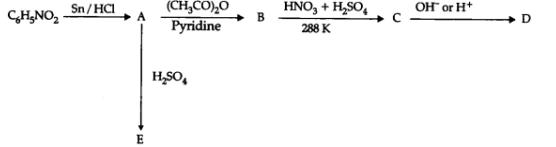
Write the structure of A, B, C, D and E in the following reactions:
Image
  1. Account for the following:
  1. Write the preparation of potassium permanganate from pyrolusite ore $\ce{(MnO_2)}.$
  2. $\ce{Mn_2O_7}$ is acidic whereas $\ce{MnO }$ is basic.
  3. Though copper has completely filled $d-$orbital $(d^{10})$ yet it is considered as a transition metal.
  4. Actinoids show wide range of oxidation states.
(a) What is van't Hoff factor? Explain.
(b) Write the equation of molecular number properties including van't Hoff factor.
Match the properties given in Column $I$ with the metals given in Column $II.$
 
Column $I ($Property$)$
 
Column $II ($Metal$)$
$(i)$
Element with highest second ionisation enthalpy
$(a)$ $Co$
$(ii)$
Element with highest third ionisation enthalpy
$(b)$ $Cr$
$(iii)$
$M$ in $M (CO)6$ is
$(c)$ $Cu$
$(iv)$
Element with highest heat of atomisation
$(d)$ $Zn$
    $(e)$ $Ni$
What is soap? How does it act in the cleansing of clothes?
Rate constant for a first order reaction has been found to be $2.54 \times 10^{-3}s^{-1}.$ Calculate its three$-$fourth life.