Question
Write the structure of A, B, C, D and E in the following reactions:
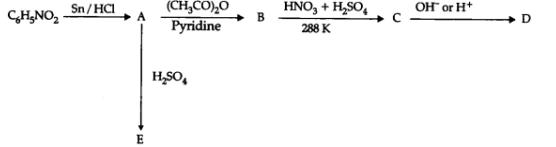
Image

Answer

Get the step-by-step solution for this question inside the Vidyadip app.

Get the answer in the app

Need a full question paper?

Generate a complete, print-ready paper with questions like this in minutes — across 16+ boards, with answer keys.

Start Generating Free

Similar questions

$(a).$ While giving intravenous injections to the patients, the doctors take utmost care of the concentration of the solution used. Why is it necessary to check the concentration of the solution?
$(b). $ A solution of phenol was obtained by dissolving $2X 10^{-2} \ kg$ of phenol in $1 \ kg$ of benzene. Experimentally it was found to be $73\%$ associated. Calculate the depression in the freezing point recorded.
The decomposition of $N_2O_5(g)$ is a first order reaction with a rate constant of $5 \times 10^{-4} s^{-1} \ at \ 45^\circ C$, i.e., $2N_2O_5(g) \rightarrow 4NO_2(g) + O_2(g)$. If initial concentration of $N_2O_5$ is $0.25M$, calculate its concentration after $2\ min$. Also, calculate half- life for decomposition of $N_2O_5(g).$
Explain the terms ideal and non-ideal solutions in the light of forces of interactions operating between molecules in liquid solutions.
A voltaic cell is set up at $25^\circ C$ with the following half$-$cells $Al^{3+} (0.001M)$ and $Ni^{2+} (0.50M).$ Write an equation for the reaction that occurs when the cell generates an electric current and determine the cell potential.
$(\text{Given:}\text{ E}^{\circ}_{\text{Ni}^{2+}/\text{Ni}}=-0.25\text{V,E}^{\circ}_{\text{Al}^{3+}/\text{Al}}=-1.66\text{V})$
 Match the complex species given in Column $I$ with the possible isomerism given in Column $II$ and assign the correct code:
 
Column $I ($Complex species$)$
 
Column $II ($Isomerism$)$
$a.$ $[Co(NH_3)_4C_{l2}]^+$ $1.$
Optical
$b.$ $cis-[Co(en)_2Cl_2]^+$ $2.$
Ionisation
$c.$ $[Co(NH_3)_5 (NO_2)]Cl_2$ $3.$
Coordination
$d.$ $[Co(NH_3)_6][Cr(CN)_6]$ $4.$
Geometrical
    $5.$
Linkage
Code:
Predict the products of electrolysis in each of the following : 
(i) An aqueous solution of AgNO3 with silver electrodes.
(ii) An aqueous solution of AgNO3 with platinum electrodes.
(iii) An aqueous solution of H2SO4 with platinum electrodes.
(iv) An aqueous solution of CuCl2 with platinum electrodes.
A mixed oxide of iron and chromium, $\ce{FeOCr_2O_3}$ is fused with sodium carbonate in the presence of air to form a yellow coloured compound $(A).$ On acidification the compound $(A)$ forms an orange coloured compound $(B),$ which is a strong oxidising agent.
  1. Identify the compounds $(A)$ and $(B).$
  2. Write balanced chemical equation for each step.
Attempt any five of the following:
(a) Aldopentoses named ribose and 2-deoxyribose are found in nucleic acids. What is their relative configuration?
(b) What are the three components of nucleic acids?
(c) Name the sugar present in milk. How many monosaccharide units are present in it? What are such oligosaccharides called?
(d) Is nucleotide and nucleoside the same? What are their roles?
(e) Why cannot vitamin C be stored in our body?
(f) During curdling of milk, what happens to sugar present in it?
(g) Account for the following:
a. There are 5-OH groups in glucose.
b. Glucose is a reducing sugar
$\ce{COSO_4Cl._5NH_3}$ exists in two isomeric forms $'A\ '$ and $'B\ '.$ Isomer $'A\ '$ reacts with $AgNO_3$ to give white precipitate but does not react with $BaCl_2.$ Isomer $'B\ '$ gives a white precipitate with $BaCl_2$ but does not react with $AgNO_3.$ Answer the following questions.
i. Identify $'A\ '$ and $'B\ '$ and write their structural formulas.
ii. Name the type of isomerism involved.
iii. Give the $\text{IUPAC}$ name of $'A\ '$ and $'B\ '.$
Answer the following questions.
Comment on the specificity of enzyme action. What is the most important reason for their specificity?