Question
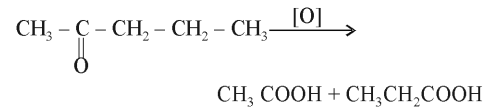
What is Popaff's rule? Explain with example.

Answer

When two different carboxylic acids are obtained by the oxidation of any unsymmetrical ketone then > C = O group goes towards small alkyl group. This is called Popaff's rule.
Image

Need a full question paper?

Generate a complete, print-ready paper with questions like this in minutes — across 16+ boards, with answer keys.
Start Generating Free

Similar questions

Following data are obtained for the reaction:
N2O5 $\rightarrow$ 2NO2 + ½O2
t/s 0 300 600
[N2O5]/mol L–1 1.6 × 10⁻² 0.8 × 10⁻² 0.4 × 10⁻²
  1. Show that it follows first order reaction.
  2. Calculate the half-life.
(Given log 2 = 0.3010 log 4 = 0.6021)
Explain Lanthanoid contraction.
The molar mass of a volatile substance cannot be determined from boiling point elevation. Why?
Two isomeric compounds (A and B) have $C _4 H _{11} N$ molecular formula react with $HNO _2$ and forms compounds (C) and (D). C is hardly oxidised but it reacts immediately with Lucas reagent whereas $D$ reacts with Lucas reagent in 5 minutes and it also gives haloform reaction. Identify $A, B, C$ and $D$.
Give the resonance structure of arenediazonium ion.
For a reaction
$2\text{H}_2\text{O}_2\xrightarrow[\text{alkaline medium}]{\text{I}^-}2\text{H}_2\text{O}+\text{O}_2$
the proposed mechanism is as given below:
  1. $\text{H}_2\text{O}_2+\text{I}^{-}\xrightarrow{\ \ \ \ \ \ \ }\text{H}_2\text{O}+\text{IO}^{-}(\text{slow})$
  2. $\text{H}_2\text{O}_2+\text{IO}^{-}\xrightarrow{\ \ \ \ \ \ \ }\text{H}_2\text{O}+\text{I}^{-}+\text{O}_2(\text{fast})$
  1. Write rate law for the reaction.
  2. Write the overall order of reaction.
  3. Out of steps (1) and (2), which one is rate determining step?
Give the chemical tests to distinguish between the following pairs of compounds: 
  1. Ethylamine and Aniline.
  2. Aniline and Benzylamine.
Explain the displacement of diazonium group of benzene diazonium salt by hydrogen with equation.### Explain the reduction process of benzene diazonium salt by giving an equation.
Write limitations of Werner's Coordination Theory