Question
What is potential gradient? How is it measured? Explain.

Answer

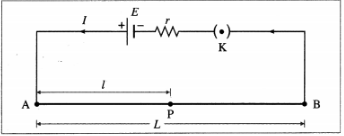
Consider a potentiometer consisting of a long uniform wire AB of length L and resistance R, stretched on a wooden board and connected in series with a cell of stable emf E and internal resistance r and a plug key K as shown in below figure

Image
Let I be the current flowing through the wire when the circuit is closed.
Current through $AB , I =\frac{E}{R+r}$
Potential difference across $A B . V_{A B}=I R$
$\therefore V _{ AB }=\frac{E R}{(R+r)}$
The potential difference (the fall of potential from the high potential end) per unit length of the wire,
$\frac{V_{ AB }}{L}=\frac{E R}{(R+r) L}$
As long as $E$ and $r$ remain constant, $\frac{V_{ AB }}{L}$ will remain constant, $\frac{V_{ AB }}{L}$ is known as potential gradient along
AB and is denoted by K. Thus the potential gradient is calculated by measuring the potential difference between ends of the potentiometer wire and dividing it by the length of the wire.
Let P be any point on the wire between A and B and AP = l = length of the wire between A and P.
Then $V_{AP} = Kl$
$\therefore V_{AP} ∝ l$ as K is constant in a particular case. Thus, the potential difference across any length of the potentiometer wire is directly proportional to that length. This is the principle of the potentiometer.

Need a full question paper?

Generate a complete, print-ready paper with questions like this in minutes — across 16+ boards, with answer keys.
Start Generating Free

Similar questions

Explain the working of P-N junction diode in forward and reverse biased mode.
In a biprism experiment, light of wavelength $5200 A$ is used to get an interference pattern on the screen. The fringe width changes by $1.3\ mm$ when the screen is moved towards the biprism by $50 \ cm$. Find the distance between the two virtual images of the slit.
A horizontal disc is freely rotating about a transverse axis passing through its centre at the rate of 100 revolutions per minute. A 20 gram blob of wax falls on the disc and sticks to the disc at a distance of \(5 cm\) from its axis. Moment of inertia of the disc about its axis passing through its centre of mass is \(2 \times 10^{-4} kg m ^2\). Calculate the new frequency of rotation of the disc.
Write the relation between relative permeability and magnetic susceptibility.
Calculate the mean free path of a gas molecule with diameter $4 \mathring A$ if the pressure of the gas is $1.013 \times 10^5 \mathrm{~N} / \mathrm{m}^2$ and the temperature is $27^{\circ} \mathrm{C}$. (The Boltzmann constant, $\mathrm{k}_{\mathrm{B}}=1.38 \times 10^{-23}$ $\mathrm{J} / \mathrm{K})$
In the above problem, what will be the magnetic field B inside the wire at a distance r from its axis, if the current density J is uniform across the cross section of the wire?
Determine the change in wavelength of electro$-$magnetic radiation as it passes from air to glass, if the refractive index of glass with respect to air for the radiation under consideration is $1.5$ and the frequency of the radiation is $3.5 \times 10^{14} Hz. [$Speed of the radiation in air $( c )=3 \left.\times 10^8\ m / s \right]$
A $10 H$ inductor carries a current of $25 A$. Flow much ice at $0{ }^{\circ} C$ could be melted by the energy stored in the magnetic field of the inductor? [Latent heat of fusion of ice, $L_f=335$ $J / g ]$
Find the principal specific heats of helium and hence the universal gas constant. Given : $C_p=$ $20.81 \mathrm{~J} / \mathrm{mol} . \mathrm{K}, \mathrm{C}_{\mathrm{V}}=12.5 \mathrm{~J} / \mathrm{mol} . \mathrm{K} . \mathrm{M}_0(\mathrm{He})=4 \times 10^{-3} \mathrm{~kg} / \mathrm{mol}$.
A body performs SHM on a path $0.12\ m$ long. Its velocity at the centre of the path is $0.12\ m / s$. Find the period of SHM. Also find the magnitude of the velocity of the body at $\sqrt{3} \times 10^{-}$ ${ }^2 m$ from the centre of the path.