Questions

Answer the following in Brief

Take a timed test

35 questions · self-marked practice — reveal the answer and mark yourself.

Question 13 Marks
A galvanometer of resistance $100 C$ gives a full scale deflection for a current of $2 mA$. How will you use it to measure (i) current up to $2 A$ (ii) voltage up to $10 V$ ?
Answer
Data : $G =100 \Omega, I _{ g }=2 mA =2 \times 10^{-3} A , I =2 A , V =10 V$
(i)
$ S=\frac{G I_g}{I-I_g}$
$=\frac{100 \times 2 \times 10^{-3}}{2-2 \times 10^{-3}}=\frac{2 \times 10^{-1}}{1.998}=\frac{10^{-1}}{0.999}$
$\therefore S=0.1001 \Omega \quad \text { (using the reciprocal table) } $
A resistance of $0.1001 \Omega$ should be connected in parallel to the coil of the galvanometer to measure current up to $2 A$.
$ \text { (ii) } R _{ S }=\frac{V}{I_{ g }}- G$
$=\frac{10}{2 \times 10^{-3}}-100=5000-100=4900 \Omega $
A resistance of $4900 \Omega$ should be connected in series with the coil of the galvanometer to measure voltage up to $10 V$.
 
View full question & answer
Question 23 Marks
A galvanometer with a coil of resistance $40 \Omega$ gives a full scale deflection for a current of 5 $mA$. How will you convert it into an ammeter of range $0-5 A$ ?
Answer
Data: $G=40 \Omega, I_g=5 mA =5 \times 10^{-3} A , I =5 A$
To convert a galvanometer into an ammeter, a shunt (i.e, low resistance in parallel) should be connected with the galvanometer coil. The required shunt resistance,
$ S=\left(\frac{I_8}{I-I_8}\right) G=\left(\frac{5 \times 10^{-3}}{5-5 \times 10^{-3}}\right) \times 40$
$=\frac{200}{4995}=0.04 \Omega $
View full question & answer
Question 33 Marks
The combined resistance of a galvanometer of resistance $1000 \Omega$ and its shunt is $25 \Omega$.
Calculate the value of the shunt.
Answer
Data: $G=1000 \Omega, R_A=25 \Omega$
$
\begin{aligned}
\frac{1}{R_{ A }} & =\frac{1}{G}+\frac{1}{S} \quad \therefore \frac{1}{S}=\frac{1}{R_{ A }}-\frac{1}{G}=\frac{G-R_{ A }}{R_{ A } \cdot G} \\
\therefore S & =\frac{R_{ A } \cdot G}{G-R_{ A }}=\frac{25 \times 1000}{1000-25}=\frac{25 \times 1000}{975} \\
& =\frac{1000}{39}=25.64 \Omega
\end{aligned}
$
This is the value of the shunt.
View full question & answer
Question 43 Marks
A resistance of $3 \Omega$ is connected in parallel to a galvanometer of resistance $297 \Omega$. Find the fraction of the current passing through the galvanometer.
Answer
Data : $G =297 \Omega, S =3 \Omega$
$Ig _{ g }=\frac{S}{S+G} \cdot I$
$\therefore \frac{I_{ g }}{I}=\frac{S}{S+G}=\frac{3}{3+297}=\frac{3}{300}=0.01$
This is the fraction of the current through the galvanometer.
[Note: The fraction of the current through the shunt $\left.=\frac{I_{ S }}{I}=1-0.01=0.99\right]$
View full question & answer
Question 53 Marks
A galvanometer is shunted by $1 / r$ of its resistance. Find the fraction of the total current passing through the galvanometer.
Answer
Let $G$ be the resistance of the galvanometer, I the total current and $I _{ g }$ the current through the galvanometer when it is shunted. The resistance of the shunt is
$ \therefore S=\frac{G}{r} \text { (by data) } \quad \text { or } \quad \frac{G}{S}=r$
$\therefore \frac{I_g}{I}=\frac{S}{S+G}=\frac{1}{1+G / S}=\frac{1}{1+r} $
The fraction $\frac{1}{1+r}$ of the total current passes through the galvanometer.
[Note : The fraction of the current through the shunt $=$
$\left.\frac{I_{ S }}{I}=1-\frac{I_{ g }}{I}=\frac{r}{1+r}\right]$
View full question & answer
Question 63 Marks
A moving-coil galvanometer of resistance 200 ohms gives a full scale deflection of 100 divisions for a current of 50 milliamperes. How will you convert it into an ammeter to read 2 amperes for 20 divisions?
Answer
Data: $G =200 \Omega, I _{ g }=50 mA =50 \times 10^{-3} A$
The total number of scale divisions is 100 . The ammeter has to read 20 divisions for a current of $2 A$. Hence, for 100 divisions, the current must be I $=10 A$.
To convert the galvanometer into an ammeter, a shunt must be connected in parallel to the galvanometer coil. The required shunt resistance,
$
\begin{aligned}
S & =\left(\frac{I_g}{I-I_g}\right){ }_{\text {}}^G \\
& =\left(\frac{50 \times 10^{-3}}{10-50 \times 10^{-3}}\right) \times 200 \\
& =1.005 \Omega
\end{aligned}
$
View full question & answer
Question 73 Marks
Calculate the value of the shunt which when connected across a galvanometer of resistance $38 \Omega$ will allow $1 / 20$ th of the current to pass through the galvanometer.
Answer

Data : $G=38 \Omega, I_g / I=\frac{1}{20}$
Data : $G=38 \Omega, I_{ g } / I=\frac{1}{20}$
$
\begin{aligned}
& I_g=\left(\frac{S}{S+G}\right) \\
\therefore & \frac{I_g}{I}=\frac{S}{S+G} \quad \therefore \frac{1}{20}=\frac{S}{S+38} \\
\therefore S & +38=20 S \\
\therefore & 9 S=38 \\
\therefore S & =2 \Omega
\end{aligned}
$
This is the required value of the shunt.
View full question & answer
Question 83 Marks
State the functions of the series resistance in modifying a galvanometer into a voltmeter.
Answer

Functions of the series, resistance:
1. It increases the effective resistance of the voltmeter.
2. It drops off a larger fraction of the measured potential difference thus protecting the sensitive meter movement of the basic galvanometer.
3. With resistance of proper value, a galvanometer can be modified to a voltmeter of desired range. .
View full question & answer
Question 93 Marks
What are the modifications required to convert a moving-coil galvanometer into a voltmeter?
Answer

The modifications required to convert a moving-coil galvanometer into a voltmeter are as follows:
1. The effective resistance of the galvanometer should be very high. This is because a voltmeter requires a very small current to deflect its pointer. If a larger current than this flows through the voltmeter, the voltmeter is said to load the circuit and it will record a much smaller voltage drop.
2. The voltage measuring capacity (range) should be increased to a desired value.
3. It must be protected from damages which are likely to occur due to an excess applied potential difference.
View full question & answer
Question 103 Marks
How do you calculate the shunt required to increase the range p times?
Answer
The value of shunt resistance required to convert a galvanometer into an ammeter is given by,
$
S =\left(\frac{I_{ g }}{I-I_{ g }}\right) G
$
If the current I is $p$ times the current $I _{ g }$ then $I = pl _{ g }$. Using this in the above expression, we get,
$
S =\frac{G I_{ g }}{p I_{ g }-I_{ g }} \text { OR } S =\frac{G}{p-1}
$
This is the required shunt resistance to increase the range $p$ times.
View full question & answer
Question 113 Marks
State the function of the shunt in modifying a galvonometer to an ammeter.
Answer

Functions of the shunt:
1. It lowers the effective resistance of the ammeter
2. It is used to divert to a large part of total current by providing an alternate path and thus it protects the instrument from damage.
3. With a shunt of proper value, a galvanometer can be modified into an ammeter of practically any desired range.
View full question & answer
Question 123 Marks
What are the modifications necessary to convert a moving-coil galvanometer (MCG) into an ammeter?
Answer

To convert a moving-coil galvanometer (MCG) into an ammeter, the following modifications are necessary:
1. The effective current capacity of the MCG must be increased to a desired higher value.
2. A galvanometer when connected in series with a resistance, should not decrease the current through the resistance. Hence, the effective resistance of the galvanometer must be decreased by connecting an appropriate low resistance across it. An ideal ammeter should have zero resistance.
3. It must be protected from the damages which are likely to occur due to the passage of an excess electric current.
View full question & answer
Question 133 Marks
Two cells of emf's $E_1$ and $E_2\left(E_1>E_2\right)$ are connected in a potentiometer circuit so as to assist each other. The null point is obtained at $8.125 m$ from the high potential end of the potentiometer wire. When the cell with emf $E_2$ is connected so as to oppose the emf $E_1$ the null point is obtained at $1.25 m$ from the same end. Compare the emf's of the two cells.
Answer

Data : $l _1=8.125 m$ (cells assisting), $l _2=1.25 m$ (cells opposing)
$E _1+ E _2= Kl _1$ and $E _1- E _2= Kl _2$
where $K$ is the potential gradient.
$
\therefore \frac{E_1+E_2}{E_1-E_2}=\frac{l_1}{l_2}
$
Hence, the ratio of the emf's of the two cells,
$
\begin{aligned}
\frac{E_1}{E_2}=\frac{l_1+l_2}{l_1-l_2} & =\frac{8.125+1.25}{8.125-1.25} \\
& =\frac{9.375}{6.875}=\frac{15}{11}= 1 . 3 6 4
\end{aligned}
$
View full question & answer
Question 143 Marks
A potentiometer wire of length $5\ m$ is connected to a battery. For a certain cell having negligible internal resistance, the null point is obtained at $250\ cm$. If the length of the potentiometer wire is increased by $1\ m$, where will be the new position of the null point?
Answer
Data : $L _1=5 m , L _2=6 m , I _1=250 cm$
$E =\left(\frac{V}{L}\right) \mid$
where $V / L$ is the potential gradient and $I$ is the balancing length.
$ \therefore E _1=\left(\frac{V}{L_1}\right) I _1=\left(\frac{V}{L_2}\right)_2$
$I _2=\left(\frac{L_2}{L_1}\right) \times I _1=\frac{6}{5} \times 250=300 cm $
View full question & answer
Question 153 Marks
A potentiometer wire has length $2 m$ and resistance $10 \Omega$. It is connected in series with a resistance $990 \Omega$ and a cell of emf $2 V$. Calculate the potential gradient along the wire.
Answer

Data : $L 10 m , R =10 \Omega, R _{\text {ext }}=990 \Omega, E =2 V$
The current in the circuit is
$
I =\frac{E}{R+R_{\text {ext }}}=\frac{2}{10+990}=\frac{2}{1000}=2 \times 10^{-3} A
$
The potential difference across the wire is
$
V=I R=2 \times 10^{-3} \times 10=2 \times 10^{-2} V
$
$\therefore$ The potential gradient along the wire
$
=\frac{V}{L}=\frac{2 \times 10^{-2}}{2}=10^{-2} V / m
$
View full question & answer
Question 163 Marks
In a potentiometer circuit. $E=2 V , r =2 \Omega_{ r } R _{\text {wire }}=10 \Omega_{ s } R _{\text {ext }}=1988 \Omega$ and $L =4 m$ (in the usual notation). What is the potential gradient along the wire?
Answer

$
\begin{aligned}
K & =\frac{E R_{\text {wire }}}{\left(R_{\text {ext }}+R_{\text {wire }}+r\right) L}=\frac{2 \times 10}{(1988+10+2) \times 4} \\
& =\frac{5}{2000}=2.5 \times 10^{-3} V / m
\end{aligned}
$
The potential gradient along the wire is $2.5 \times 10^{-3} V / m$
View full question & answer
Question 173 Marks
State the precautions which must be taken in using a potentiometer.
Answer

Precautions to be taken in using a potentiometer:
1. The potential difference across the potentiometer wire must be greater than the emf or potential difference to be balanced. Hence, in comparing emfs, the driver emf $E>$ $E_1, E_2$ (direct method) or $E>E_1+E_2$ (combination method).
2. The positive terminal of the cell with emf $E 1$ and that with emf $E_2$ or their combination, must be connected to the higher potential terminal of the potentiometer.
3. The potentiometer wire must be of uniform cross section and homogeneous.
4. The potentiometer wire should be long and have a high resistivity and low temperature coefficient of resistance.
View full question & answer
Question 183 Marks
An unknown resistance is placed in the left gap and resistance of $50$ ohms is placed in the right gap of a meter bridge. The null point is obtained at $40\ cm$ from the left end. Determine the unknown resistance.
Answer
Data : $R=50 C$ in the right gap, $I _{ X }=40 cm$
Now, $I_R=100-I_X=100-40=60 cm$
$ \therefore \frac{X}{50}=\frac{40}{60}$
$\therefore X=50 \times \frac{2}{3}=\frac{100}{3}=33.33 \Omega $
This is the unknown resistance.
View full question & answer
Question 193 Marks
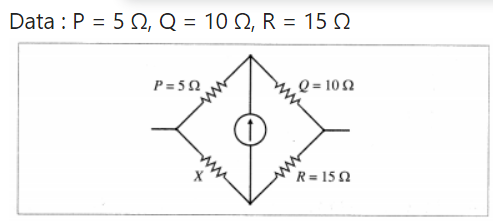
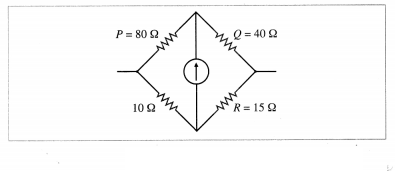
Four resistances $80 \Omega, 40 \Omega, 10 \Omega$ and $15 \Omega$ are connected to form Wheatstone's network $A B C D$ as shown in the following figure.
Image
What resistance must be connected in the branch containing $10 \Omega$ to balance the network?
Answer
Data : P $=80 \Omega, Q=40 \Omega, 10 \Omega$ and $R=15 \Omega$ are connected as shown in above figure.
When the network is balanced,
$ \frac{P}{Q}=\frac{S}{R}$
$\therefore \frac{80}{40}=\frac{S}{15}$
$\therefore S=15 \times 2=30 \Omega $
Let $X$ be the resistance to be connected in series with $10 \Omega$ so as to obtain $30 \Omega$.
$ \therefore X+10=30$
$\therefore X=20 \Omega $
View full question & answer
Question 203 Marks
Four resistances $4 \Omega, 4 \Omega, 4 \Omega$ and $12 \Omega$ form a Wheatstone network. Find the resistance which connected across the $12 \Omega$ resistance will balance the network.
Answer
The resistance in each of the three arms of the network is $4 \Omega$. Hence, to balance the network, the resistance in the fourth arm must also be $4 \Omega$.Hence, the resistance ( $R$ ) to be connected across. i.e, in parallel to, the $12 \Omega$ resistance should be such that their equivalent resistance is $4 \Omega$.
$ \therefore \frac{1}{4}=\frac{1}{12}+\frac{1}{R}$
$\therefore \frac{1}{R}=\frac{1}{4}-\frac{1}{12}=\frac{3-1}{12}=\frac{2}{12}=\frac{1}{6}$
$\therefore R=6 \Omega $
View full question & answer
Question 213 Marks
Two diametrically opposite points of a metal ring are connected to two tenninals of the left gap of a metre bridge. A resistance of $11 \Omega$ is connected in the right gap. If the null point is obtained at $45 cm$ from the left end, find the resistance of the metal ring.
Answer
Data: $R=11 \Omega, L_x=45 cm$
$
\therefore L_R=100-L_X=100-45=55 cm
$
Let $\frac{X}{2}$ be the resistance of each half of the metal ring. Therefore the resistance in the left gap is the effective resistance of the parallel combination of $\frac{X}{2}$ and $\frac{X}{2}$
$
R_{ P }=\frac{\left(\frac{X}{2}\right)\left(\frac{X}{2}\right)}{\frac{X}{2}+\frac{X}{2}}=\frac{X^2 / 4}{X}=\frac{X}{4}
$

At balance, $\frac{R_{ P }}{R}=\frac{L_X}{L_R} \quad \therefore \frac{X / 4}{11}=\frac{45}{55}=\frac{9}{11}$
$
\therefore \frac{X}{4}=9 \Omega \quad \therefore X=4 \times 9=36 \Omega
$
The resistance of the metal ring is $36 \Omega$

View full question & answer
Question 223 Marks
Four resistances $5 \Omega, 10 \Omega, 15 \Omega$ and X (unknown) are connected in the cyclic order so as to form a Wheatstone network. Determine $X$ if the network is balanced.
Answer
Image

Since the network is balanced,
$ \frac{P}{Q}=\frac{X}{R}$
$\therefore \frac{5}{10}=\frac{X}{15}$
$\therefore X=15 \times \frac{5}{10}=7.5 \Omega $
View full question & answer
Question 233 Marks
Why is Kelvin's method to measure the resistance of a galvanometer called an equal deflection method?
Answer

In Kelvin's method of determination of the galvanometer resistance using a Wheatstone metre bridge, the galvanometer is connected in one gap of the bridge and a variable known resistance is connected in the other gap. The junction of the two gaps (say, B) is connected directly to a pencil jockey.
The jockey is tapped along the wire to locate the equipotential balance point $D$ when the galvanometer shows no change in deflection.
Since the galvanometer shows the same deflection on making or breaking the contact between the jockey and the wire, the method is an equal deflection method.
View full question & answer
Question 243 Marks
Define the following terms:
1. Electrical circuit
2. Junction
3. Loop
4. Branch
5. Electrical network.
Answer

1. Electrical circuit: An electrical circuit, in general, consists of a number of electrical components such as an electrical cell, a plug key (or a switch), a resistor, a current: meter (a miliammeter or an ammeter), a voltmeter, etc., connected together to form a conducting path.
2. Junction: A point in an electrical circuit where two or more conductors are joined together is called a junction.
3. Loop: A closed conducting path in an electrical network is called a loop or mesh.
4. Branch: A branch is any part of an electrical network that lies between two junctions.
5. Electrical network: An electrical network consists of a number of electrical components connected together to form a system of inter-related circuits.
View full question & answer
Question 253 Marks
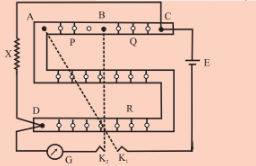
Post Office Box
A post office box (PO Box) is a practical form of Wheatstone bridge as shown in the figure.

Image
It consists of three arms P, Q and R. The resistances in these three arms are adjustable. The two ratio arms P and Q contain resistances of $10$ ohm, $100$ ohm and $1000$ ohm each. The third arm R contains resistances from $1$ ohm to $5000$ ohm. The unknown resistance X (usually, in the form of a wire) forms the fourth arm of the Wheatstone’s bridge. There are two tap keys $K_1$​​​​​​​ and $K_2​​​​​​​$​​​​​​​ .
Answer
The resistances in the arms P and Q are fixed to a desired ratio. The resistance in the arm R is adjusted so that the galvanometer shows no deflection. Now the bridge is balanced. The unknown resistance X = RQ/P, where P and Q are the fixed resistances in the ratio arms and R is the adjustable known resistance.If L is the length of the wire used to prepare the resistor with resistance X and r is its radius, then the specific resistance (resistivity) of the material of the wire is given by
$\rho=\frac{X \pi r^2}{L}$
View full question & answer
Question 263 Marks
What will be the effect on the position of zero deflection if only the current flowing through the potentiometer wire is
(i) increased (ii) decreased.
Answer
(1) On increasing the current through the potentiometer wire, the potential gradient along the wire will increase. Hence, the position of zero deflection will occur at a shorter length.

(2) On decreasing the current through the potentiometer wire, the potential gradient along the wire will decrease. Hence, the position of zero deflection will occur at a longer length.

[Note : In the usual notation,
$
E _1=\left.\left(\frac{I R}{L}\right)\right|_1=\text { constant }
$
Hence, (i) $E$, decreases when $I$ is increased (ii) $I_1$ increases when $I$ is decreased.]

View full question & answer
Question 273 Marks
Distinguish between a potentiometer and a voltmeter.
Answer
PotentiometerVoltmeter
1. A potentiometer is used to determine the emf of a cell, potential difference and internal resistance.1. A voltmeter can be used to measure the potential difference and terminal voltage of a cell. But it cannot be used to measure the emf of a cell.
2. Its accuracy and sensitivity are very high.2. Its accuracy and sensitivity are less as compared to a potentiometer.
3. It is not a portable instrument.3. It is a portable instrument.
4. It does not give a direct reading.4. It gives a direct reading.
View full question & answer
Question 283 Marks
What are the disadvantages of a potentiometer?
Answer
Disadvantages of a potentiometer over a voltmeter :
  1. The use of a potentiometer is an indirect measurement method while a voltmeter is a direct reading instrument.
  2. A potentiometer is unwieldy while a voltmeter is portable.
  3. Unlike a voltmeter, the use of a potentiometer in measuring an unknown emf requires a standard . source of emf and calibration.
View full question & answer
Question 293 Marks
State the uses of a potentiometer.
Answer
The applications (uses) of the potentiometer :
  1. Voltage divider :
    The potentiometer can be used as a voltage divider to change the output voltage of a voltage supply.
  2. Audio control:
    Sliding potentiometers are commonly used in modern low-power audio systems as audio control devices. Both sliding (faders) and rotary potentiometers (knobs) are regularly used for frequency attenuation, loudness control and for controlling different characteristics of audio signals.
  3. Potentiometer as a sensor:
    If the slider of the potentiometer is connected to the moving part of a machine, it can work as a motion sensor. A small displacement of the moving part causes a change in potential which is further amplified using an amplifier circuit. The potential difference is calibrated in terms of displacement of the moving part.
  4. To measure the emf (for this, the emf of the standard cell and potential gradient must be known).
  5. To compare the emf’s of two cells.
  6. To determine the internal resistance of a cell.
View full question & answer
Question 303 Marks
Why is potentiometer preferred over a voltmeter for measuring emf?
Answer
A voltmeter should ideally have an infinite resistance so that it does not draw any current from the circuit. However a voltmeter cannot be designed to have infinite resistance. A potentiometer does not draw any current from the circuit at the null point. Therefore, it gives more accurate measurement. Thus, it acts as an ideal voltmeter.
View full question & answer
Question 313 Marks
What is potential gradient? How is it measured? Explain.
Answer
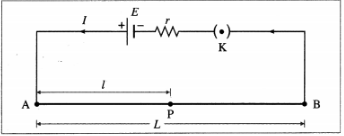
Consider a potentiometer consisting of a long uniform wire AB of length L and resistance R, stretched on a wooden board and connected in series with a cell of stable emf E and internal resistance r and a plug key K as shown in below figure

Image
Let I be the current flowing through the wire when the circuit is closed.
Current through $AB , I =\frac{E}{R+r}$
Potential difference across $A B . V_{A B}=I R$
$\therefore V _{ AB }=\frac{E R}{(R+r)}$
The potential difference (the fall of potential from the high potential end) per unit length of the wire,
$\frac{V_{ AB }}{L}=\frac{E R}{(R+r) L}$
As long as $E$ and $r$ remain constant, $\frac{V_{ AB }}{L}$ will remain constant, $\frac{V_{ AB }}{L}$ is known as potential gradient along
AB and is denoted by K. Thus the potential gradient is calculated by measuring the potential difference between ends of the potentiometer wire and dividing it by the length of the wire.
Let P be any point on the wire between A and B and AP = l = length of the wire between A and P.
Then $V_{AP} = Kl$
$\therefore V_{AP} ∝ l$ as K is constant in a particular case. Thus, the potential difference across any length of the potentiometer wire is directly proportional to that length. This is the principle of the potentiometer.
View full question & answer
Question 323 Marks
State any two sources of errors in meterbridge experiment. Explain how they can be minimized.
Answer
The chief sources of error in the metre bridge experiment are as follows :

  1. The bridge wire may not be uniform in cross section. Then the wire will not have a uniform resistance per unit length and hence its resistance will not be proportional to its length.
  2. End resistances at the two ends of the wire may be introduced due to
    1. the resistance of the metal strips
    2. the contact resistance of the bridge wire with the metal strips
    3. unmeasured lengths of the wire at the ends because the contact points of the wire with the metal strips do not coincide with the two ends of the metre scale attached.

Such errors are almost unavoidable but can be minimized considerably as follows :

  1. Readings must be taken by adjusting the standard known resistance such that the null point is obtained close to the centre of the wire. When several readings are to be taken, the null points should lie in the middle one-third of the wire.
  2. The measurements must be repeated with the standard resistance (resistance box) and the unknown resistance interchanged in the gaps of the bridge, obtaining the averages of the two results.
View full question & answer
Question 333 Marks
In a Wheatstone’s meter-bridge experiment, the null point is obtained in middle one third portion of wire. Why is it recommended?
Answer
  1. The value of unknown resistance $X$, may not be accurate due to non-uniformity of the bridge wire and development of contact resistance at the ends of the wire.
  2. To minimise these errors, the value of R is so adjusted that the null point is obtained in the middle one-third of the wire (between $34\ cm$ and $66\ cm$) so that the percentage errors in the measurement of $I_X$ and $I_R$ are minimum and nearly the same.
View full question & answer
Question 343 Marks
Are Kirchhoff’s laws applicable for both AC and DC currents?
Answer
Kirchhoff’s laws are applicable to both AC and DC ’ circuits (networks). For AC circuits with different loads, (e.g. a combination of a resistor and a capacitor, the instantaneous values for current and voltage are considered for addition.

[Note : Gustav Robert Kirchhoff (1824-87), German physicist, devised laws of electrical network and, with Robert Wilhelm Bunsen, (1811-99), German chemist, did pioneering work in chemical spectroscopy. He also con-tributed to radiation.]

View full question & answer
Question 353 Marks
Define or describe a Potentiometer.
Answer
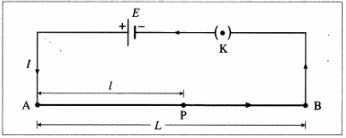
The potentiometer is a device used for accurate measurement of potential difference as well as the emf of a cell. It does not draw any current from the circuit at the null point. Thus, it acts as an ideal voltmeter and it can be used to determine the internal resistance of a cell. It consist of a long uniform wire AB of length L, stretched on a wooden board. A cell of stable emf (E), with a plug key K in series, is connected across AB as shown in the following figure.

Image

View full question & answer