Question
What is power factor? Explain.

Answer

We know that expression of average power is
$\overline{ P }= E _{ rms } I _{ rms } \cos \phi$
$\cos \phi=\frac{\overline{ P }}{ E _{ rms } I _{ rms }}$
$\cos \phi=\frac{\overline{ P }}{ P _{ app }}$
where $P_{\text {app }}=E_{ rms } I_{ rms }$
Hence the ratio of $\overline{ P }$ and $P _{\text {qpp }}$ is known as power factor.
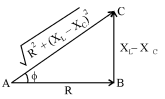
Image
In other words, cosine of the phase difference $\phi$ between emf and current is known as power factor.
We know that
$\tan \phi=\frac{ X _{ L }- X _{ C }}{ R }$
$\cos \phi=\frac{ AB }{ AC }$
$\cos \phi=\frac{ R }{\sqrt{ R ^2+\left( X _{ L }- X _{ C }\right)^2}}$
$\cos \phi=\frac{R}{Z}$
$\because \quad Z =\sqrt{ R ^2+\left( X _{ L }- X _{ C }\right)^2}$
Power factor is equal to the ratio of resistance and impedance.
If $\phi=0^{\circ}, \cos \phi=+1$,maximum power factor.
If $\phi= \pm 90^{\circ}, \cos \phi=0$, minimum power factor.

Need a full question paper?

Generate a complete, print-ready paper with questions like this in minutes — across 16+ boards, with answer keys.
Start Generating Free

Similar questions

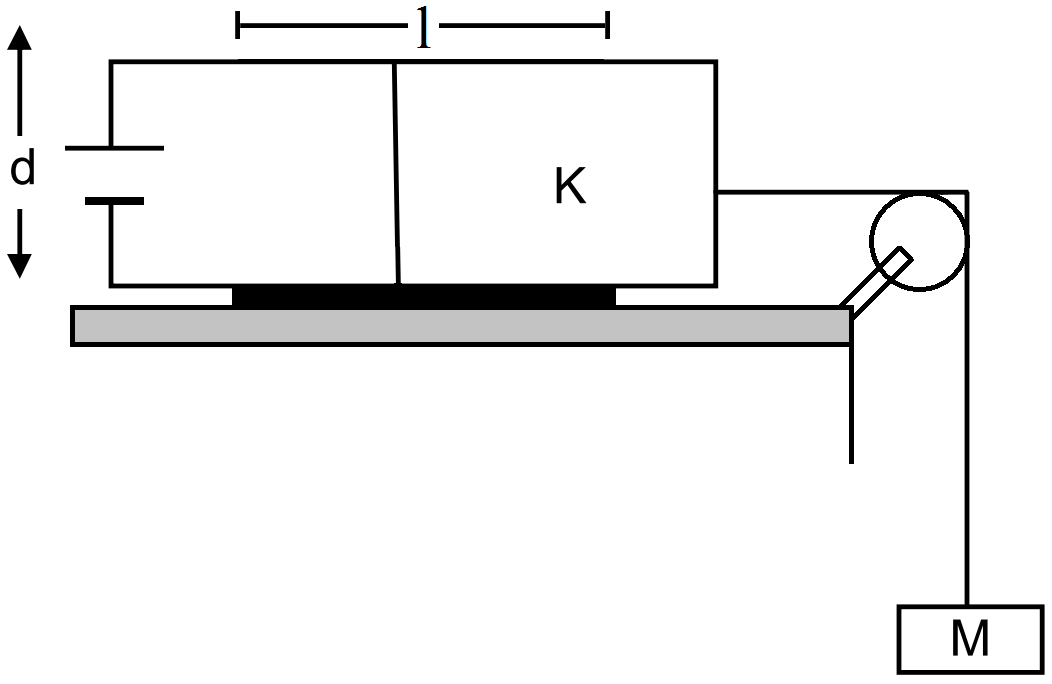
Consider the situation shown in figure. The width of each plate is b. The capacitor plates are rigidly clamped in the laboratory and connected to a battery of emf $\in.$ All surfaces are frictionless. Calculate the value of M for which the dielectric slab will stay in equilibrium.
The magnetometer of the previous problem is used with the same magnet in $\tan-\text{B}$ position. Where should the magnet be placed to produce a 37° deflection of the needle?
Power (P) of a lens is given by reciprocal of focal length (f) of the lens i.e. $\text{p}=\frac{1}{\text{f}},$ where f is in metre and P is in dioptre. For a convex lens, power is positive and for a concave lens, power is negative. When a number of thin lenses of powers $P_1, P_2, P_3, ...... $ are held in contact with one another, the power of the combination is given by algebraic sum of the powers of all the lenses i.e., $P = P_1 + P_2 + P_3 +......$
  1. A convex and a concave lens separated by distance d are then put in contact. The focal length of the combination.
  1. Becomes 0.
  2. Remains the same.
  3. Decreases.
  4. Increases.
  1. If two lenses of power +1.5D and +1.0D are placed in contact, then the effective power of combination will be.
  1. 2.5D
  2. 1.5D
  3. 0.5D
  4. 3.25D
  1. If the power of a lens is +5 dioptre, what is the focal length of the lens?
  1. 10cm
  2. 20cm
  3. 15cm
  4. 5cm
  1. Two thin lenses of focal lengths +10cm and -5cm are kept in contact. The power of the combination is:
  1. -10D
  2. -20D
  3. 10D
  4. 15D
  1. A convex lens of focal length 25cm is placed coaxially in contact with a concave lens of focal length 20cm. The system will be.
  1. Converging in nature.
  2. Diverging in nature.
  3. Can be converging or divergin.
  4. None of the above.
At a prayer meeting, the disciples sing JAI-RAM JAI-RAM. The sound amplified by a loudspeaker comes back after reflection from a building at a distance of 80m from the meeting. What maximum time interval can be kept between one JAI-RAM and the next JAI-RAM so that the echo does not disturb a listener sitting in the meeting. Speed of sound in air is 320m/s.
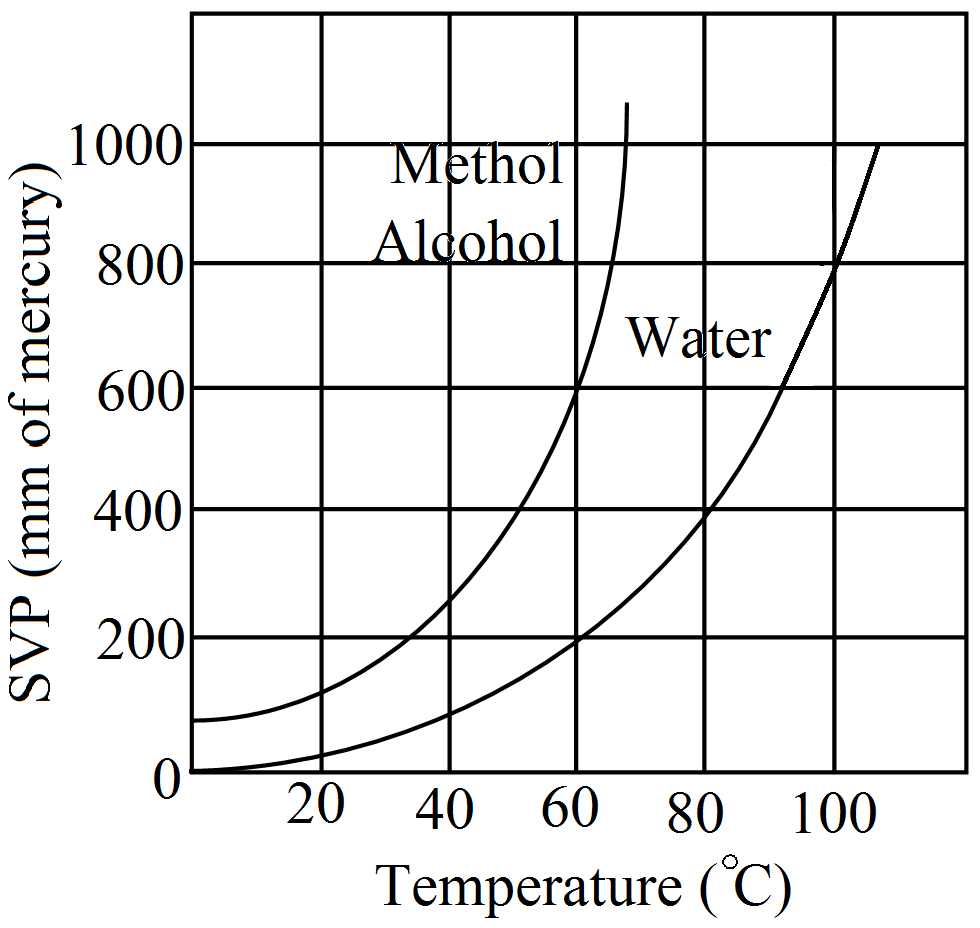
The human body has an average temperature of 98°F. Assume that the vapour pressure of the blood in the veins behaves like that of pure water. Find the minimum atmospheric pressure which is necessary to prevent the blood from boiling. Use figure. of the text for the vapour pressures.

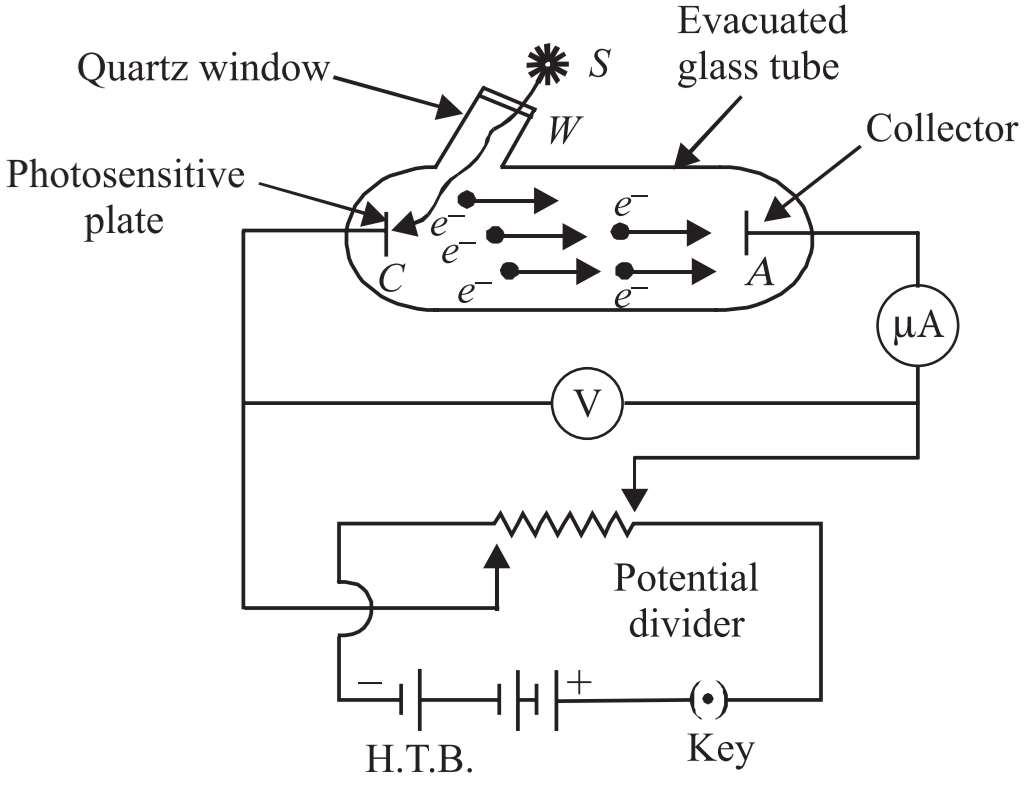
To study photoelectric effect, an emitting electrode C of a photosensitive material is kept at negative potential and collecting electrode A is kept at positive potential in an evacuated tube. When light of sufficiently high frequency falls on emitting electrode, photoelectrons are emitted which travel directly to collecting electrode and hence an electric current called photoelectric current starts flowing in the circuit, which is directly proportional to the number of photoelectrons emitted by emitting electrode C.

While demonstrating the existence of electromagnetic waves, Hertz found that high voltage sparks passed across the metal electrodes of the detector loop more easily when the cathode was illuminated by ultraviolet light from an arc lamp. The ultraviolet light falling on the metal surface caused the emission of negatively charged particles, which are now known to be electrons, into the surrounding space and hence enhanced the high voltage sparks.
  1. Cathode rays were discovered by:
  1. Maxwell Clerk James.
  2. Heinrich Hertz.
  3. William Crookes.
  4. J. J. Thomson.
  1. Cathode rays consists of:
  1. Photons
  2. Electrons
  3. Pistons
  4. $\alpha$-particles
  1. Who discovered the charge on an electron for the frist time?
  1. Millikan
  2. Thomson
  3. Kelvin
  4. Coulomb
  1. The dual nature oflight is exhibited by:
  1. Diffraction and photoelectric effect.
  2. Photoelectric effect.
  3. Refraction and interference.
  4. Diffraction and reflection.
  1. ln the phenomenon of electric discharge through gases at low pressure, the coloured glow in the tube appears as a result of:
  1. Collisions between the charged particles emitted from the cathode and the atoms of the gas.
  2. Collision between different electrons of the atoms of the gas.
  3. Excitation of electrons in the atoms.
  4. Collision between the atoms of the gas.
The friction coefficient between an athelete's shoes and the ground is 0.90. Suppose a superman wears these shoes and races for 50m. There is no upper limit on his capacity of running at high speeds.
  1. Find the minimum time that he will have to take in completing the 50m starting from rest.
  2. Suppose he takes exactly this minimum time to complete the 50m, what minimum time will he take to stop?
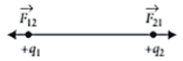
Coulomb's law states that the electrostatic force of attraction or repulsion acting between two stationary point charges is given by
Image

where $F$ denotes the force between two charges $q _1$ and $q _2$ separated by a distance $r$ in free space, $\varepsilon_0$ is a constant known as the permittivity of free space. Free space is a vacuum and may be taken to be air practically. If free space is replaced by a medium, then $\varepsilon_0$ is replaced by $\left(\varepsilon_0 k\right)$ or $\left(\varepsilon_0 \varepsilon_r\right)$ where $k$ is known as dielectric constant or relative permittivity.
$(i)$ In coulomb's law, $F =k \frac{q_1 q_2}{r^2}$, then on which of the following factors does the proportionality constant $k$ depends?
$(a)$ Nature of the medium between the two charges
$(b)$ Distance between the two charges
$(c)$ Electrostatic force acting between the two charges
$(d)$ Magnitude of the two charges
$(ii)$ Dimensional formula for the permittivity constant $\varepsilon_0$ of free space is
$(a) \left[ M ^{-1} L^3 T^2 A^2\right]$
$(b) \left[ ML ^{-3} T^4 A^2\right]$
$(c) \left[ M ^{-1} L^{-3} T^4 A^2\right]$
$(d) \left[ ML ^{-3} T^4 A^{-2}\right]$
$(iii)$ The force of repulsion between two charges of $1 C$ each, kept $1m$ apart in vaccum is
$(a) \frac{1}{9 \times 10^9} N$
$(b) \frac{1}{9 \times 10^{12}} N$
$(c) 9 \times 10^7 N$
$(d) 9 \times 10^9 N$
$(iv)$ Two identical charges repel each other with a force equal to $10$ mgwt when they are $0.6 m$ apart in air.
$(g =10 m s ^{-2} ).$ The value of each charge is
$(a) 2 mC$
$(b) 2 \times 10^{-7} mC$
$(c) 2 \mu C$
$(d) 2 nC$
OR
Coulomb's law for the force between electric charges most closely resembles with
$(a)$ law of conservation of energy
$(b)$ Newton's $2^{nd}$ law of motion
$(c)$ law of conservation of charge .
$(d)$ Newton's law of gravitation
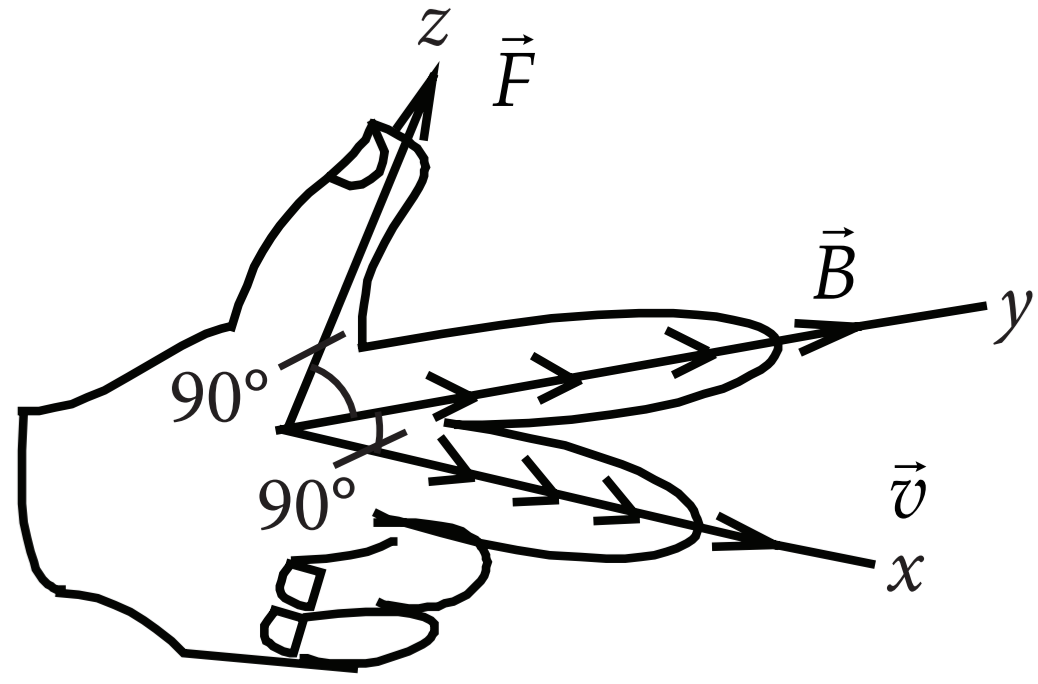
A charged particle moving in a magnetic field experiences a force that is proportional to the strength of the magnetic field, the component of the velocity that is perpendicular to the magnetic field and the charge of the particle. This force is given by $\vec{\text{F}}=\text{q}(\vec{\text{v}}\times\vec{\text{B}})$ where q is the electric charge of the particle, v is the instantaneous velocity of the particle, and Bis the magnetic field (in tesla). The direction of force is determined by the rules of cross product of two vectors. Force is perpendicular to both velocity and magnetic field. Its direction is same as $\vec{\text{v}}\times\vec{\text{B}}$ if q is positive and opposite of $\vec{\text{v}}\times\vec{\text{B}}$ if q is negative. The force is always perpendicular to both the velocity of the particle and the magnetic field that created it. Because the magnetic force is always perpendicular to the motion, the magnetic field can do no work on an isolated charge. It can only do work indirectly, via the electric field generated by a changing magnetic field.
  1. When a magnetic field is applied on a stationary electron, it:
  1. Remains stationary.
  2. Spins about its own axis.
  3. Moves in the direction of the field.
  4. Moves perpendicular to the direction of the field.
  1. A proton is projected with a uniform velocity v along the axis of a current carrying solenoid, then,
  1. The proton will be accelerated along the axis.
  2. The proton path will be circular about the axis.
  3. The proton moves along helical path.
  4. The proton will continue to move with velocity v along the axis.
  1. A charged particle experiences magnetic force in the presence of magnetic field. Which of the following statement is correct?
  1. The particle is stationary and magnetic field is perpendicular.
  2. The particle is moving and magnetic field is perpendicular to the velocity.
  3. The particle is stationary and magnetic field is parallel.
  4. The particle is moving and magnetic field is parallel to velocity.
  1. A charge q moves with a velocity $2m\ s^{-1}$ along x-axis in a uniform magnetic field $\vec{\text{F}}=(\vec{\text{i}}+2\vec{\text{j}}+3\vec{\text{k}})\text{T,}$ charge will experience a force.
  1. In z-y plane.
  2. Along -y axis.
  3. Along +z axis.
  4. Along -z axis.
  1. Moving charge will produce.
  1. Electric field only.
  2. Magnetic field only.
  3. Both electric and magnetic field.
  4. None of these.
A person goes to bed at sharp 10:00 pm every day. Is it an example of periodic motion? If yes, what is the time period? If no, why?