Question
What is quantization of charge?

Answer

No matter what may be the reason for the origin of charge on any charged object, the charge is always an absolute multiple of the charge of the electron, not a fractional multiple. In mathematical form $q= \pm$ ne where $n=$ integer multiple number $i . e . n =0,1,2,3, \ldots$

Need a full question paper?

Generate a complete, print-ready paper with questions like this in minutes — across 16+ boards, with answer keys.
Start Generating Free

Similar questions

Write down the conditions for constructive and destructive interference in terms of path difference.
X-rays of wavelength $'\lambda'$ fall on a photosensitive surface, emitting electrons. Assuming that the work function of the surface can be neglected, prove that the de Broglie wavelength of electrons emitted will be $\sqrt{\frac{\text{h}\gamma}{2\text{mc}}}.$
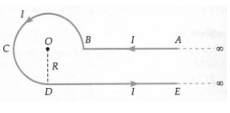
A current I is flowing in an infinitely long conductor bent into the shape shown in Fig. If the radius of the curved part is R, find the magnetic field at the centre O. 
Image
State with reason why a photodiode is usually operated at a reverse bias.
Answer the following questions regarding earth’s magnetism:
The earth's field, it is claimed, roughly approximates the field due to a dipole of magnetic moment $8 \times 10^{22} \mathrm{~J} \mathrm{~T}^{-1}$ located at its centre. Check the order of magnitude of this number in some way.
The mass of cyclist together with the bike is 90kg. Calculate the increase in kinetic energy if the speed increases from 6.0km/h to 12km/h.
Two electric bulbs whose resistances are in the ratio 1 : 2 are connected in parallel to a source of constant voltage. What will be the ratio of power dissipation in these wires?
Can the dispersive power $\omega=\frac{\mu_\text{v}-\mu\text{r}}{\mu-1}$ be negative? What is the sign of co if a hollow prism is immersed into water?
A tightly-wound, long solenoid has n turns per unit length, a radius r and carries a current i. A particle having charge q and mass m is projected from a point on the axis in a direction perpendicular to the axis. What can be the maximum speed for which the particle does not strike the solenoid ?
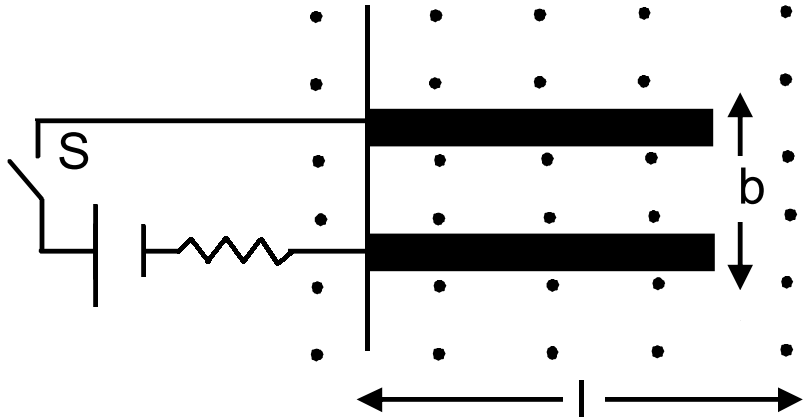
Two metal strips, each of length l, are clamped parallel to each other on a horizontal floor with a separation b between them. A wire of mass m lies on them perpendicularly, as shown in A vertically-upward magnetic field of strength B exists in the space. The metal strips are smooth but the coefficient of friction between the wire and the floor is $\mu.$ A current i is established when the switch S is closed at the instant t = 0. Discuss the motion of the wire after the switch is closed. How far away from the strips will the wire reach?