Question
Write down the conditions for constructive and destructive interference in terms of path difference.

Answer

$•$ Constructive Interference :
$\rightarrow $If we have two coherent sources $S _1$ and $S _2$ vibrating in phase, then for an arbitrary point $P$, whenever the path difference,
$S _1 P \sim S _2 P =n \lambda \ (n=0,1,2,3, \ldots)$
we will have maximum intensity $\left( I =4 I _0\right. )$ at the given point, which means we will have constructive interference.
$[$The sign $\sim$ between $S _1 P$ and $S _2 P$ represents the difference between $S _1 P$ and $S _2 P.]$
$•$ Destructive interference :
$\rightarrow $When two coherent sources $\left( S _1\right.$ and $\left.S _2\right)$ are vibrating in phase, and if the point $P$ is such that the path difference
$S _1 P \sim S _2 P =\left(n+\frac{1}{2}\right) \lambda$
$\left( OR S _1 P \sim S _2 P =(2 n+1) \frac{\lambda}{2}\right)$
$($where $,  n=0,1,2,3 \ldots  )$
We will have destructive interference and the resultant intensity will be zero.

Need a full question paper?

Generate a complete, print-ready paper with questions like this in minutes — across 16+ boards, with answer keys.
Start Generating Free

Similar questions

Explain the formation of potential barrier and depletion region in a p-n junction diode. What is effect of applying forward bias on the width of depletion region?
The phenomenon of diffraction is commonly seen in sound waves. But generally not in light waves, why?
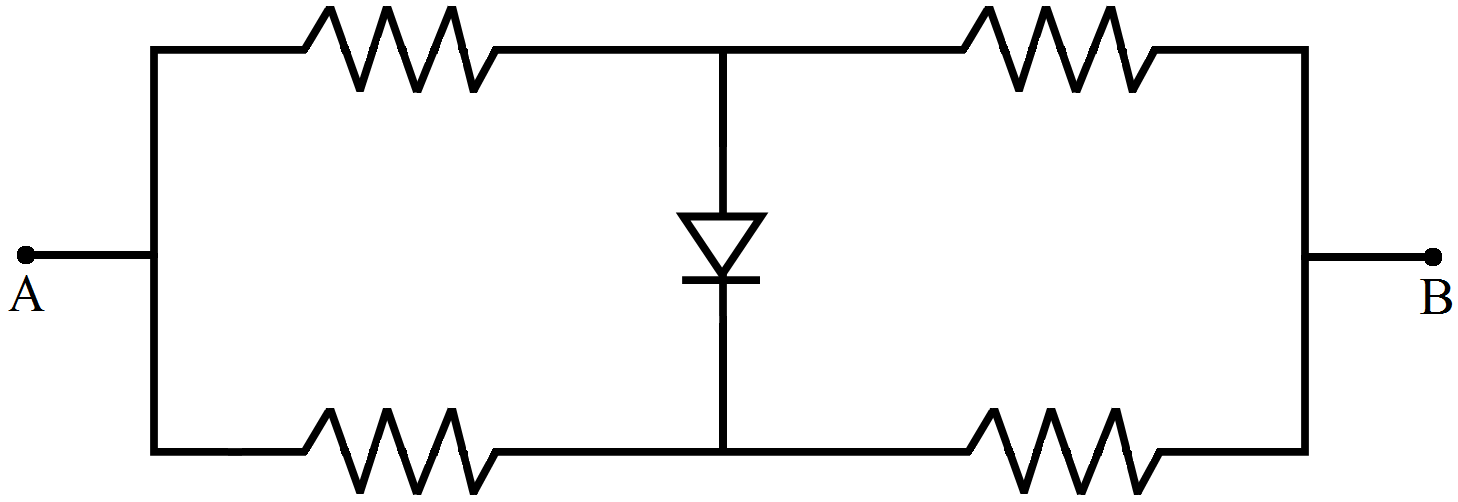
Each of the resistances shown in figure. has a value of $20\Omega.$ Find the equivalent resistance between A and B. Does it depend on whether the point A or B is at higher potential?
Two uniformly large parallel thin plates having charge densities +σ and –σ are kept in the X-Z plane at a distance 'd' apart. Sketch an equipotential surface due to electric field between the plates. If a particle of mass m and charge '-q' remains stationary between the plates, what is the magnitude and direction of this field?
Consider the situation of the previous problem. Take "the table plus the ball" as the system. Friction between the table and the ball is then an internal force. As the ball slows down, the momentum of the system decreases. Which external force is responsible for this change in the momentum?
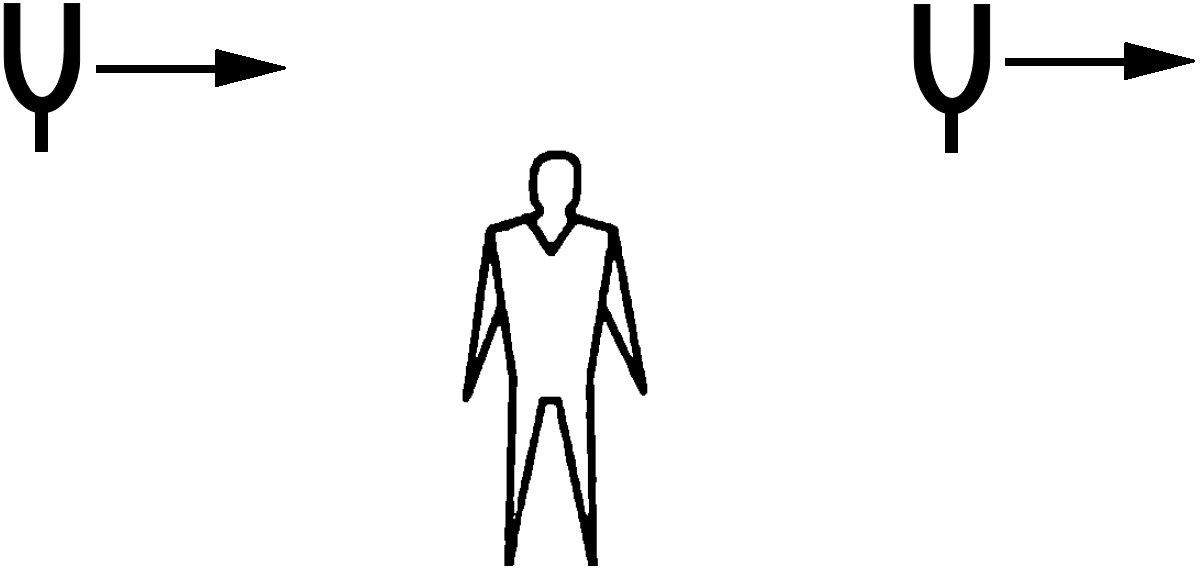
Figure, shows a person standing somewhere in between two identical tuning forks, each vibrating at 512Hz. If both the tuning fbrks move towards right at a speed of 5.5m/s, find the number of beats heard by the listener. Speed of sound in air = 330m/s.
In a Young's double slit experiment $\lambda=500\text{nm},$ d = 1.0mm and D = 1.0m. Find the minimum distance from the central maximum for which the intensity is half of the maximum intensity.
A filter transmits only the radiation of wavelength greater than 440nm. Radiation from a hydrogen-discharge tube goes through such a filter and is incident on a metal of work function 2.0eV. Find the stopping potential which can stop the photoelectrons.
A wire has a length of 2.0m and a resistance of $5.0\Omega.$ Find the electric field existing inside the wire if it carries a current of 10A.
Define the international definition of ampere.