Question
What is rivetted galvanometer? What is the function of shunt in a galvanometer?

Answer

SELF

Need a full question paper?

Generate a complete, print-ready paper with questions like this in minutes — across 16+ boards, with answer keys.
Start Generating Free

Similar questions

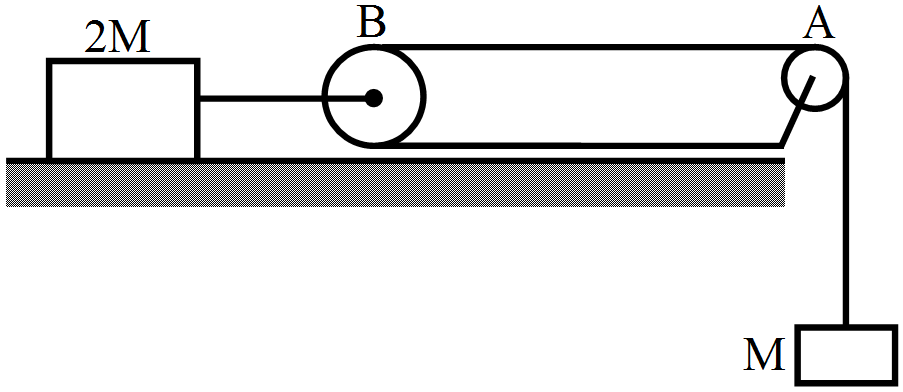
Consider the situation shown in figure. Both the pulleys and the string are light and all the surfaces are frictionless.
  1. Find the acceleration of the mass $M.$
  2. Find the tension in the string.
  3. Calculate the force exerted by the clamp on the pulley $A$ in the figure.
A converging lens of focal length $15\ cm$ and a converging mirror of focal length $10\ cm$ are placed $50\ cm$ apart. If a pin of length $2.0\ cm$ is placed $30\ cm$ from the lens farther away from the mirror, where will the final image form and what will be the size of the final image?
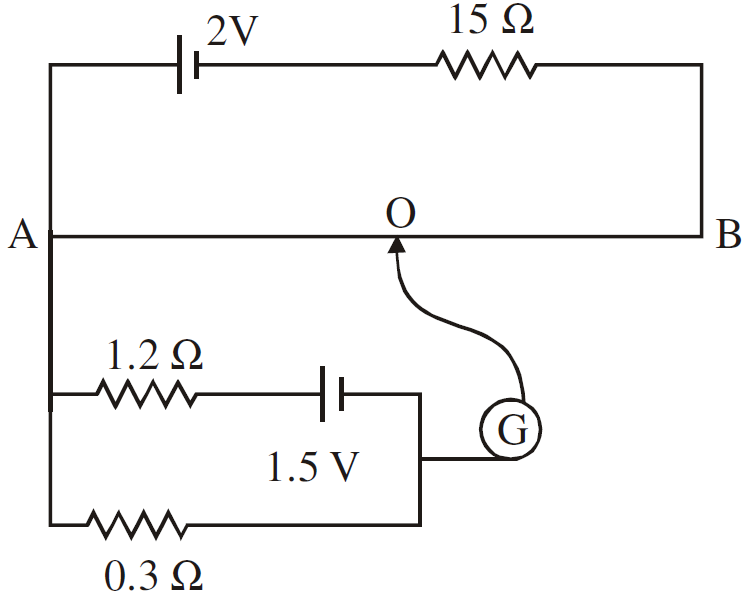
  1. State the principle of working of a potentiometer.
  2. In the following potentiometer circuit, AB is a uniform wire of length 1 m and resistance 10Ω. Calculate the potential gradient along the wire and balance length AO ( = l).
To ensure almost $100$ per cent transmittivity, photographic lenses are often coated with a thin layer of dielectric material. The refractive index of this material is intermediated between that of air and glass $($which makes the optical element of the lens$)$. A typically used dielectric film is $\ce{MgF_2 (n = 1.38).}$ What should the thickness of the film be so that at the center of the visible speetrum $(5000\mathring{\text{A}})$ there is maximum transmission.
Steam at $120^\circ C$ is continuously passed through a $50\ cm$ long rubber tube of inner and outer radii $1.0\ cm$ and $1.2\ cm.$ The room temperature is $30^\circ C.$ Calculate the rate of heat flow through the walls of the tube. Thermal conductivity of rubber $= 0.15Js^{-1}m^{-1\ \circ}C^{-1}.$
In a Young's double slit experiment using monochromatic light, the fringe pattern shifts by a certain distance on the screen when a mica sheet of refractive index $1.6$ and thickness $1.964$ micron $(1$ micron $= 10^{-6}m)$ is introduced in the path of one of the interfering waves. The mica sheet is then removed and the distance between the screen and the slits is doubled. It is found that the distance between the successive maxima now is the same as the observed fringe-shift upon the introduction of the mica sheet. Calculate the wavelength of the monochromatic light used in the experiment.
An inductor of inductance 5.0H, having a negligible resistance, is connected in series with a $100\Omega$ resistor and a battery of emf 2.0V. Find the potential difference across the resistor 20ms after the circuit is switched on.
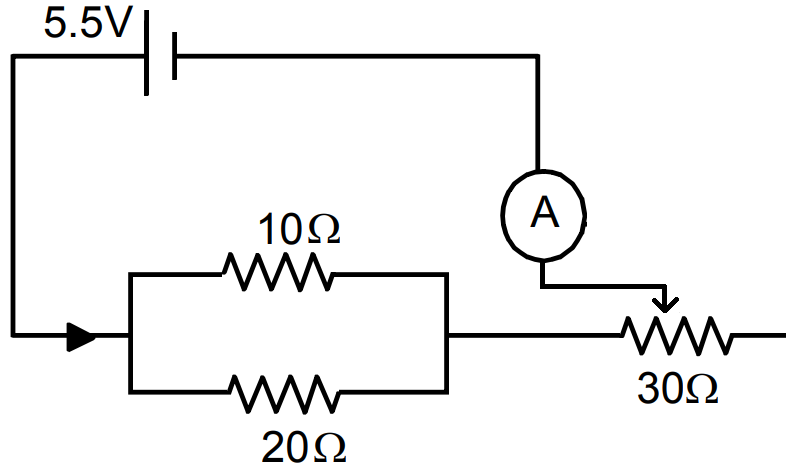
The resistance of the rheostat shown in the figure. is $30\Omega.$ Neglecting the meter resistance, find the minimum and maximum currents through the ammeter as the rheostat is varied.
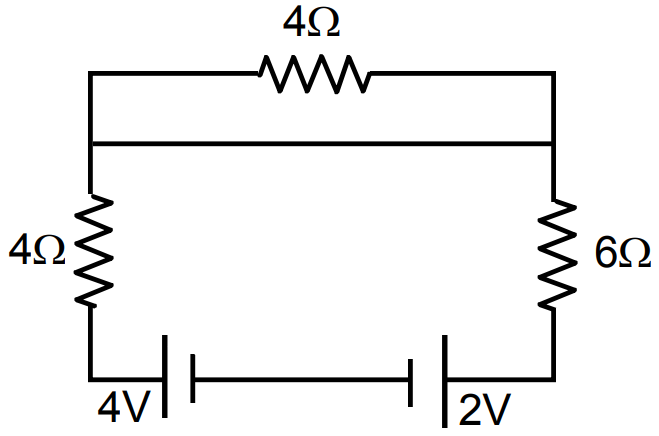
Find the currents through the three reaiators shown in figure.
A cubical block of mass $1.0\ kg$ and edge $5.0\ cm$ is heated to $227^\circ C.$ It is kept in an evacuated chamber maintained at $27^\circ C$. Assuming that the block emits radiation like a blackbody, find the rate at which the temperature of the block will decrease. Specific heat capacity of the material of the block is $400\ J\ kg^{-1}K^{-1}.$