Question
What is simple tissue? Classify and explain its Different types with suitable diagram.

Answer


Simple tissues: These tissues are composed of cells which are structurally and functionally similar.
There are three types of simple tissues:
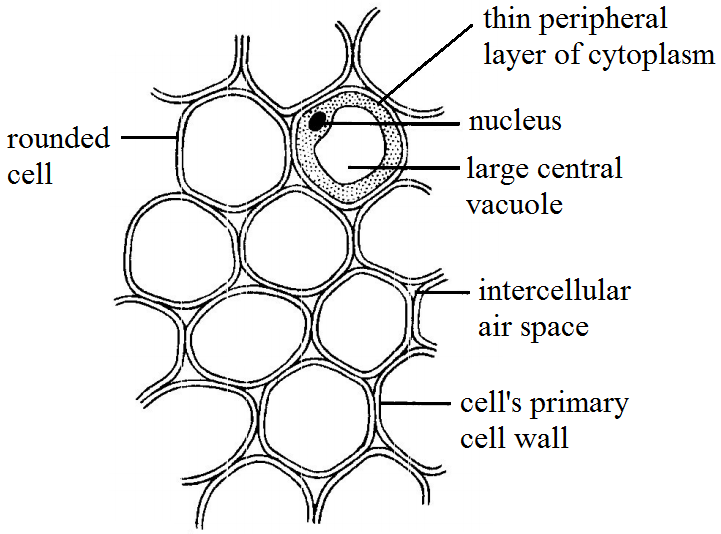
  1. Parenchyma: Parenchyma cells are living and posses the power of division. The cell wall is thin and encloses a dense cytoplasm which contains a small nucleus and surrounds a large central vacuole.
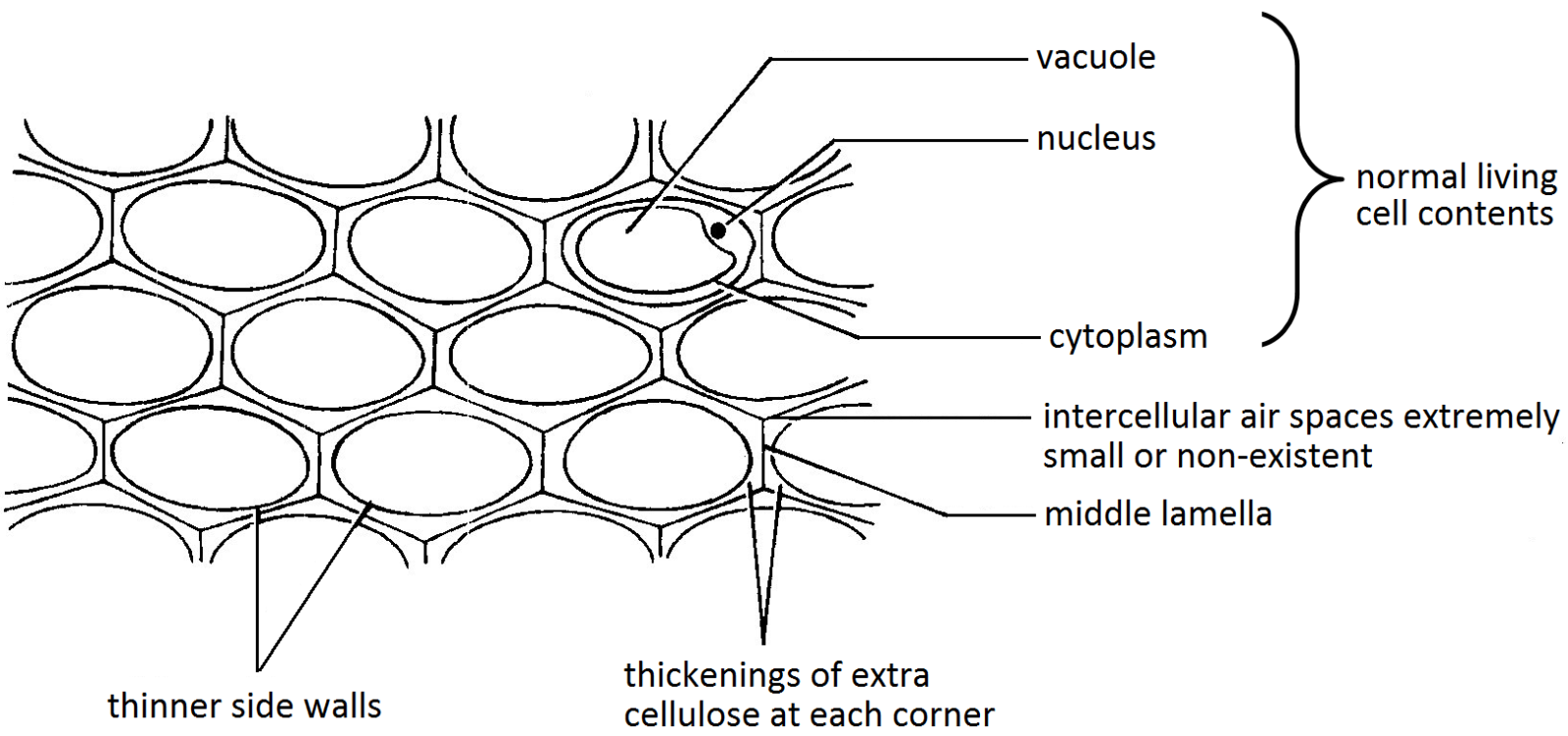
  1. Collenchyma: It tissues also consists of living cells. It is characterized by the deposition of extra cellulose at the corners of the cells. In collenchymas, intercellular spaces are generally absent. Collenchyma cells are elongated in shape. They often contain a few chloroplasts.
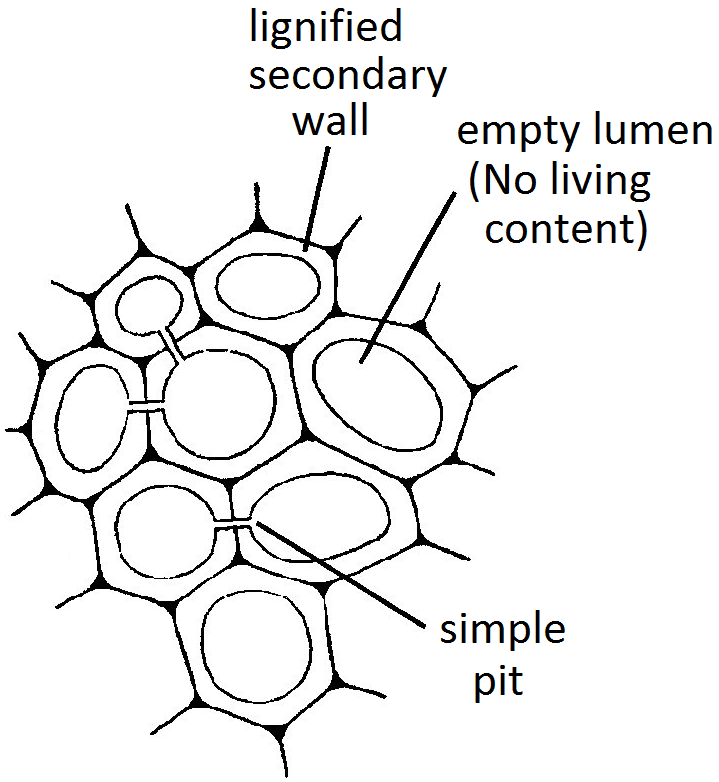
  1. Sclerenchyma: Sclerenchyma cells are dead cells and they are devoid of protoplasm. The cells walls of sclerenchyma are greatly thickened by the deposition of lignin. The cells of sclerenchyma are closely packed without intercellular spaces.

Need a full question paper?

Generate a complete, print-ready paper with questions like this in minutes — across 16+ boards, with answer keys.
Start Generating Free

Similar questions

Describe a simple experiment to show that the prongs of a sound producing tuning fork are vibrating.
Suggest some preventive measures for the diseases of poultry birds.
The mass of one atom of an element $X$ is $2.0 \times 10^{-23}g.$
  1. Calculate the atomic mass of element $X.$
  2. What could element $X$ be$?$
​​​​​​​
How could you  convince a small child that when ou speak, it is not necessary for air to travel from your mouth to the ear of a listener?
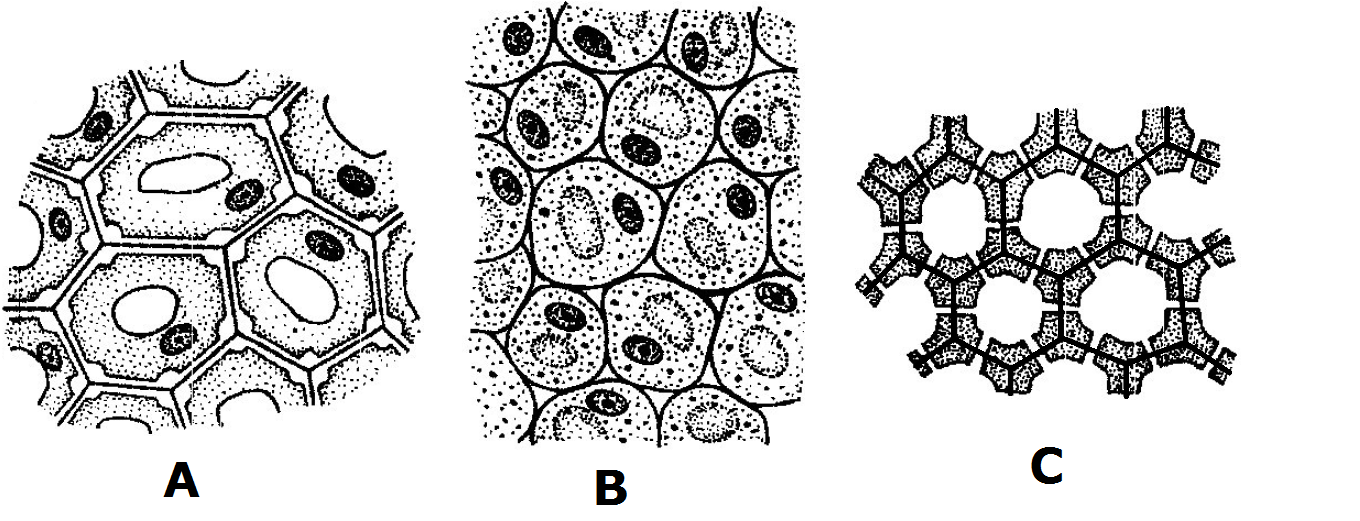
  1. Identify Figure A, B and C.
  2. Which one of them has heavy deposition of lignin?
  3. Which one of them provides both mechanical strength as well as flexibility?
  4. Which one of them can be modified to form air cavities in awuatic plants?
  5. Which one of them is commercially exploited to obtain Hemp and Jute?
Carry out the following osmosis experiment:
Take four peeled potato halves and scoop each one out to make potato cups, one of these potato cups should be made from a boiled potato. Put each potato cup in a trough containing water. Now,
  1. Keep cup A empty.
  2. Put one teaspoon sugar in cup B.
  3. Put one teaspoon salt in cup C.
  4. Put one teaspoon sugar in the boiled potato cup D.
Keep these for two hours. Then observe the four potato cups and answer the following:
  1. Explain why water gathers in the hollowed portion of B and C.
  2. Why is potato A necessary for this experiment?
  3. Explain why water does not gather in the hollowed out portions of A and D.
Show by using the graphical method that:$\text{s}=\text{ut}+\frac{1}{2}\text{at}^2$
where the symbols have their usual meanings.
Using second law of motion, derive the relation between force and acceleration. A bullet of $10g$ strikes a sand$-$bag at a speed of $103m\ s^{-1}$ and gets embedded after travelling $5\ cm.$ Calculate
  1. The resistive force exerted by the sand on the bullet.
  2. The time taken by the bullet to come to rest.
Name the following:
  1. Smallest cell organelle.
  2. Largest cell organelle.
  3. ER studded with ribosomes.
  4. Functional segments of the DNA molecule.
A gun of mass $3\ kg$ fires a bullet of mass $30g.$ The bullet takes $0.003s$ to move through the barrel of the gun and acquires a velocity of $100\ m/s.$ Calculate:
  1. The velocity with which the gun recoils.
  2. The force exerted on gunman due to recoil of the gun.