Question
What is specific conductivity ? Give its unit in S.I. system. Prove that $ \vec{j}=\sigma\vec{E} $, where $ \vec{E} = $ Intensity of electric field, $ \vec{j} = $ current density and $ \sigma = $ specific conductivity.

Answer

Specific Conductivity : The reciprocal of specific resistance of a material is called specific conductivity. It is denoted by $ \sigma $.
∴ Specific conductivity $=\frac{1}{\text { Specific Resistance }}$ i.e. $\sigma=\frac{1}{\rho}$
Proof of $ \vec{j} = \sigma \cdot \vec{E} $ : When an electric potential difference V is applied across the ends of an electric conductor of length l and area of cross-section A, then an electric field $ E = V/l $ is established inside the conductor. In this field, free electrons in the conductor begin to drift with drift velocity $ v_d $ due to which electric current I flowing through the conductor is given by: $ I = ne A v_d $ and
$ v_d = \frac{eV\tau}{ml} \Rightarrow v_d = e(\frac{V}{l})\frac{\tau}{m} \Rightarrow \frac{eE\tau}{m} $
$\therefore I = neA(\frac{eE\tau}{m}) = \frac{ne^2AE\tau}{m} $
$ \frac{I}{A} = (\frac{ne^2\tau}{m})E $
But $ \frac{I}{A} = current~density = j $
and $ \frac{m}{ne^2\tau} = \rho \Rightarrow \frac{ne^2\tau}{m} = \frac{1}{\rho} $
$ \Rightarrow j = (\frac{1}{\rho})E $ but $ \frac{1}{\rho} = \sigma $
$ j = \sigma E $ or in vector form $ \vec{j} = \sigma \cdot \vec{E} $

Need a full question paper?

Generate a complete, print-ready paper with questions like this in minutes — across 16+ boards, with answer keys.
Start Generating Free

Similar questions

Obtain the Ohm's law $j=\sigma$ E. Using this relation, establish the relation $V=I R$. What are ohmic and non-ohmic devices? Explain by giving examples.
  1. A rod of length l is moved horizontally with a uniform velocity ‘v’ in a direction perpendicular to its length through a region in which a uniform magnetic field is acting vertically downward. Derive the expression for the emf induced across the ends of the rod.
  2. How does one understand this motional emf by invoking the Lorentz force acting on the free charge carriers of the conductor? Explain.
If the operating potential in an X-ray tube is increased by 1%, by what percentage does the cutoff wavelength decrease?

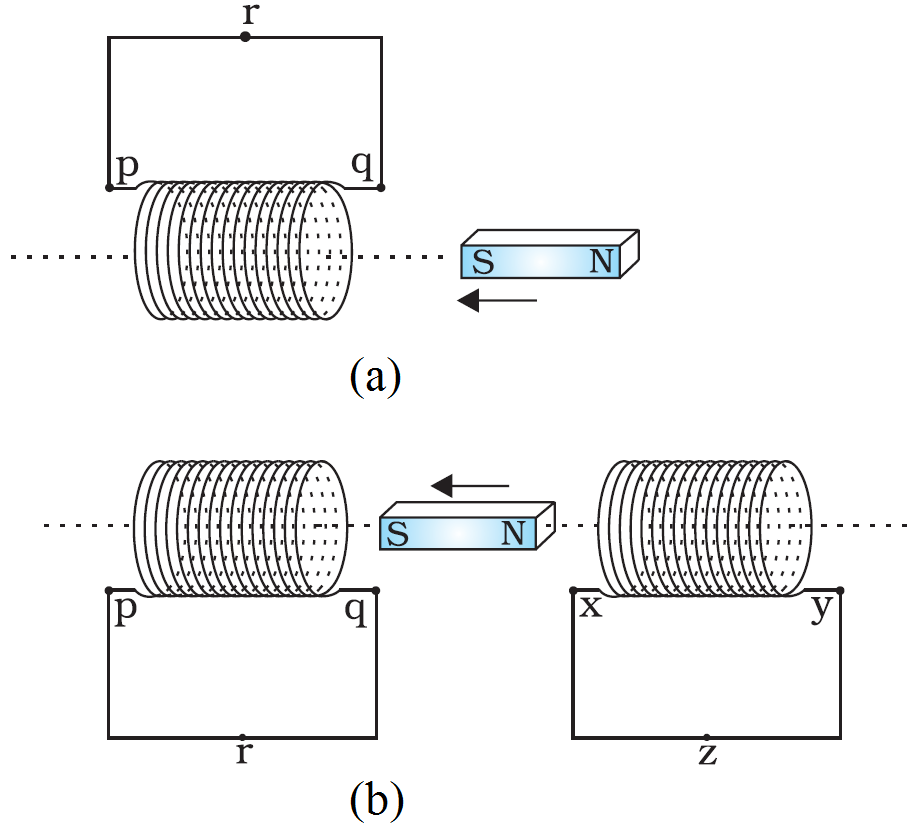
Predict the direction of induced current in the situations described in the following figs.
A 100W light bulb is placed at the centre of a spherical chamber of radius 20cm. Assume that 60% of the energy supplied to the bulb is converted into light and that the surface of the chamber is perfectly absorbing. Find the pressure exerted by the light on the surface of the chamber.
The fission properties of $^{239}_{94}\text{Pu}$ are very similar to those of $^{235}_{92}\text{U}.$ The average energy released per fission is $180 MeV$. How much energy, in $MeV,$ is released if all the atoms in $1 \ kg$ of pure $^{239}_{94}\text{Pu}$ undergo fission?
Define the term work function of a metal. The threshold frequency of a metal is $2f_0$. When the light of frequency $2f_0$ is incident on the metal plate, the maximum velocity of electrons emitted is $v_1$ When the frequency of the incident radiation is increased to $5f_0$ the maximum velocity of electrons emitted is $v_2$. Find the ratio of $v_1$ to $v_2$.
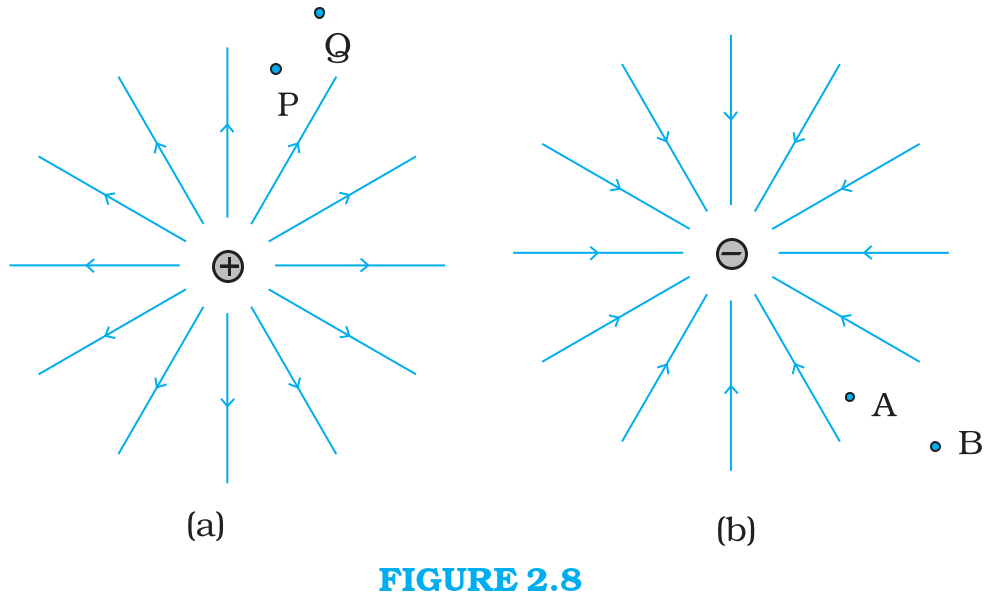
Figures 2.8 (a) and (b) show the field lines of a positive and negative point charge respectively.
Image
(a) Give the signs of the potential difference $V_{ P }-V_{ Q } ; V_{ B }-V_{ A }$.
(b) Give the sign of the potential energy difference of a small negative charge between the points $O$ and $P ; A$ and $B$.
(c) Give the sign of the work done by the field in moving a small positive charge from $Q$ to $P$.
(d) Give the sign of the work done by the external agency in moving a small negative charge from $B$ to $A$.
(e) Does the kinetic energy of a small negative charge increase or decrease in going from $B$ to $A$ ?
Consider a uniform electric field E =
3 × 10³ $\hat{ i }$ N/C.
(a) What is the flux of this field through a square of 10 cm on a side whose plane is parallel to the yz plane?
(b) What is the flux through the same square if the normal to its plane makes of 60° angle with the x-axis?
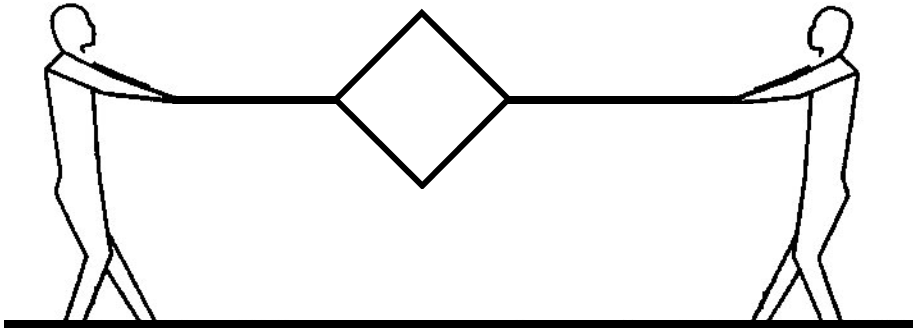
Figure shows a metallic square frame of edge a in a vertical plane. A uniform magnetic field B exists in the space in a direction perpendicular to the plane of the figure. Two boys pull the opposite corners of the square to deform it into a rhombus. They start pulling the corners at t = 0 and displace the corners at a uniform speed u.
  1. Find the induced emf in the frame at the instant when the angles at these corners reduce to 60°.
  2. Find the induced current in the frame at this instant if the total resistance of the frame is R.
  3. Find the total charge which flows through a side of the frame by the time the square is deformed into a straight line.