Question
What is stereochemistry ? Explain plane polarised light, optical activity and optical isomers.

Answer

→ Stereochemistry is the branch of that involves "the study of the different spatial arrangements of atoms in molecules".
→ Plane polarised light (PPL) when ordinary light is passed through a nicol prism a light of single wavelength vibrating in a single plane is obtained this is known as plane polarised light.
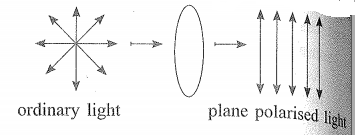
Image
→ Optical activity: "When plane polarised ligh is passed through a solution the light is rotated either in clockwise or in a anticlockwise direction by a certain angle. These types of compounds an known as optical active compound and such property is known as optical activity."
→ The angle by which the plane polarised light is rotated is measured by an instrument called polarimeter.
→ If the compound rotates the plane of plan polarised light to the right, i.e., clockwis direction, it is called dextrorotatory (Greek for right rotating) or the d-form and is indicated by placing a positive (+) sign before the degree of rotation.
→ If the light is rotated towards left (anticlockwis direction), the compound is said to be laevo rotatory or the l-form and a negative (-) sign in placed before the degree of rotation.
→ Such (+) and (-) isomers of a compound an called optical isomers and the phenomenon is termed as optical isomerism.
Need a full question paper?

Generate a complete, print-ready paper with questions like this in minutes — across 16+ boards, with answer keys.

Start Generating Free

Similar questions

Define isomerism and tell its types.
A solution of glucose (Molar mass = 180 g mol–1) in water has a boiling point of 100.20C. Calculate the freezing point of the same solution. Molal constants for water Kf and Kb are 1.86 K kg mol–1 and 0.512 K kg mol–1 respectively.
How does acetone reacts with HCN and NaHSO3?
Calculate the amount of benzoic acid (C6H5COOH) required for preparing 250 mL of 0.15 M solution in methanol.
Calculate emf of the following cell at 25 °C:
Fe|Fe2+(0.001 M)||H+(0.01 M)|H2(g) (1bar)|Pt(s)
Eo(Fe2+| Fe) = –0.44 V Eo(H+|H2) = 0.00 V
What mass of NaCl (molar mass = 58.5 g mol–1) must be dissolved in 65 g of water to lower the freezing point by 7.50oC? The freezing point depression constant, Kf, for water is 1.86 K kg mol–1.  Assume van’t Hoff factor for NaCl is 1.87.
Write a mote on molar conductivity $\left(\wedge_{\text {m }}\right)$ of solution and write down it's formula.
An organic compound gives hydrogen on reacting with sodium metal. It also gives iodofom test and the end product of its oxidation is ethanoic acid. Name the compound and give the equation of these reactions.
Give reasons for the following:
p-nitrochlorobenzene undergoes nucleophilic substitution faster than chlorobenzene. Explain giving the resonating structures as well.