Question
What is the acceleration due to gravity at the bottom of a sea 30km deep taking radius of the earth as 6.3 × 10km?
Answer

$\text{g}'=\text{g}\Big(1-\frac{\text{d}}{\text{R}}\Big)$ $=9.8\Big(1-\frac{30\times1000}{6.3\times(1000)^2}\Big) $ $=9.8\Big(1-\frac{1}{210}\Big)$ $=9.8\Big(\frac{209}{210}\Big)=9.75\text{ms}^{-2}$

Need a full question paper?

Generate a complete, print-ready paper with questions like this in minutes — across 16+ boards, with answer keys.

Start Generating Free

Similar questions

A constant torque is acting on a wheel. If starting from rest, the wheel makes n rotations in t seconds, show that the angular acceleration is given by $\alpha=\frac{4\pi\text{n}}{\text{t}^2}\text{rad}{\text{ s}}^{-2}$
It is a common observation that rain clouds can be at about a kilometre altitude above the ground.
Estimate the time required to flatten the drop.
Why do different planets have different escape velocities?
A ferry boat has internal volume $1m^3$ and weight $50\ kg$.
  1. Neglecting the thickness of the wood, find the fraction of the volume of the boat immersed in water.
  2. If aleak develops in the bottom and water starts coming in, what fraction of the boat's volume will be filled with water before water starts coming in from the sides
At what speed the volume of an object shrinks to half its rest value?
An electric heater supplies heat to system at a rate 100W. If system performs work at a rate of 75 joules/ sec, at what rate is the internal energy increased?
The particle position in one-dimensional motion is
$
x=\left(3+4 t-t^2\right) \text { meter }
$
Draw the displacement velocity diagram for this motion from the time interval $t=0 sec$ to $t=4 sec$.
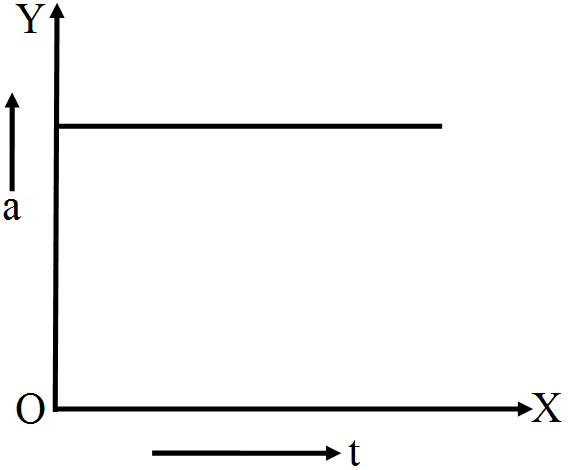
A particle starts from rest, and its acceleration (a) plotted against time (t) is shown here. Plot the corresponding velocity (v) against time (t). Also plot the corresponding displacement (s) against time (t).
A woman throws an object of mass 500g with a speed of $25m s^1$. What is the impulse imparted to the object?
What will be the value of the coefficient and performance of $a$ Carnot refrigerant oprating between $40^{\circ} C$ and $0^{\circ} C$ ?