What is the area of the plates of a $3\,F$ parallel plate capacitor, if the separation between the plates is $5\,mm$
AIIMS 1998, Easy


Download our appand get started for free
Experience the future of education. Simply download our apps or reach out to us for more information. Let's shape the future of learning together!No signup needed.*
Similar Questions
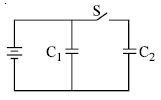
- 1Two capacitors of equal capacitance $(C_1 = C_2)$ are shown in the figure. Initially, while the switch $S$ is open, one of the capacitors is uncharged and the other carries charge $Q_0$. The energy stored in the charged capacitor is $U_0$. Sometimes after the switch is closed, the capacitors $C_1$ and $C_2$ carry charges $Q_1$ and $Q_2$, respectively; the voltages across the capacitors are $ V_1$ and $V_2$; and the energies stored in the capacitors are $U_1$ and $U_2$. Which of the following statements is INCORRECT ?View Solution
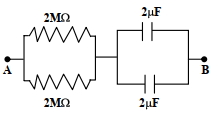
- 2At time $\mathrm{t}=0$, a battery of $10 \mathrm{~V}$ is connected across points $\mathrm{A}$ and $\mathrm{B}$ in the given circuit. If the capacitors have no charge initially, at what time (in seconds) does the voltage across them becomes $4$ volt?View Solution
[take $\ln 5=1.6, \ln 3=1.1]$
- 3A capacitor $C$ is fully charged with voltage $V _{0}$ After disconnecting the voltage source, it is connected in parallel with another uncharged capacitor of capacitance $\frac{ C }{2} .$ The energy loss in the process after the charge is distributed between the two capacitors is$.........$$CV _{0}^{2}$View Solution
- 4A parallel plate capacitor is made of two circular plates separated by a distance $5\ mm$ and with a dielectric of dielectric constant $2.2$ between them. When the electric field in the dielectric is $3 \times 10^4$ $ Vm^{-1}$ the charge density of the positive plate will be close toView Solution
- 5There is a uniformly charged non conducting solid sphere made of material of dielectric constant one. If electric potential at infinity be zero, then the potential at its surface is $V$. If we take electric potential at its surface to be zero, then the potential at the centre will beView Solution
- 6Energy per unit volume for a capacitor having area $A$ and separation $d$ kept at potential difference $V$ is given byView Solution
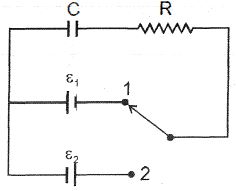
- 7Intially, switch $S$ is connected to position $1$ for a long time shown in figure. The net amount of heat generated in the circuit after it is shifted to position $2$ isView Solution
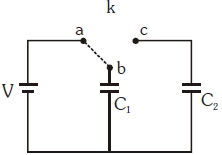
- 8Two Identical capacttors $\mathrm{C}_{1}$ and $\mathrm{C}_{2}$ of equal capacitance are connected as shown in the circult. Terminals $a$ and $b$ of the key $k$ are connected to charge capacitor $\mathrm{C}_{1}$ using battery of $emf \;V\; volt$. Now disconnecting $a$ and $b$ the terminals $b$ and $c$ are connected. Due to this, what will be the percentage loss of energy?.....$\%$View Solution
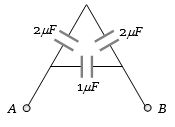
- 9What is the effective capacitance between $A$ and $B$ in the following figure........$\mu \,F$View Solution
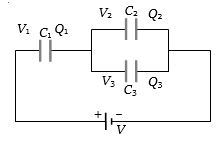
- 10In an adjoining figure are shown three capacitors ${C_1}$,${C_2}$ and ${C_3}$ joined to a battery. The correct condition will be (Symbols have their usual meanings)View Solution