Question
What is the average binding energy per nucleon over a wide range?

Answer

  1. 8MeV
Explanation:
The average binding energy per nucleon is just the total binding energy divided by the number of nucleons. If we consider Na atom, its binding energy is 194MeV. 
Its binding energy per nucleon is given by $\frac{194\text{MeV​}}{24}$
= 8.08MeV

Need a full question paper?

Generate a complete, print-ready paper with questions like this in minutes — across 16+ boards, with answer keys.
Start Generating Free

Similar questions

The energy of a charged capacitor is given by the expression $( q=$ charge on the conductor and $C=$ its capacity$)$
For protecting a sensitive equipment from the external magnetic field, it should be(a) Placed inside an aluminium cane(b) Placed inside an iron cane(c) Wrapped with insulation around it when passing current through it(d) Surrounded with fine copper sheet


Consider sunlight incident on a pinhole of width $10^3\mathring{\text{A}}$. The image of the pinhole seen on a screen shall be:
When air is replaced by a dielectric medium of constant $k,$ the maximum force of attraction between two charges separated by a distance
Which source is associated with a line emission spectrum (a) Electric fire(b) Neon street sign(c) Red traffic light(d) Sun
       
Planck constant has the same dimensions as:
  1. Force × time.
  2. Force × distance.
  3. Force × speed.
  4. Force × distance × time.
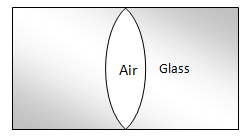
In the figure, an air lens of radii of curvature $10 \ cm (\mathrm{R}_1=\mathrm{R}_2= 10 \ cm)$ is cut in a cylinder of glass $(\mu = 1.5).$ The focal length and the nature of the lens is
In a $npn$ transistor circuit, the collector current is $10\ mA$. If $95$ per cent of the electrons emitted reach the collector, which of the following statements are true?
Two straight long conductors $\text{PAOB}$ and $\text{COD}$ are perpendicular to each other and carry currents
$\mathrm{i}_1$ and $\mathrm{i}_2.$ The magnitude of the magnetic induction at a point $P$ at a distance a from the point $O$ in a direction perpendicular to the plane $\text{ACBD}$ is

 
A uniform wire of resistance $R$ is uniformly compressed along its length, until its radius becomes $n$ times the original radius. Now resistance of the wire becomes