MCQ
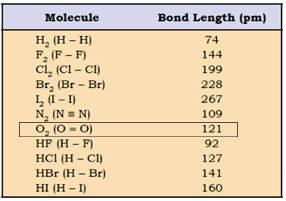
What is the bond lengths in common molecules O2 (O = O) :
  • A
    92
  • B
    109
  • C
    121
  • D
    127

Answer

Need a full question paper?

Generate a complete, print-ready paper with questions like this in minutes — across 16+ boards, with answer keys.

Start Generating Free

Similar questions

There are some deposits of nitrates and phosphates in earth's crust. Nitrates are more soluble in water. Nitrates are difficult to reduce under the laboratory conditions but microbes do it easily. Ammonia forms large number of complexes with transition metal ions. Hybridization easily explains the ease of sigma donation capability of $\mathrm{NH}_3$ and $\mathrm{PH}_3$. Phosphine is a flammable gas and is prepared from white phosphorus.

$1.$   Among the following, the correct statement is

$(A)$ Phosphates have no biological significance in humans

$(B)$ Between nitrates and phosphates, phosphates are less abundant in earth's crust

$(C)$ Between nitrates and phosphates, nitrates are less abundant in earth's crust

$(D)$ Oxidation of nitrates is possible in soil

$2.$   Among the following, the correct statement is

$(A)$ Between $\mathrm{NH}_3$ and $\mathrm{PH}_3, \mathrm{NH}_3$ is better electron donor because the lone pair of electrons occupies spherical ' $\mathrm{s}$ ' orbital and is less directional

$(B)$ Between $\mathrm{NH}_5$ and $\mathrm{PH}_5, \mathrm{PH}_5$ is better electron donor because the lone pair of electrons occupies $\mathrm{sp}^3$ orbital and is more directional

$(C)$ Between $\mathrm{NH}_3$ and $\mathrm{PH}_3, \mathrm{NH}_3$ is a better electron donor because the lone pair of electrons occupies $\mathrm{sp}^3$ orbital and is more directional

$(D)$ Between $\mathrm{NH}_3$ and $\mathrm{PH}_3, \mathrm{PH}_3$ is better electron donor because the lone pair of electrons occupies spherical ' $\mathrm{s}$ ' orbital and is less directional

$3.$  White phosphorus on reaction with $\mathrm{NaOH}$ gives $\mathrm{PH}_3$ as one of the products. This is a

$(A)$ dimerization reaction

$(B)$ disproportionation reaction

$(C)$ condensation reaction

$(D)$ precipitation reaction

Give the answer question $1,2$ and $3.$

The vapour pressure of a solvent decreases by $10 \,mm$ of $Hg$ when a non-volatile solute was added to the solvent. The mole fraction of the solute in the solution is $0.2$. What should be the mole fraction of the solvent if the decrease in the vapour pressure is to be $20\,mm$ of $Hg$ ?
$0.5\,g$ of an organic compound containing phosphorous was heated with conc. $HNO_3$ in the carius tube. The phosphoric acid thus formed was precipitated with magnesia mixture $[MgNH_4PO_4]$ which on ignition gave residue of $1.0\, g$ of magnesium pyrophosphate $(Mg_2P_2O_7)$. The percentage......$\%$ of phosphorous in the organic compound is
The correct order of reactivity of the given chlorides with acetate in acetic acid is:
When $1\,coulomb$ of charge is passed through electrolyte solution, then the mass deposited is equal to
Which one of the following process is non-spontaneous
Given below are the oxides:

$Na _{2} O , As _{2} O _{3}, N _{2} O , NO$ and $Cl _{2} O _{7}$

Number of amphoteric oxides is ..... .
$\mathrm{H}_2 \mathrm{~S}$ ($5$ moles) reacts completely with acidified aqueous potassium permanganate solution. In this reaction, the number of moles of water produced is $x$, and the number of moles of electrons involved is $y$. The value of $(x+y)$ is. . . . . .
Which has maximum enol contents ?
The lanthanide contraction is responsible for the fact that