Question
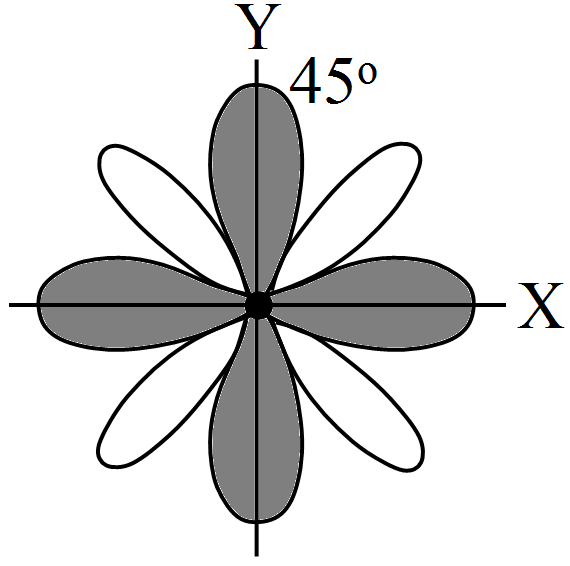
  1. What is the common between $d_{xy}$ and $d_{x^2 - y^2}$​​​​​​​ orbitals?
  2. What is the difference between them?
  3. What is the angle between the lobes of the above two orbitals?
Answer

  1. Both have identical shape, consisting of four lobes.
  2. Lobes of $d_{x^2 - y^2}$ lie along the x and y-axes whereas those of $d_{xy}$ lie between x and y-axes.
  3. 45°

Need a full question paper?

Generate a complete, print-ready paper with questions like this in minutes — across 16+ boards, with answer keys.
Start Generating Free

Similar questions

Arrange the following sets of molecules in the decreasing order of bond angle.
i. $\mathrm{SF}_6, \mathrm{CCl}_4, \mathrm{H}_2 \mathrm{O}, \mathrm{NH}_3$
ii. $\mathrm{CH}_4, \mathrm{NH}_3, \mathrm{H}_2 \mathrm{O}, \mathrm{BF}_3$
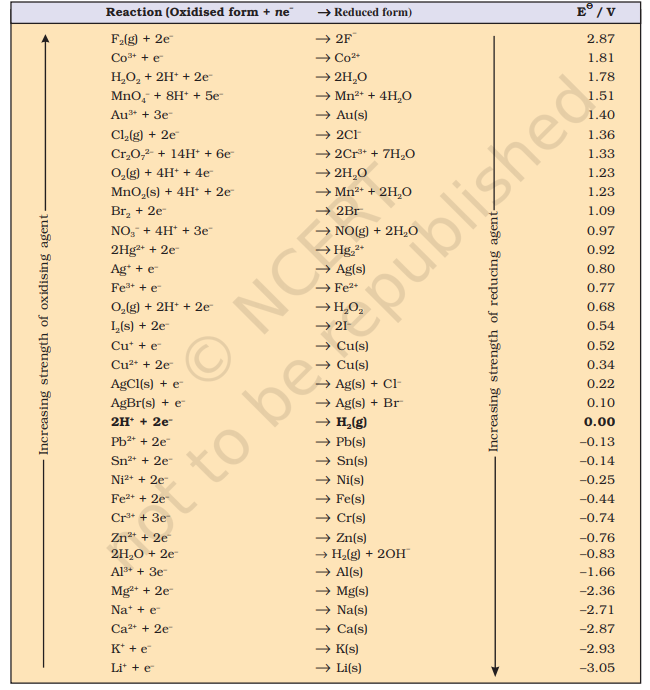
Using the standard electrode potentials given in the Table, predict if the reaction between the following is feasible:

$\mathrm{Br}_2(\mathrm{aq})$ and $\mathrm{Fe}^{2+}(\mathrm{aq})$.
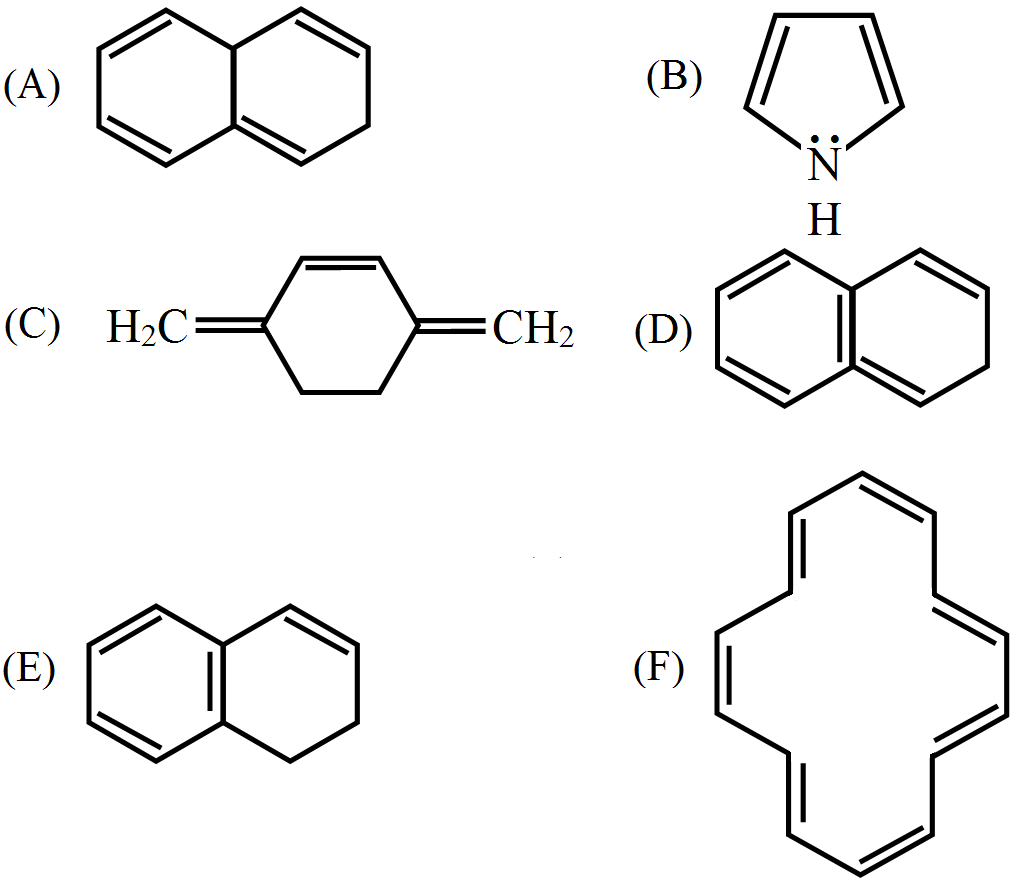
Which of the following compounds are aromatic according to Huckel's rule?
Explain the harmful effects of oxides of sulphur and nitrogen on plants and animals.
Calculate the atomic mass (average) of chlorine using the following data:
 
% Natural Abundance
Molar Mass
${ }^{35} \mathrm{Cl}$
75.77
34.9689
${ }^{35} \mathrm{Cl}$
24.23
36.9659
An organometallic compound on analysis was found to contain, C = 64.4%, H = 5.5% and Fe= 29.9%. Determine its empirical formula (At. mass of Fe = 56u).
Use Lewis symbols to show electron transfer between the following atoms to form cations and anions: K and S.
  1. Show the difference of ortho and para hydrogen by a diagram.
  2. Difference in chemical behaviour of compound of hydrogen with elements of atomic number 17 and 20
A 0.02M solution of pyridinium hydrochloride has pH = 3.44. Calculate the inoisation constant of pyridine.
Following data is given for the reaction: $\text{CaCO}_3\text{(s)}\xrightarrow{ \ \ \ \ \ \ \ \ \ \ \ }\text{CaO(s)}+\text{CO}_2\text{(g)}$
$\Delta_\text{f}\text{H}^\ominus[\text{CaO}\text{(s)}]=-635.1\text{KJ mol}^{-1}$
$\Delta_\text{f}\text{H}^\ominus[\text{CO}_2\text{(g)}]=-393.5\text{KJ mol}^{-1}$
$\Delta_\text{f}\text{H}^\ominus[\text{CaCO}_3\text{(s)}]=-1206.9\text{KJ mol}^{-1}$
Predict the effect of temperature on the equilibrium constant of the above reaction.