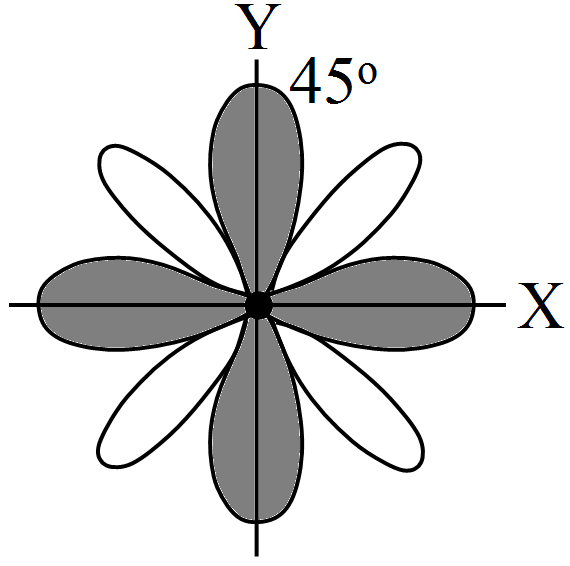
Question
  1. What is the common between dxy and dx2 - y2 orbitals?
  2. What is the difference between them?
  3. What is the angle between the lobes of the above two orbitals?

Need a full question paper?

Generate a complete, print-ready paper with questions like this in minutes — across 16+ boards, with answer keys.

Start Generating Free

Similar questions

Give two similarities and one difference between Boron and Aluminium.
Calculate the total number of electrons present in 1.6g of methane.
  1. Name the group of the elements in which electrons are progressively filled in 4f-orbital and 5f orbitals.
  2. Which of the following is the correct order of size of the given species: I, I+, I-?
  3. Which of the following elements can show covalency greater than 4?

Be, P, S, B

Dinitrogen and dihydrogen react with each other to produce ammonia according to the following chemical equation:
N2(g) + H2(g) → 2NH3(g)
Calculate the mass of ammonia produced if 2.00 × 10³g dinitrogen reacts with 1.00 × 10³g of dihydrogen.
Give reason for the following:
  1. Electron gain enthalpy of fluorine is less negative than that of chlorine.
  2. Anionic radius is always more than that of neutral atom.
  3. Ionization enthalpy of nitrogen is more than that of oxygen.
Use molecular orbital theory to explain why the Be2 molecule does not exist.
Write the anode reaction, the cathode reaction and the net cell reaction in the following cells. Which electrode would be positive terminal in each cell?
  1. $\text{Zn}\text{(s)}|\text{Zn}^{2+}||\text{Br}_2|\text{Br}^-|\text{Pt}\text{(s)}$
  2. $\text{Cr}\text{(s)}|\text{Cr}^{3+}||\text{I}_2|\text{I}^-|\text{Pt}\text{(s)}$
  3. $\text{Pt}\text{(s)}|\text{H}_2\text{(g)}||\text{H}^+\text{(aq)}||\text{Cu}^{2+}|\text{Cu}\text{(s)}$
Explain the following:
  1. Common ion effect.
  2. Bronsted Lowry concepts of acids and bases.
What is the maximum number of emission lines when the excited electron of a H atom in n = 6 drops to the ground state?
Which of the species have similar shape and why?
$\text{NO}^-_2,\text{NO}^+_2,\text{CO}_2,\text{O}$