Questions

3 Marks Question

Take a timed test

77 questions · self-marked practice — reveal the answer and mark yourself.

Question 13 Marks
Calculate the wavelength of an electron moving with a velocity of 2.05 × 10⁷ms–1.
Answer
According to de Broglie’s equation,
$\lambda=\frac{\text{h}}{\text{mv}}$
Where,
$\lambda$ = wavelength of moving particle
m = mass of particle
v = velocity of particle
h = Planck’s constant
Substituting the values in the expression of $\lambda:$
$\lambda=\frac{6.626\times10^{-34}\text{Js}}{(9.10939\times10^{-31}\text{kg})(2.05\times10^7\text{ms}^{-1})}$
$\lambda=3.548\times10^{-11}\text{m}$
Hence, the wavelength of the electron moving with a velocity of 2.05 × 10⁷ms–1 is 3.548 × 10⁻¹¹m.

View full question & answer
Question 23 Marks
The quantum numbers of six electrons are given below. Arrange them in order of increasing energies. If any of these combination(s) has/ have the same energy lists:
  1. $\text{n}=4,\text{l}=2,\text{m}_\text{l}=-2,\text{m}_{\text{s}}=-\frac{1}{2}$
  2. $\text{n}=3,\text{l}=2,\text{m}_\text{l}=1,\text{m}_{\text{s}}=+\frac{1}{2}$
  3. $\text{n}=4,\text{l}=1,\text{m}_\text{l}=0,\text{m}_{\text{s}}=+\frac{1}{2}$
  4. $\text{n}=3,\text{l}=2,\text{m}_\text{l}=-2,\text{m}_{\text{s}}=-\frac{1}{2}$
  5. $\text{n}=3,\text{l}=1,\text{m}_\text{l}=-1,\text{m}_{\text{s}}=+\frac{1}{2}$
  6. $\text{n}=4,\text{l}=1,\text{m}_\text{l}=0,\text{m}_{\text{s}}=+\frac{1}{2}$
Answer
For n = 4 and l = 2, the orbital occupied is 4d.
For n = 3 and l = 2, the orbital occupied is 3d.
For n = 4 and l = 1, the orbital occupied is 4p.
Hence, the six electrons i.e., 1, 2, 3, 4, 5, and 6 are present in the 4d, 3d, 4p, 3d, 3p, and 4p orbitals respectively.
Therefore, the increasing order of energies is 5(3p) < 2(3d) = 4(3d) < 3(4p) = 6(4p) < 1(4d).
View full question & answer
Question 33 Marks
An ion with mass number 56 contains 3 units of positive charge and 30.4% more neutrons than electrons. Assign the symbol to this ion.
Answer
Let the number of electrons in the ion = x
Then, number of neutrons $=\text{x}+\Big(\frac{30.4\text{x}}{100}\Big)=1.304\text{x}$
Number of electrons in the neutral atom = x + 3 (ion possesses 3 units of positive charge)
$\therefore$ Number of protons = x + 3
Mass number = No. of protons + No. of neutrons
$\therefore$ 1.304 x + x + 3 = 56
⇒ 2.304 x = 53
⇒ x = 23
$\therefore$ No. of protons = Atomic no. = x + 3 = 23 + 3 = 26
The symbol of the ion is $\text{ }^{56}_{29}\text{Fe}^{+3}$
View full question & answer
Question 43 Marks
The unpaired electrons in Al and Si are present in 3p orbital. Which electrons will experience more effective nuclear charge from the nucleus?
Answer
Nuclear charge is defined as the net positive charge experienced by an electron in a multi-electron atom.
The higher the atomic number, the higher is the nuclear charge. Silicon has 14 protons while aluminium has 13 protons. Hence, silicon has a larger nuclear charge of (+14) than aluminium, which has a nuclear charge of (+13). Thus, the electrons in the 3p orbital of silicon will experience a more effective nuclear charge than aluminium.
View full question & answer
Question 53 Marks
The mass of an electron is 9.1 × 10⁻³¹kg. If its K.E. is 3.0 × 10⁻²⁵J, calculate its wavelength.
Answer
From de Broglie’s equation,
$\lambda=\frac{\text{h}}{\text{mv}}$
Given,
Kinetic energy (K.E) of the electron = 3.0 × 10⁻²⁵J
Since $\text{K.E}=\frac{1}{2}\text{mv}^2$
$\therefore\text{Velocity (v)}=\sqrt{\frac{2\text{K.E}}{\text{m}}}$
$=\sqrt{\frac{2(3.0\times10^{-25}\text{J})}{9.10939\times10^{-31}\text{kg}}}$
$=\sqrt{6.5866\times10^4}$
$\text{v}=811.579\text{ ms}^{-1}$
Substituting the value in the expression of $\lambda:$
View full question & answer
Question 63 Marks
Dual behaviour of matter proposed by de Broglie led to the discovery of electron microscope often used for the highly magnified images of biological molecules and other type of material. If the velocity of the electron in this microscope is 1.6 × 10⁶ms–1, calculate de Broglie wavelength associated with this electron.
Answer
From de Broglie’s equation,
$\lambda=\frac{\text{h}}{\text{mv}}$
$\lambda=\frac{6.626\times10^{-34}\text{Js}}{(9.10939\times10^{-31}\text{kg})(1.6\times10^6\text{ms}^{-1})}$
$=4.55\times10^{-10}\text{m}$
$\lambda=455\text{pm}$
$\therefore$ De Broglie’s wavelength associated with the electron is 455pm.
View full question & answer
Question 73 Marks
Find energy of each of the photons which,
Have wavelength of 0.50 $\mathring{\text{A}}.$
Answer
Energy (E) of a photon having wavelength $(\lambda)$ is given by the expression,
$\text{E}=\frac{\text{hc}}{\lambda}$
h = Planck’s constant = 6.626 × 10⁻³⁴Js
c = velocity of light in vacuum = 3 × 10⁸m/s
Substituting the values in the given expression of E:
$\text{E}=\frac{(6.626\times10^{-34})(3\times10^8)}{0.50\times10^{-10}}=3.976\times10^{-15}\text{J}$
$\therefore\text{E}=3.98\times10^{-15}\text{J}$
View full question & answer
Question 83 Marks
Electromagnetic radiation of wavelength 242nm is just sufficient to ionise the sodium atom. Calculate the ionisation energy of sodium in kJ mol–1.
Answer
Energy of sodium (E) $=\frac{\text{N}_{\text{A}}\text{hc}}{\lambda}$
$=\frac{(6.023\times10^{23}\text{mol}^{-1})(6.626\times10^{-34}\text{Js})(3\times10^8\text{ms}^{-1})}{242\times10^{-9}\text{m}}$
= 4.947 × 10⁵J mol–1
= 494.7 × 10³J mol–1
= 494kJ mol–1
View full question & answer
Question 93 Marks
Electrons are emitted with zero velocity from a metal surface when it is exposed to radiation of wavelength 6800 $\mathring{\text{A}}.$ Calculate threshold frequency (ν0 ) and work function (W0 ) of the metal.
Answer
Threshold wavelength of radian $(\lambda_0)=6800\mathring{\text{A}}=6800\times10^{-10}\text{m}$
Threshold frequency (v0) of the metal
$=\frac{\text{c}}{\lambda_0}=\frac{3\times10^8\text{ms}^{-1}}{6.8\times10^{-7}\text{m}}=4.41\times10^{14}\text{s}^{-1}$
Thus, the threshold frequency (v0) of the metal is 4.41 × 10¹⁴ s–1.
Hence, work function (W0) of the metal = hν0
= (6.626 × 10⁻³⁴Js)(4.41 × 10¹⁴ s–1)
= 2.922 × 10⁻¹⁹J
View full question & answer
Question 103 Marks
Find energy of each of the photons which
correspond to light of frequency 3 × 10¹⁵Hz.
Answer
Energy (E) of a photon is given by the expression,
E = hv
Where,
h = Planck’s constant = 6.626 × 10⁻³⁴Js
ν = frequency of light = 3 × 10¹⁵Hz
Substituting the values in the given expression of E:
E = (6.626 × 10⁻³⁴) (3 × 10¹⁵)
E = 1.988 × 10⁻¹⁸J
View full question & answer
Question 113 Marks
A certain particle carries 2.5 × 10⁻¹⁶C of static electric charge. Calculate the number of electrons present in it.
Answer
Charge on one electron = 1.6022 × 10⁻¹⁹C
⇒ 1.6022 × 10⁻¹⁹C charge is carried by 1 electron.
$\therefore$ Number of electrons carrying a charge of 2.5 × 10⁻¹⁶C
$=\frac{1}{1.6022\times10^{-19}\text{C}}(2.5\times10^{-16}\text{C})$
$=1.560\times10^{3}\text{C}$
$=1560\text{C}$
View full question & answer
Question 123 Marks
The bromine atom possesses 35 electrons. It contains 6 electrons in 2p orbital, 6 electrons in 3p orbital and 5 electron in 4p orbital. Which of these electron experiences the lowest effective nuclear charge?
Answer
Nuclear charge experienced by an electron (present in a multi-electron atom) is dependant upon the distance between the nucleus and the orbital, in which the electron is present. As the distance increases, the effective nuclear charge also decreases.
Among p-orbitals, 4p orbitals are farthest from the nucleus of bromine atom with (+35) charge. Hence, the electrons in the 4p orbital will experience the lowest effective nuclear charge. These electrons are shielded by electrons present in the 2p and 3p orbitals along with the s-orbitals. Therefore, they will experience the lowest nuclear charge.
View full question & answer
Question 133 Marks
Symbols $\text{ }^{79}_{35}\text{Br}$ and $\text{ }^{79}\text{Br}$ can be written, whereas symbols $\text{ }^{35}_{79}\text{Br}$ and $\text{ }^{35}\text{Br}$ are not acceptable. Answer briefly.
Answer
The general convention of representing an element along with its atomic mass (A) and atomic number (Z) is $\text{ }^{\text{A}}_{\text{Z}}\text{X}.$
Hence, $\text{ }^{79}_{35}\text{Br}$ is acceptable but $\text{ }^{35}_{79}\text{Br}$ is not acceptable.
$\text{ }^{79}\text{Br}$ can be written but $\text{ }^{35}\text{Br}$ cannot be written because the atomic number of an element is constant, but the atomic mass of an element depends upon the relative abundance of its isotopes. Hence, it is necessary to mention the atomic mass of an element.
View full question & answer
Question 143 Marks
Calculate the number of electrons which will together weigh one gram.
Answer
Mass of one electron = 9.10939 × 10⁻³¹kg
$\therefore$ Number of electrons that weigh 9.10939 × 10⁻³¹kg = 1
Number of electrons that will weigh 1g = (1 × 10⁻³kg)
$=\frac{1}{9.10939\times10^{-31}\text{kg}}\times(1\times10^{-3}\text{kg})$
$=0.1098\times10^{-3}+31$
$=0.1098\times10^{28}$
$=1.098\times10^{27}$
View full question & answer
Question 153 Marks
What is the number of photons of light with a wavelength of 4000 pm that provide 1J of energy?
Answer
Energy (E) of a photon = hν
Energy (En) of ‘n’ photons = nhν
$\Rightarrow\text{n}=\frac{\text{E}_{\text{n}}\lambda}{\text{hc}}$
Where,
$\lambda$ = wavelength of light = 4000 pm = 4000 × 10–12m
c = velocity of light in vacuum = 3 × 10⁸m/s
h = Planck’s constant = 6.626 × 10⁻³⁴Js
Substituting the values in the given expression of n:
$\text{n}=\frac{(1)\times(4000\times10^{-12})}{(6.626\times10^{-34})(3\times10^8)}=2.012\times10^{16}$
Hence, the number of photons with a wavelength of 4000 pm and energy of 1J are 2.012 × 10¹⁶.
View full question & answer
Question 163 Marks
Give the number of electrons in the species $\text{H}^+_2,\text{H}_2$ and $\text{O}^+_2$
Answer
$\text{H}^+_2:$
Number of electrons present in hydrogen molecule (H2) = 1 + 1 = 2
$\therefore$ Number of electrons in $\text{H}^+_2 = 2 – 1 = 1$
$\text{H}_2:$
Number of electrons in $\text{H}_2= 1 + 1 = 2$
$\text{O}^+_2:$
Number of electrons present in oxygen molecule (O2) = 8 + 8 = 16
$\therefore$ Number of electrons in $\text{O}^+_2= 16 – 1 = 15$
View full question & answer
Question 173 Marks
If the diameter of a carbon atom is 0.15nm, calculate the number of carbon atoms which can be placed side by side in a straight line across length of scale of length 20cm long.
Answer
1m = 100cm
1cm = 10–2m
Length of the scale = 20cm
= 20 × 10–2m
Diameter of a carbon atom = 0.15nm
= 0.15 × 10⁻⁹m
One carbon atom occupies 0.15 × 10⁻⁹m.
$\therefore$ Number of carbon atoms that can be placed in a straight line
$=\frac{20\times10^{-2}\text{m}}{0.15\times10^{-9}\text{m}}$
$=133.33\times10^7$
$=1.33\times10^9$
View full question & answer
Question 183 Marks
An ion with mass number 37 possesses one unit of negative charge. If the ion conatins 11.1% more neutrons than the electrons, find the symbol of the ion.
Answer
Let the number of electrons in the ion carrying a negative charge be x.
Then,
Number of neutrons present
= x + 11.1% of x
= x + 0.111 x
= 1.111 x
Number of electrons in the neutral atom = (x – 1)
(When an ion carries a negative charge, it carries an extra electron)
$\therefore$ Number of protons in the neutral atom = x – 1
Given,
Mass number of the ion = 37
$\therefore$ (x – 1) + 1.111 x = 37
2.111 x = 38
x = 18
$\therefore$ The symbol of the ion is $\text{ }^{37}_{17}\text{Cl}^-.$
View full question & answer
Question 193 Marks
A 25watt bulb emits monochromatic yellow light of wavelength of 0.57µm. Calculate the rate of emission of quanta per second.
Answer
Energy emitted by the bulb = 25watt = 25Js-1
Energy of one photon (E) $=\text{hv}=\frac{\text{hc}}{\lambda}$
$\lambda=0.57\mu\text{m}=0.57\times10^{-6}\text{m}$
 $\text{E}=\frac{(6.626\times10^{-34}\text{Js}\times3.0\times10^8\text{ms}^{-1})}{0.57\times10^{-6}\text{m}=3.48\times10^{-19}\text{J}}$
$\therefore$ No. of photons emitted per sec $=\frac{25\text{Js}^{-1}}{3.48\times10^{-19}\text{J}=7.18\times10^{19}}$
View full question & answer
Question 203 Marks
Similar to electron diffraction, neutron diffraction microscope is also used for the determination of the structure of molecules. If the wavelength used here is 800pm, calculate the characteristic velocity associated with the neutron.
Answer
From de Broglie’s equation,
$\lambda=\frac{\text{h}}{\text{mv}}$
$\text{v}=\frac{\text{h}}{\text{m}\lambda}$
Where,
v = velocity of particle (neutron)
h = Planck’s constant
m = mass of particle (neutron)
$\lambda$ = wavelength
Substituting the values in the expression of velocity (v),
$\text{v}=\frac{6.626\times10^{-34}\text{Js}}{(1.67493\times10^{-27}\text{kg})(800\times10^{-12}\text{m})}$
$=4.94\times10^2\text{ms}^{-1}$
$\text{v}=494\text{ms}^{-1}$
$\therefore$ Velocity associated with the neutron = 494ms–1
View full question & answer
Question 213 Marks
Calculate the mass and charge of one mole of electrons.
Answer
Mass of one electron = 9.10939 × 10⁻³¹kg
Mass of one mole of electron = (6.022 × 1023) × (9.10939 ×10–31kg)
= 5.48 × 10⁻⁷kg
Charge on one electron = 1.6022 × 10⁻¹⁹ coulomb
Charge on one mole of electron = (1.6022 × 10⁻¹⁹C) (6.022 × 10²³)
= 9.65 × 10⁴C
View full question & answer
Question 223 Marks
Find

  1. The total number and.
  2. The total mass of protons in 34mg of NH3 at STP.

Will the answer change if the temperature and pressure are changed?

Answer
  1. 1 mol of NH= 17g NH= 6.022 × 10²³ molecules of NH

1 atom of NH3 contains = 7 + 3 = 10 protons

$\therefore$ The number of protons in 1 mol of NH= 6.022 × 1024 protons.

Number of protons in 34mg of NH3 $=\frac{(6.022\times10^{24}\times34)}{17\times1000}=1.2044\times10^{22}\text{ protons.}$

  1. Mass of one proton = 1.6726 × 10⁻²⁷kg

$\therefore$ Mass of 1.2044 × 10²² protons = (1.6726 × 10-27) × (1.2044×1022)kg = 2.0145 × 10⁻⁵kg.

No, there will be no effect of temperature and pressure.

View full question & answer
Question 233 Marks
Find:

  1. The total number and.
  2. The total mass of neutrons in 7 mg of 14C.

(Assume that mass of a neutron = 1.675 × 10⁻²⁷kg).

Answer
  1. Number of atoms in 14C in 1 mole = 6.022 × 10²³ atoms

1 atom of 14C contains = 14 - 6 = 8 neutrons.

$\therefore$ The number of neutrons in 14g of 14C = 6.022 × 1023 × 8 neutrons

Number of neutrons in 7mg $=\frac{(6.022\times10^{23}\times8\times7)}{14000}=2.4088\times10^{21}\text{ netrons}$

  1. Mass of one neutron = 1.674 × 10⁻²⁷kg

Mass of total neutrons in 7g of 14C = (2.4088 × 10²¹)(1.675 × 10⁻²⁷kg) = 4.035 × 10⁻⁶kg

View full question & answer
Question 243 Marks
Which atoms are indicated by the following configurations?
  1. [He] 2s1.
  2. [Ne] 3s2 3p3.
  3. [Ar] 4s2 3d1.
Answer
  1. [He] 2s1

The electronic configuration of the element is [He] 2s1 = 1s2 2s1.

$\therefore$ Atomic number of the element = 3

Hence, the element with the electronic configuration [He] 2s1 is lithium (Li).

  1. [Ne] 3s2 3p3

The electronic configuration of the element is [Ne] 3s2 3p= 1s2 2s2 2p6 3s2 3p3.

$\therefore$ Atomic number of the element = 15

Hence, the element with the electronic configuration [Ne] 3s2 3pis phosphorus (P).

  1. [Ar] 4s2 3d1

The electronic configuration of the element is [Ar] 4s2 3d= 1s2 2s2 2p6 3s2 3p6 4s2 3d1.

$\therefore$ Atomic number of the element = 21

Hence, the element with the electronic configuration [Ar] 4s2 3dis scandium (Sc).

View full question & answer
Question 253 Marks
If the velocity of the electron in Bohr’s first orbit is 2.19 × 10⁶ms–1, calculate the de Broglie wavelength associated with it.
Answer
According to de Broglie’s equation,
$\lambda=\frac{\text{h}}{\text{mv}}$
Where,
$\lambda$ = wavelength associated with the electron
h = Planck’s constant
m = mass of electron
v = velocity of electron
Substituting the values in the expression of $\lambda:$
$\lambda=\frac{6.626\times10^{-34}\text{Js}}{(9.10939\times10^{-31}\text{kg})(2.19\times10^6\text{ms}^{-1})}$
$=3.32\times10^{-10}\text{m}=3.32\times10^{-10}\text{m}\times\frac{100}{100}$
$=332\times10^{-12}\text{m}$
$\lambda=332\text{pm}$
$\therefore$ Wavelength associated with the electron = 332pm
View full question & answer
Question 263 Marks
  1. Define principal quantum number(n).
  2. Write the electronic configuration of Cr+ [Atomic number of Cr = 24].
  3. Define Pauli's exclusion principle.
Answer
  1. Principal quantum number tells the principal energy level or shell to which the electron belongs. It gives the information about the distance and the energy of the electron.
  2. Cr+ = 1s2 2s2 2p6 3s2 3p6 3d5
  3. Pauli's exclusion principle states that no two electrons in an atom can have the same set of four quantum numbers.
View full question & answer
Question 273 Marks
Answer
  1. Electromagnetic Waves Theory: Energy is radiated or absorbed continuously.

Planck's Quantum Theory: Energy is radiated or absorbed not continuously but discontinuously in the form of small packets called quantas or photons.

  1. Hund's rule is being violated: Because orbitals having equal energy should be singly filled first and then pairing of electron should take place.
View full question & answer
Question 283 Marks
Threshold frequency, ν0 is the minimum frequency which a photon must possess to eject an electron from a metal. It is different for different metals. When a photon of frequency 1.0 × 10¹⁵s-1 was allowed to hit a metal surface, an electron having 1.988 × 10⁻¹⁹J of kinetic energy was emitted. Calculate the threshold frequency of this metal. Show that an electron will not be emitted if a photon with a wavelength equal to 600 nm hits the metal surface.
Answer
$\text{hv}=\text{h}_0+\text{K.E}.$
$\text{hv}_0=\text{hv}-\text{K.E.}$
$\text{v}_0=\text{v}-\frac{\text{K.E.}}{\text{h}}\ ...(\text{i})$
$\text{v}=1.0\times10^{15}\text{s}^{-1}$
$\text{K.E.}=1.988\times^{-19}\text{J},\text{ h}=6.626\times10^{-34}\text{Js}$
From (i) we have,
$\text{v}_0=1.0\times10^{15}\text{s}^{-1}-\frac{1.988\times10^{-19}\text{J}}{6.626\times10^{-34}\text{Js}}$
$=(1.0\times10^{15}-0.30\times10^{15})\text{s}^{-1}$
$=0.7\times10^{15}\text{s}^{-1}=7\times10^{14}\text{s}^{-1}$
$\lambda=600\text{nm}=600\times10^{-9}\text{m}=6.0\times^{-7}\text{m}$
$\text{v}=\frac{\text{v}}{\lambda}=\frac{3.0\times10^8\text{ms}^{-1}}{6.0\times10^{-1}\text{m}}=5\times10^{14}\text{s}^{-1}$
Thus v < v0, Hence, no electron will be emitted.
View full question & answer
Question 293 Marks
  1. Which orbital is non-directional?
  2. What are the frequency and wavelength of a photon emitted during a transition from n = 5 state to n = 2 state in the hydrogen atom?

(h = 6.626 × 10⁻³⁴Js)

Answer
  1. s-Orbital is spherically symmetrical, i.e. it is non directional.
  2. Transition is from n1 = 5 to n2 = 2 state,

$\Delta\text{E}=2.18\times10^{-18}\text{J}\bigg(\frac{1}{\text{n}^2_1}-\frac{1}{\text{n}^2_2}\bigg)$

$=2.18\times10^{-18}\text{J}\Big(\frac{1}{5 ^2}-\frac{1}{3^2}\Big)$

$=-4.58\times10^{-19}\text{J}$

The negative sign of energy means it is an emission energy.

Frequency $=\frac{\text{Energy}}{\text{Plant's constant}}$

$\Rightarrow\text{v}=\frac{\Delta\text{E}}{\text{h}}=\frac{4.58\times10^{19}\text{J}}{6.626\times10^{-34}\text{Js}}$

$=6.91\times10^{14}\text{Hz}$

Wavelength $=\frac{\text{Velocity}}{\text{Frequency}}$

$\Rightarrow\lambda=\frac{\text{c}}{\text{v}}=\frac{3\times10^8\text{ms}^{-1}}{6.91\times10^{14}\text{Hz}}$

$\lambda=0.434\times10^{-6}\text{m}$

$\lambda=434\times10^{-9}\text{m}=434\text{nm}$ $[\because1\text{nm}=10^{-9}\text{m}]$

View full question & answer
Question 303 Marks
  1. The frequency of the strong yellow line in the spectrum of sodium is 5.09 × 10¹⁴ s-1. Calculate the wavelength of the light in nanometer.
  2. Using s, p, d notations, describes the orbital with the following quantum numbers:
  • n = 3, l = 1, m = 0, (b) n = 1, l = 0
  1. Which quantum number distinguishes the electron in the same orbital? Name the principle involved.
Answer
  1. Given, $\text{n}=5.09\times10^{14}\text{s}^{-1},$

$\text{c}=3\times10^8\text{ms}^{-1},\lambda=\ ?$

Wavelenth, $\lambda=\frac{\text{c}}{\text{v}}=\frac{3\times10^8\text{ms}^{-1}}{5.09\times10^{14}\text{s}^{-1}}$

$=5.89\times10^{-7}\text{m}$

$=5.89\times10^{-7}\times10^9\text{nm}=589\text{nm}$

  1. (a) 3py; (b) 1s
  2. Spin quantum number, Pauli exclusion principle.
View full question & answer
Question 313 Marks
  1. The mass of an electron is 9.1 × 10⁻²⁸g. If its K.E. is 3.0 × 10⁻²⁵J, calculate its wave-length in Angstrom. [h = 6.6 × 10⁻³⁴Js]
  2. What is photoelectric effect?
Answer
  1. $\text{m}=9.1\times10^{-28}\text{g}=9.1\times10^{-31}\text{kg}$

$\text{K.E}=3.0\times10^{-25}\text{J}$

$\frac{1}{2}\text{mv}^2=3.0\times10^{-25}\text{J}$

$\text{K.E}=\frac{1}{2}\text{mv}^2$

$\Rightarrow\text{V}=\sqrt{\frac{2\text{KE}}{\text{m}}}$

$\lambda=\frac{\text{h}}{\text{mV}}=\frac{\text{h}}{\text{m}\times\sqrt{\frac{2\text{K.E}}{\text{m}}}}=\frac{\text{h}}{\sqrt{2\times\text{K.E}\times\text{m}}}$

$\lambda=\frac{\text{h}}{\sqrt{2\text{m}\times\text{K.E}}}=\frac{6.6\times10^{-34}\text{Js}}{\sqrt{2\times9.1\times10^{-31}\times3\times10^{-25}}}$

$\lambda=\frac{6.6\times10^{-34}}{\sqrt{54.6\times10^{-56}}}=\frac{6.6\times10^{-34}}{7.39\times10^{-28}}$

$=8.93\times10^{-7}\text{m}=893\text{nm}=8930\mathring{\text{A}}$

  1. When a beam of light having frequency more than threshold frequency is made to fall on metals like alkali metals, electrons are ejected. These electrons are called photoelectrons and this phenomenon is called photoelectric effect.

View full question & answer
Question 323 Marks
  1. List two main differences between orbit and orbital.
  2. If an electron is moving with a velocity 600m/ s which is accurate upto 0.005%, then calculate the uncertainty in its position.

(h = 6.626 × 10-34Js and mass of election = 9.11 × 10-31kg)

Answer
  1. Differences between orbit and orbitals:
S. No
Orbit
Orbital
1.
Orbit is a well defined2-D circular path around the nucleus in which the electrons revolve.
Orbital is a 3-D space around the nucleus within which the probability of finding the electrons is maximum
2.
Concept of orbit is not in Accor-dance with the wave nature of electrons.
It is in accordance with the wave nature of electrons.
3.
Orbits do not have directional characteristics.
All orbital’s except s-orbital have directional characteristics.
  1. Uncertainty in speed, $\Delta\text{V}=\frac{0.005}{100}\times600\text{m/ s}$

$=0.03\text{ms}^{-1}$

Heisenberg Uncertainty Principle,

$\Delta\text{x} \times\text{m}\Delta\text{V}=\frac{\text{h}}{4\pi},\Delta\text{x}=$ Uncertainty in position,

$\Rightarrow\Delta\text{x}=\frac{6.626\times10^{-34}\text{Js}}{4\times\frac{22}{7}\times9.11\times10^{-31}\text{kg}\times0.03\text{ms}^{-1}}$

$=1.93\times10^{-3}\text{m}$

View full question & answer
Question 333 Marks
  1. What is the shape of orbital with l = 2 and l = 3?
  2. Account for the following:
  • Chromium has configuration 3d5 4s1 and not 3d4 4s2.
  • Bohr's orbits are called stationary orbits or states.
Answer
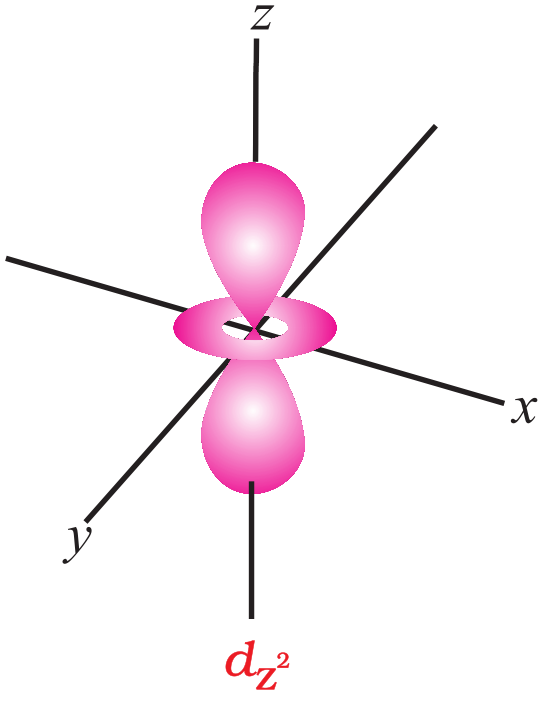
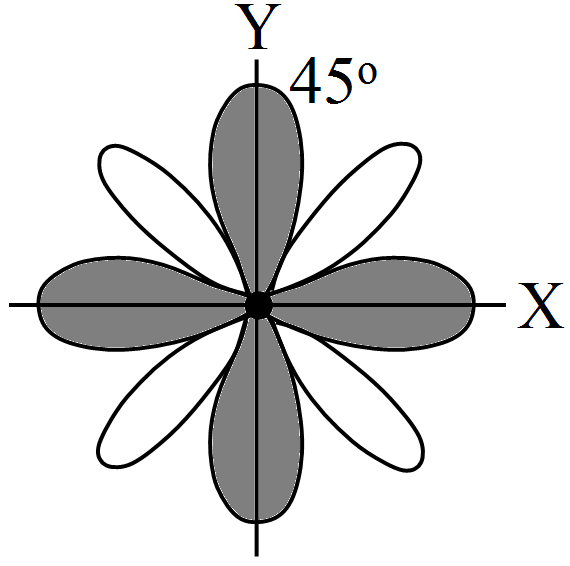
  1. l = 2, i.e. d-orbital has double dumb-bell shape, l = 3. i.e. f-orbital, having 7orbitals: four of them are triple dumb-bells in a hexagonal pattern, two are quadruple dumb-bells and one is a dumb-bell with a double donut.
  2.  
  • It is due to stability of half filled orbitals.
  • It is because electrons do not radiate energy as long as they remain in the same energy level.
View full question & answer
Question 343 Marks
  1. What is de-Broglie wavelength of an electron moving with velocity of light? Mass of electron = 9.1 × 10-31kg, h = 6.626 × 10-34Js.
  2. What is angular momentum of electron in the 5th shell?
Answer
  1. $\text{m}=9.1\times10^{-31}\text{kg},$

$\text{c} =3.0\times10^8\text{ms}^{-1}$

$\lambda=\ ?,\text{h}=6.626\times10^{-34}\text{Js}$ or $\text{Kg}/\ \text{m}^2\text{s}^{-1}$

Applying de Broglie equation:

$\lambda=\frac{\text{h}}{\text{mc}}=\frac{6.626\times10^{-34}\text{kg/ m}^2\text{s}^{-1}}{9.1\times10^{-31}\text{kg}\times3.0\times10^8\text{ms}^{-1}}$

$\lambda=\frac{6.626}{27.3}\times10^{-34+31-8}\text{m}$

$\lambda=\frac{6.626}{27.3}\times10^{-11}=\frac{66.26}{27.3}\times10^{-12}\text{m}$

$\lambda=2.427\times10^{-12}\text{m}$

  1. Angular momentum mvr $=\frac{\text{nh}}{2\pi}$

For 5th energy level, $\text{n}=5$

$\therefore\text{mvr}=\frac{5\text{h}}{2\pi}$

View full question & answer
Question 373 Marks
  1. An orbital has n = 2, what are possible values of I and ml?
  2. List the quantum numbers ml and I of electrons for 3d-orbital?
  3. Which of the following orbitals are possible?

2d, 1s, 2p, 3f

Answer
  1. n = 2, l = 0, m = 0

n = 2, l = 1, m = -1, 0, + 1

  1. l = 2, ml = -2, - 1, 0, + 1, + 2
  2. 1s and 2p orbitals are possible.
View full question & answer
Question 383 Marks
The quantum numbers of six electrons are given below. Arrange them in order of increasing energies. If any of these combination(s) has/ have the same energy lists:
  1. $\text{n}=4,\text{l}=2,\text{m}_\text{l}=-2,\text{m}_{\text{s}}=-\frac{1}{2}$
  2. $\text{n}=3,\text{l}=2,\text{m}_\text{l}=1,\text{m}_{\text{s}}=+\frac{1}{2}$
  3. $\text{n}=4,\text{l}=1,\text{m}_\text{l}=0,\text{m}_{\text{s}}=+\frac{1}{2}$
  4. $\text{n}=3,\text{l}=2,\text{m}_\text{l}=-2,\text{m}_{\text{s}}=-\frac{1}{2}$
  5. $\text{n}=3,\text{l}=1,\text{m}_\text{l}=-1,\text{m}_{\text{s}}=+\frac{1}{2}$
  6. $\text{n}=4,\text{l}=1,\text{m}_\text{l}=0,\text{m}_{\text{s}}=+\frac{1}{2}$
Answer
For n = 4 and l = 2, the orbital occupied is 4d.
For n = 3 and l = 2, the orbital occupied is 3d.
For n = 4 and l = 1, the orbital occupied is 4p.
Hence, the six electrons i.e., 1, 2, 3, 4, 5, and 6 are present in the 4d, 3d, 4p, 3d, 3p, and 4p orbitals respectively.
Therefore, the increasing order of energies is 5(3p) < 2(3d) = 4(3d) < 3(4p) = 6(4p) < 1(4d).
View full question & answer
Question 393 Marks
Calculate the energy and frequency of the radiation emitted when an electron jumps from n = 3 to n = 2 in a hydrogen atom.
Answer
$\bar{\text{v}}=\text{R}_\text{H}\Big[\frac{1}{\text{n}_1^2}-\frac{1}{\text{n}_2^2}\Big]$
$\bar{\text{v}}=109677\text{cm}^{-1}\Big[\frac{1}{2^2}-\frac{1}{3^2}\Big]$
$\Rightarrow\bar{\text{v}}=109677\times\frac{5}{36}=1523.9\text{cm}^{-1}$
$\bar{\text{v}}=\frac{1}{\lambda}\Rightarrow\lambda=\frac{1}{\bar{\text{v}}}=\frac{1}{1523.9}=6564\times10^{-5}\text{cm}$
$\lambda=6564\times10^{-7}\text{m}$
$\text{E}=\frac{\text{hc}}{\lambda}=\frac{6.626\times10^{-34}\times3\times10^8}{6564\times10^{-7}}0$
$=3.028\times10^{-19}\text{J}$
View full question & answer
Question 403 Marks
The electron energy in hydrogen atom is given by $\text{E}_{\text{n}}=\frac{ (–2.18 \times 10–18 )}{\text{n}^2}\text{J}.$ Calculate the energy required to remove an electron completely from the n = 2 orbit. What is the longest wavelength of light in cm that can be used to cause this transition?
Answer
$\text{E}_{\text{n}}=\frac{ (–2.18 \times 10–18 )}{\text{n}^2}\text{J}$
Energy required for ionization from n = 2 is given by,
$\triangle\text{E = E}_{\infty}-\text{E}_2$
$=\Big[\Big(\frac{-2.18\times10^{-18}}{(\infty)^2}\Big)-\Big(\frac{-2.18\times10^{-18}}{(2)^2}\Big)\Big]\text{J}$
$=\Big[\frac{2.18\times10^{-18}}{4}-0\Big]\text{J}$
$=0.545\times10^{-18}\text{J}$
$\triangle\text{E}=5.45\times10^{-19}\text{J}$
$\lambda=\frac{\text{hc}}{\triangle\text{E}}$
Here, $\lambda$ is the longest wavelength causing the transition.
$\lambda=\frac{(6.626\times10^{-34})(3\times10^8)}{5.45\times10^{-19}}=3.647\times10^{-7}\text{m}$
$=3647\times10^{-19}\text{m}$
$=3647\mathring{\text{A}}$
View full question & answer
Question 413 Marks
What is the energy in joules, required to shift the electron of the hydrogen atom from the first Bohr orbit to the fifth Bohr orbit and what is the wavelength of the light emitted when the electron returns to the ground state? The ground state electron energy is –2.18 × 10⁻¹¹ergs.
Answer
1erg = 10-7J
As ground state electronic energy is  –2.18 × 10⁻¹¹ergs, this means that $\text{E}_{\text{n}}\frac{-21.8\times10^{-11}}{\text{n}^2}\text{ergs}.$
$\triangle\text{E = E}_5-\text{E}_1=2.18\times10^{-11}\Big(\frac{1}{1^2}-\frac{1}{5^2}\Big)$
$=2.18\times10^{-11}\Big(\frac{24}{25}\Big)$
$=2.09\times10^{-1}\text{ ergs}$
$=2.09\times10^{-18}\text{J}$
When electron returns to ground state (n = 1), energy emitted = 2.09 × 10⁻¹¹ergs.
As, $\text{E = hv}=\frac{\text{hc}}{\lambda}$
$\Rightarrow\lambda=\frac{\text{hc}}{\text{E}}=\frac{(6.626\times10^{-27}\text{ erg sec})(3.0\times10^{10}\text{cm s}^{-1})}{2.09\times10^{-11}\text{ergs}}$
$=9.51\times10^{-6}\text{cm}$
$=951\times10^{-8}\text{cm}$
$=951\mathring{\text{A}}$
View full question & answer
Question 423 Marks
Yellow light emitted from a sodium lamp has a wavelength $(\lambda)$ of 580 nm. Calculate the frequency (ν) and wavenumber $(\bar{\text{v}})$ of the yellow light.
Answer
From the expression,
$\lambda=\frac{\text{c}}{\text{v}}$
We get,
$\text{v}=\frac{\text{c}}{\lambda} \ ...(1)$
Where,
ν = frequency of yellow light
c = velocity of light in vacuum = 3 × 10⁸m/s
λ = wavelength of yellow light = 580nm = 580 × 10–9m
Substituting the values in expression (i)
$\text{v}=\frac{3\times10^{8}}{580\times10^{-9}}=5.17\times10^{14}\text{ s}^{-1}$
Thus, frequency of yellow light emitted from the sodium lamp
= 5.17 × 10¹⁴ s–1
Wave number of yellow light, $\bar{\text{v}}=\frac{1}{\lambda}$
$=\frac{1}{580\times10^{-9}}=1.72\times10^{6}\text{ m}^{-1}$
View full question & answer
Question 433 Marks
The first shell may contain up to 2 electrons, the second shell up to 8, the third shell up to 18, and the fourth shell up to 32. Explain this arrangement in terms of quantum numbers.
Answer
For the fust shell $\text{n}=1,\text{l}=0,\text{m}_\text{l}=0,\text{m}_\text{s}=+\frac{1}{2}$ and $-\frac{1}{2}.$ It can have 2 electrons both with opposite spins.

  1. For $\text{n}=2,$

$\text{l}=0,\text{m}_\text{l}=0,\text{m}_\text{s}=+\frac{1}{2},-\frac{1}{2},$

$\text{l}=1,\text{m}_\text{l}=1,0+1,\text{m}_\text{s}=+\frac{1}{2},-\frac{1}{2}.$

Therefore, a total of 2 + 6 = 8 electrons are present.

  1. For $\text{n}=3,$ when

$\text{l}=0,\text{m}_\text{l}=0,\text{m}_\text{s}=+\frac{1}{2},-\frac{1}{2}$

$\text{l}=1,\text{m}_\text{l}=-1,0+1,\text{m}_\text{s}=\frac{1}{2},-\frac{1}{2}$

$\text{l}=2,\text{m}_\text{l}=-2,-1,0,+1,+2,,\text{m}_\text{s}$

$=+\frac{1}{2},-\frac{1}{2}$

Therefore, a total of 2 + 6 + 10 = 18 electlons aie present.

  1. For $\text{n}=4,$ when

$\text{l}=0,\text{m}_\text{l}=0,\text{m}_\text{s}=+\frac{1}{2},-\frac{1}{2}$

$\text{l}=1,\text{m}_\text{l}=-1,0+1,\text{m}_\text{s}=+\frac{1}{2},-\frac{1}{2}$

$\text{l}=3,\text{m}_\text{l}=-2,-1,0+1,+2,\text{m}_\text{s}=+\frac{1}{2},-\frac{1}{2}$

$\text{l}=3,\text{m}_\text{l}=-3,-2,-1,0,+1,+2,+3,\text{m}_\text{s}$

$=+\frac{1}{2},-\frac{1}{2}$

Therefore, a total of 2 + 6 + 10 + 14 = 32 electrons are present.

View full question & answer
Question 443 Marks
A bulb emits light of wavelength $4500\mathring{\text{A}}.$ The bulb is rated as 150 watt and 8% energy is emitted as light. How many photons are emitted by the bulb per second?
[h = 6.626 × 10⁻³⁴Js]
Answer
Energy of 1 photon $=\frac{\text{hc}}{\lambda}$
$=\frac{6.626\times10^{-34}\text{Js}\times3\times10^8\text{ms}^{-1}}{4500\times10^{-10}\text{m}}$
$=\frac{19.878}{45\times100}\times10^{-34+8+10}\text{J}$
$=\frac{19.878}{45}\times10^{-16-2}\text{J}=\frac{19.878}{45}\times10^{-18}\text{J}$
$=\frac{198.78}{45}\times10^{-19}\text{J}=4.417\times10^{-19}\text{J}$
Power of bulb = 150 watt = 150Js-1
Energy radiated as light per second,
$=150\text{Js}^{-1}\times\frac{8}{100}=12\text{Js}^{-1}$
Number of photons emitted by bulb per second,
$=\frac{\text{Total energy radiate per second}}{\text{Energy of 1 photon}}$
$=\frac{12\text{Js}^{-1}}{4.417\times10^{-19}\text{J}}=2.716\times10^{19}$ photons per second
View full question & answer
Question 453 Marks
According to de Broglie, matter should exhibit dual behaviour, that is both particle and wave like properties. However, a cricket ball of mass 100g does not move like a wave when it is thrown by a bowler at a speed of 100km/h. Calculate the wavelength of the ball and explain why it does not show wave nature.
Answer
$\lambda=\frac{\text{h}}{\text{mv}}$
$\text{m}=100\text{g}=0.1\text{kg.}$
$\text{v}=100\text{km/hr}=\frac{100\times1000\text{m}}{60\times60\text{s}}=\frac{1000}{36}\text{ms}^{-1}$
$\text{h}=6.626\times10^{-34}\text{Js}$
$\lambda=\frac{6.626\times10^{-34}\text{Js}}{0.1\text{kg}\times\frac{1000}{36}\text{ms}^{-1}}=6.626\times10^{-36}\times36\text{m}^{-1}$
$=238.5\times10^{-36}\text{m}^{-1}$
View full question & answer
Question 463 Marks
What is the energy in joules, required to shift the electron of the hydrogen atom from the first Bohr orbit to the fifth Bohr orbit and what is the wavelength of the light emitted when the electron returns to the ground state? The ground state electron energy is – 2.18 × 10-11 erg.
Answer
$\Delta\text{E}=\text{E}_5-\text{E}_1$
$=2.18\times10^{-11}\Big(\frac{1}{\text{n}^2_\text{i}}-\frac{1}{\text{n}^2_\text{f}}\Big)\text{erg}$ $[\text{n}_\text{i}=1$ and $\text{n}_\text{f}=5]$
$\Delta\text{E}=2.18\times10^{-11}\Big(\frac{1}{1^2}-\frac{1}{5^2}\Big)\text{erg}$
$\Delta\text{E}=2.18\times10^{-11}\times\frac{24}{25}$
$=2.0928\times10^{-11}\text{erg}$
$=2.0928\times10^{-18}\text{J}$ $[\because1\text{erg}=10^{-7}\text{J}]$
When electron retums to ground state, it emits enrrgy equals to $\Delta\text{E}$ hence,
$\Delta\text{E}=\frac{\text{hc}}{\lambda}$
or $\lambda=\frac{\text{hc}}{\Delta\text{E}}=\frac{6.626\times10^{-34}\text{Js}\times3.0\times10^8\text{ms}^{-1}}{2.0928\times10^{-18}\text{J}}$
$=9.498\times10^{-8}\text{m}$
$=949.8\times10^{-10}\text{m}$
$\text{m}=949.8\mathring{\text{A}}$
View full question & answer
Question 473 Marks
The radius of first Bohr orbit of hydrogen atom is $0.529\mathring{\text{A}}.$ Calculate the radii of:
  1. The third orbit of He+ ion,
  2. The second orbit of Li2+ ion.
Answer
Radius of nth Bohr orbit, $\text{r}_\text{n}=\frac{\text{n}^2\text{h}^2}{4\pi^2\text{m}.\text{Ze}^2}$

For hydrogen atom Z = 1, first orbit n = 1

$\text{r}_1=\frac{\text{h}^2}{4\pi^2\text{me}^2}=0.529\mathring{\text{A}}$

  1. For He+ ion, Z = 2, third orbit, n = 3

$\text{r}_3(\text{He}^+)=\frac{3^2\text{h}^2}{4\pi^2\text{m}\times2\times\text{e}^2}$

$=\frac{9}{2}\Big[\frac{\text{h}^2}{4\pi^2\text{me}^2}\Big]=\frac{9}{2}\times0.529=2.380\mathring{\text{A}}$

  1. For Li2+ ion, Z = 3, second orbit, n = 2

$\text{r}_2(\text{Li}^{2+})=\frac{2^2\text{h}^2}{4\pi^2\text{m}\times3\times\text{e}^2}=\frac{4}{3}\Big[\frac{\text{h}^2}{4\pi^2\text{me}^2}\Big]$

$=\frac{4}{3}\times0.529=0.7053\mathring{\text{A}}$

View full question & answer
Question 483 Marks
Calculate the wavelength of tennis ball of mass 60 gram moving with a velocity of 10ms-1. (h = 6.626 × 10⁻³⁴Js)
Answer
According to de Broglie equation,
$\text{m}=60\text{g}=\frac{60}{1000}\text{kg}$
$\text{c}=10\text{ms}^{-1}$
$\text{h}=6.626\times10^{-34}\text{Js}$
$\lambda=\frac{\text{h}}{\text{mc}}$
$\lambda=\frac{6.626\times10^{-34}\text{Js}}{6\times10^{-2}\text{kg}\times10\text{ms}^{-1}}$
$\lambda=\frac{6.626}{6}\times10^{-33}\text{m}$
$\lambda=1.104\times10^{-33}\text{m}$
View full question & answer
Question 493 Marks
Calculate the wavelength of a 1000kg rocket moving with a velocity of 3000km/ hour.
Answer
$\text{m}=1000\text{kg}$
$\text{c}=3000\text{kg/ hour}$
$=\frac{3000\times1000}{60\times60}\text{ms}^{-1}$
Using de Brogloie equation,
$\lambda=\frac{\text{h}}{\text{mc}}=\frac{6.626\times10^{-34}\times60\times60}{1000\text{kg}\times3000\times1000}$
$\lambda=\frac{6.626\times36}{3}\times10^{-34+2-9}$
$\lambda=79.512\times10^{-41}\text{m}$
$=7.9512\times10^{-40}\text{m}$
View full question & answer
Question 503 Marks
Chlorophyll present in green leaves of plants absorbs light at 4.620 × 10¹⁴Hz. Calculate the wavelength of radiation in nanometer. Which part of the electromagnetic spectrum does it belong to?
Answer
Frequency and wavelength are related by the following equation:
$\text{f}=\frac{\text{c}}{\lambda}$ Where f is the frequency = 4.620 x 10¹⁴Hz
c =speed of light = 3 x 10⁸m/s
Therefore, $\lambda=\frac{\text{c}}{\text{f}}$
$=\frac{3\times10^8}{4.620\times10^{14}}$
= 6.49 x 10⁻⁷m = 649nm
It belongs to the visible light of the spectrum.
View full question & answer
Question 513 Marks
How much energy is required to ionise a H atom if the electron occupies n = 5 orbit? Compare your answer with the ionization enthalpy of H atom (energy required to remove the electron from n = 1 orbit).
Answer
$\text{E}_{\text{n}}=\frac{-21.8\times10^{-19}}{\text{n}^2\text{Jatom}^{-1}}$
For ionization from 5th orbit, $\text{n}_{1}=5,\text{n}_2=\infty$
$\therefore\triangle\text{E = E}_2-\text{E}_1=-21.8\times10^{-19}\times\Big(\frac{1}{\text{n}2^2}-\frac{1}{\text{n}1^2}\Big)$
$=21.8\times10^{-19}\times\Big(\frac{1}{\text{n}1^2}-\frac{1}{\text{n}2^2}\Big)$
$=21.8\times10^{-19}\times\Big(\frac{1}{5^2}-\frac{1}{\infty}\Big)$
$=8.72\times10^{-20}\text{J}$
For ionization from 1st orbit, $\text{n}_1=1,\text{n}_2=\infty$
$\therefore\triangle\text{E}'=21.8\times10^{-19}\times\Big(\frac{1}{1^2}-\frac{1}{\infty}\Big)=21.8\times10^{-19}\text{J}$
$\frac{\triangle\text{E}'}{\triangle\text{E}}=\frac{21.8\times10^{-19}}{8.72\times10^{-20}}=25$
Hence, 25 times less energy is required to ionize an electron in the 5th orbital of hydrogen atom as compared to that in the ground state.
View full question & answer
Question 523 Marks
Lifetimes of the molecules in the excited states are often measured by using pulsed radiation source of duration nearly in the nano second range. If the radiation source has the duration of 2 ns and the number of photons emitted during the pulse source is 2.5 × 10¹⁵, calculate the energy of the source.
Answer
Frequency of radiation (ν),
$\text{v}=\frac{1}{2.0\times10^{-9}\text{s}}$
ν = 5.0 × 10⁸s–1
Energy (E) of source = Nhν
Where,
N = number of photons emitted
h = Planck’s constant
ν = frequency of radiation
Substituting the values in the given expression of (E):
E = (2.5 × 10¹⁵)(6.626 × 10⁻³⁴Js)(5.0 × 10⁸s–1)
E = 8.282 × 10⁻¹⁰J
Hence, the energy of the source (E) is 8.282 × 10⁻¹⁰J.
View full question & answer
Question 533 Marks
Out of electron and proton which one will have, a higher velocity to produce matter waves of the same wavelength? Explain it.
Answer
The de-broglie relationship is given by,
$\lambda=\frac{\text{h}}{\text{mv}}$
Where $\lambda$ is wavelength, m is mass and v is velocity.
We can also write the relation as,
$\text{v}=\frac{\text{h}}{\text{m}\lambda}$
So, velocity is inversely proportional to the mass.
Mass of electron = 9.1 × 10⁻³¹kg
mass of proton = 1.6 × 10⁻²⁷kg
Mass of proton is more than mass of electron therefore the velocity of electron is more than that of proton.
View full question & answer
Question 543 Marks
What is the experimental evidence in support of the idea that electronic energies in an atom are quantized?
Answer
The bright line spectrum shows that the energy levels in an atom are quantized. These lines corresponds to definite wavelength sand are obtained as a result of electronic transitions between the energy levels. Hence, the electrons in these levels have quantized values.
View full question & answer
Question 553 Marks
According to de Broglie, matter should exhibit dual behaviour, that is both particle and wave like properties. However, a cricket ball of mass 100g does not move like a wave when it is thrown by a bowler at a speed of 100km/ h. Calculate the wavelength of the ball and explain why it does not show wave nature.
Answer
de Broglie equation,
$\lambda=\frac{\text{h}}{\text{mc}},\text{m}=100\text{g}=\frac{100}{1000}=0.1\text{kg},$
Velocity of cricket ball c,
$=100\text{km/ h}$
$=\frac{100\times1000\text{m}}{60\times60\text{s}}=-\frac{1000}{36}\text{ms}^{-1},$
Planck's constant, $\text{h}=6.626\times10^{-34}\text{Js}$
Wavelength,
$\lambda=\frac{6.626\times10^{-34}\text{Js}}{0.1\text{kg}\times\frac{1000}{36}\text{ms}^{-1}}=6.626\times10^{-36}\times36\text{m}$
$\lambda=2.385\times10^{-34}\text{m}$
Since mass of the ball is large, therefore, $'\lambda'$ is very small, the wave nature cannot be observed.
View full question & answer
Question 563 Marks
Calculate the wavenumber for the longest wavelength transition in the Balmer series of atomic hydrogen.
Answer
For the Balmer series, ni = 2. Thus, the expression of wave number $(\bar{\text{v}})$ is given by,
$\bar{\text{v}}=\bigg[\frac{1}{(2)^2}{}-\frac{1}{\text{n}^{2}_{\text{r}}}\bigg](1.097\times10^7\text{m}^{-1})$
Wave number $(\bar{\text{v}})$ is inversely proportional to wavelength of transition. Hence, for the longest wavelength transition, $\bar{\text{v}}$ has to be the smallest.
For $\bar{\text{v}}$ to be minimum, nf should be minimum. For the Balmer series, a transition from ni = 2 to nf = 3 is allowed. Hence, taking nf = 3, we get:
$\bar{\text{v}}=(1.097\times10^7)\Big[\frac{1}{2^2}-\frac{1}{3^2}\Big]$
$\bar{\text{v}}=(1.097\times10^7)\Big[\frac{1}{4}-\frac{1}{9}\Big]$
$=(1.097\times10^7)\Big(\frac{9-4}{36}\Big)$
$=(1.097\times10^7)\Big(\frac{5}{36}\Big)$
$\bar{\text{v}}=1.5236\times10^6\text{ m}^{-1}$
View full question & answer
Question 573 Marks
What are the frequency and wavelength of a photon during a transition from n = 5 state to n = 2 state in the He+ ion.
Answer
$\text{n}_1=2$
$\text{n}_2=5$
By Rydberg equation
$\frac{1}{\lambda}=\text{R}_{\text{H}}\text{Z}^2\Big[\frac{1}{\text{n}_1{^2}}-\frac{1}{\text{n}_2{^2}}\Big]$ $\text{R}_{\text{H}}=1.09\times10^7\text{m}^{-1}\\ \text{Z}=2$
$=1.09\times10^7\times4\Big[\frac{1}{2^2}-\frac{1}{5^2}\Big]$
$=4.36\times10^7\Big[\frac{25-4}{25\times4}\Big]$
$=4.36\times10^{-5}\times21$
$\lambda=\frac{1}{21\times4.36\times10^{-5}}$
$=0.01\times10^{-5}\text{m}$
$\nu=\frac{\text{c}}{\lambda}=\frac{3\times10^8}{0.01\times10^{-5}}$
$=300\times10^{13}\text{m}^{-1}$
View full question & answer
Question 583 Marks
How many neutrons and protons are there in the following nuclei?
$\text{ }^{13}_{06}\text{C},\text{ }^{16}_{08}\text{O},\text{ }^{24}_{12}\text{Mg},\text{ }^{56}_{26}\text{Fe},\text{ }^{88}_{38}\text{Sr}$
Answer
$\text{ }^{13}_{06}\text{C}:$
Atomic mass = 13
Atomic number = Number of protons = 6
Number of neutrons = (Atomic mass) – (Atomic number)
= 13 – 6 = 7
$\text{ }^{16}_{08}\text{O}:$
Atomic mass = 16
Atomic number = 8
Number of protons = 8
Number of neutrons = (Atomic mass) – (Atomic number)
= 16 – 8 = 8
$\text{ }^{24}_{12}\text{Mg}:$
Atomic mass = 24
Atomic number = Number of protons = 12
Number of neutrons = (Atomic mass) – (Atomic number)
= 24 – 12 = 12
$\text{ }^{56}_{26}\text{Fe}:$
Atomic mass = 56
Atomic number = Number of protons = 26
Number of neutrons = (Atomic mass) – (Atomic number)
= 56 – 26 = 30
$\text{ }^{88}_{38}\text{Sr}:$
Atomic mass = 88
Atomic number = Number of protons = 38
Number of neutrons = (Atomic mass) – (Atomic number)
= 88 – 38 = 50
View full question & answer
Question 593 Marks
Find out the number of wave made by a Bohr electron in one complete revolution in its 3rd orbit.
Answer
In general, number of waves in any orbit is,
Number of wayes $=\frac{\text{Circumference of orbit}}{\text{Wavelength}}=\frac{2\pi\text{r}}{\lambda}$
But $\lambda=\frac{\text{h}}{\text{mc}}$
Number of waves $=\frac{2\pi\text{r}}{\frac{\text{h}}{\text{mv}}}=\frac{2\pi\text{r}.\text{mv}}{\text{h}}=\frac{2\pi(\text{mvr})}{\text{h}}$
The angular momentum of Bohr's 3rd orbit is,
$\text{mvr}=\frac{3\text{h}}{2\pi}$
$\therefore$ Number of wayes $=\frac{2\pi}{\text{h}}\times\frac{3\text{h}}{2\pi}=3$
Number of waves in Bohr,s 3rd orbit = 3.
View full question & answer
Question 603 Marks
Table-tennis ball has a mass 10g and a speed of 90m/s. If speed can be measured within an accuracy of 4% what will be the uncertainty in speed and position?
Answer
Uncertainty in the speed of ball
$=\frac{90\times4}{100}=\frac{360}{100}=3.6\text{ms}^{-1}$
Uncertainty in position $=\frac{\text{h}}{4\pi\text{m}\Delta\text{v}}$
$=\frac{6.626\times10^{-34}\text{Js}}{4\times3.14\times10\times10^{-3}\text{kg g}^{-1}\times3.6\text{ms}^{-1}}$
$=1.46\times10^{-33}\text{m}$
View full question & answer
Question 613 Marks
Hydrogen atom has only one electron, so mutual repulsion between electrons is absent. However, in multielectron atoms mutual repulsion between the electrons is significant. How does this affect the energy of an electron in the orbitals of the same principal quantum number in multielectron atoms?
Answer
The energy of an electron in a hydrogen atom is determined solely by the principal quantum number. Thus, the energy of the orbitals increases as follows:
1s < 2s = 2p < 3s = 3p = 3d < 4s = 4p = 4d = 4f < (2.23),
The energy of an electron in a multielectron atom, that of the hydrogen atom, depends not only on its principal quantum number (shell), but also on its azimuthal quantum number (subshell). That is, for a given principal quantum number, s, p, d, f .... all have different energies.
View full question & answer
Question 623 Marks
Write down the quantum numbers n, and I for the following orbitals.
  1. 3dx2 - y2
  2. 4dz2
  3. 3dxy
  4. 4dxz
  5. 2pz
  6. 3px
Answer
  1. n = 3, l = 2,
  2. n = 4, l = 2
  3. n = 3, l = 2
  4. n = 4, l = 2,
  5. n = 2, l = 1,
  6. n = 3, l = 1.
View full question & answer
Question 633 Marks
What is the difference between the terms orbit and orbital?
Answer
 
Orbit
 
Orbital
i.
An orbit is a well-defined circular path around the nucleus in which the electrons revolve.
i.
An orbital is the three-dimensional space around the nucleus within which the probability of finding an electron is maximum (upto 90%)
ii.
It represents the planar motion of an electron around the nucleus.
ii.
It represents the three dimensional motion of an electron around the nucleus.
iii.
All orbits are circular and disc like.
iii.
Different orbitals have different shapes, i.e. s-irbitals are spherically symmetrical, p-orbitals are dumb-bell shaped and so on.
View full question & answer
Question 643 Marks
The arrangement of orbitals on the basis of energy is based upon their (n + l) value. Lower the value of (n + l), lower is the energy. For orbitals having same values of (n + l), the orbital with lower value of n will have lower energy.

  1. Based upon the above information, arrange the following orbitals in the increasing order of energy.
  1. 1s, 2s, 3s, 2p
  2. 4s, 3s, 3p, 4d
  3. 5p, 4d, 5d, 4f, 6s
  4. 5f, 6d, 7s, 7p
  1. Based upon the above information, solve the questions given below:
  1. Which of the following orbitals has the lowest energy?

4d, 4f, 5s, 5p

  1. Which of the following orbitals has the highest energy?

5p, 5d, 5f, 6s, 6p

Answer
  1.  
  1. (n + l) values are 1s = 1 + 0 = 1, 2s = 2 + 0 = 2, 3s = 3 + 0 = 3, 2p = 2 + 1 = 3

Hence, increasing order of their energy is 1s < 2s < 2p < 3s.

  1. 4s = 4 + 0 = 4, 3s = 3 + 0 = 3, 3p = 3 + 1 = 4, 4d = 4 + 2 = 6.

Hence, 3s < 3p < 4s < 4d.

  1. 5p = 5 + 1 = 6, 4d = 4 + 2 = 6, 5d = 5 + 2 = 7, 4f = 4 + 3 = 7, 6s = 6 + 0 = 6.

Hence, 4d < 5p < 6s < 4f < 5d.

  1. 5f = 5 + 3 = 8, 6d = 6 + 2 = 8, 7s = 7 + 0 = 7, 7p = 7 + 1 = 8.

Hence, 7s < 5f < 6d < 7p.

  1.  
  1. 4d = 4 + 2 = 6, 4f = 4 + 3 = 7, 5s = 5 + 0 = 5, 7p = 7 + 1 = 8.

Hence, 5s has the lowest energy.

  1. 5p = 5 + 1 = 6, 5d = 5 + 2 = 7, 5f = 5 + 3 = 8, 6s = 6 + 0 = 6, 6p = 6 + 1 = 7.

Hence, 5f has the highest energy.

View full question & answer
Question 653 Marks
Which of the following sets of orbitals are degenerate and why?
  1. 1s, 2s and 3s in Mg-atom.
  2. 2px, 2py and 2pz in C-atom.
  3. 3s, 3px and 3d-orbitals in H-atom.
Answer
  1. 1s, 2s and 3s-orbitals in Mg-atom are not degenerate because these have different values of n.
  2. 2px, 2py and 2pz-orbitals in C-atom are degenerate because these belong to same subshell.
  3. 3s, 3px and 3d-orbitals in H-atom are degenerate because for H-atom, the subshells having same value of n have same energies.
View full question & answer
Question 663 Marks
Correct the following electronic configuration of the elements in the ground state.
  1. $1\text{s}^2\ 2\text{s}^1,2\text{p}^2_\text{x},2\text{p}^2_\text{y},2\text{p}^2_\text{z},3\text{s}62,2\text{p}^1_\text{x}$
  2. $1\text{s}^2\ 2\text{s}^1,2\text{p}^1_\text{x},2\text{p}^1_\text{y},2\text{p}^1_\text{z}$
  3. $1\text{s}^2\ 2\text{s}^1,2\text{p}^6,3\text{s}^2,3\text{p}^6,3\text{d}^5$
  4. $1\text{s}^2\ 2\text{s}^2,2\text{p}^6,3\text{p}^6,3\text{d}^4,4\text{s}^2$
Answer
  1. $1\text{s}^2\ 2\text{s}^2,2\text{p}^2_\text{x},2\text{p}^2_\text{y},2\text{p}^2_\text{z},3\text{s}^2$

  2. $1\text{s}^2\ 2\text{s}^2,2\text{p}^1_\text{x},2\text{p}^1_\text{y},2\text{p}^1_\text{y},2\text{p}^1_\text{z}$

  3. $1\text{s}^2\ 2\text{s}^2,2\text{p}^6,3\text{s}^2,3 \text{p}^6,4\text{s}^2,3\text{d}^2$

  4. $1\text{s}^2\ 2\text{s}^2,2\text{p}^6,3\text{s} ^2,3\text{p}^6,3\text{d}^5,4\text{s}^1$

View full question & answer
Question 673 Marks
Which of the following are isoelectronic species i.e., those having the same number of electrons?
$\text{Na}^+,\text{K}^+,\text{Mg}^{2+},\text{Ca}^{2+},\text{S}^{2-},\text{Ar}.$
Answer
Notes:

Isoelectronic are the species having same number of electrons.

A positive charge means the shortage of an electron.

A negative charge means gain of electron.

Number of electrons in Na+ = 11 - 1 = 10

Number of electrons in K+ = 19 - 1 = 18

Number of electrons in Mg2+ = 12 - 2 = 10

Number of electrons in Ca2+ = 20 - 2 = 18

Number of electrons in S2- = 16 + 2 = 18

Number of electrons in Ar = 18

Hence, the following are isoelectronic species:

  1. Na+ and Mg2+ (10 electrons each)
  2. K+, Ca2+, S2- and Ar (18 electrons each)

$\lambda=\frac{6.626\times10^{-34}\text{Js}}{(9.10939\times10^{-31}\text{kg})(811.579\text{ ms}^{-1})}$

$\lambda=8.9625\times10^{-7}\text{m}$

Hence, the wavelength of the electron is 8.9625 × 10⁻⁷m.

View full question & answer
Question 683 Marks
What transition in the hydrogen spectrum would have the same wavelength as the Balmer transition n = 4 to n = 2 of He+ spectrum?
Answer
For Heion, the wave number $(\bar{\text{v}})$ associated with the Balmer transition, n = 4 to n = 2 is given by:

$\bar{\text{v}}=\frac{1}{\lambda}=\text{RZ}^2\Big(\frac{1}{\text{n}^2_1}-\frac{1}{\text{n}^2_2}\Big)$

Where,

n1 = 2

n2 = 4

Z = atomic number of helium

$\bar{\text{v}}=\frac{1}{\lambda}=\text{R}(2)^2\Big(\frac{1}{4}-\frac{1}{16}\Big)$

$=4\text{R}\Big(\frac{4-1}{16}\Big)$

$\bar{\text{v}}=\frac{1}{\lambda}=\frac{3\text{R}}{4}$

$\Rightarrow\lambda=\frac{4}{3\text{R}}$

According to the question, the desired transition for hydrogen will have the same wavelength as that of He+.

$\Rightarrow\text{R}(1)^2\bigg[\frac{1}{\text{n}^2_1}-\frac{1}{\text{n}_2^2}\bigg]=\frac{3\text{R}}{4}$

$\bigg[\frac{1}{\text{n}_1^2}-\frac{1}{\text{n}^2_2}\bigg]=\frac{3}{4}...(1)$

By hit and trail method, the equality given by equation (1) is true only when

n1 = 1and n2 = 2.

$\therefore$ The transition for n2 = 2 to n = 1 in hydrogen spectrum would have the same wavelength as Balmer transition n = 4 to n = 2 of He+ spectrum.

View full question & answer
Question 693 Marks
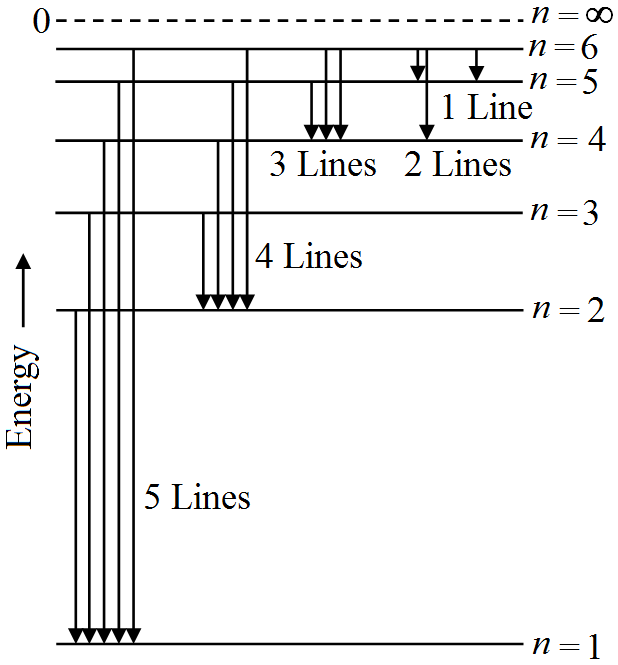
What is the maximum number of emission lines when the excited electron of a H atom in n = 6 drops to the ground state?
View full question & answer
Question 703 Marks
Write the electronic configurations of the following ions:
  1. H
  2. Na+
  3. O2–
  4. F
Answer
  1. H ion

The electronic configuration of H atom is 1s1.

A negative charge on the species indicates the gain of an electron by it.

$\therefore$ Electronic configuration of H = 1s2

  1. Naion

The electronic configuration of Na atom is 1s2 2s2 2p6 3s1.

A positive charge on the species indicates the loss of an electron by it.

$\therefore$ Electronic configuration of Na+ = 1s2 2s2 2p6 3s0 or 1s2 2s2 2p6

  1. O2– ion

The electronic configuration of 0 atom is 1s2 2s2 2p4.

A dinegative charge on the species indicates that two electrons are gained by it.

$\therefore$ Electronic configuration of O2– ion = 1s2 2s2 p6

  1. F ion

The electronic configuration of F atom is 1s2 2s2 2p5.

A negative charge on the species indicates the gain of an electron by it.

$\therefore$ Electron configuration of F ion = 1s2 2s2 2p6

View full question & answer
Question 713 Marks
The diameter of zinc atom is 2.6 $\mathring{\text{A}}$.Calculate,
  1. Radius of zinc atom in pm
  2. Number of atoms present in a length of 1.6cm if the zinc atoms are arranged side by side lengthwise.
Answer
  1. $\text{Radius of zinc atom }=\frac{\text{Diameter}}{2}$

$=\frac{2.6\mathring{\text{A}}}{2}$

$=1.3\times10^{-10}\text{m}$

$=130\times10^{-12}\text{m}=130\text{pm}$

  1. Length of the arrangement = 1.6cm

= 1.6 × 10⁻²m

Diameter of zinc atom = 2.6 × 10⁻¹⁰m

$\therefore$ Number of zinc atoms present in the arrangement

$=\frac{1.6\times10^{-2}\text{m}}{2.6\times10^{-10}\text{m}}$

$=0.6153\times10^8\text{m}$

$=6.153\times10^7$

View full question & answer
Question 723 Marks
Calculate the energy required for the process,
$\text{He}^+(\text{g})\rightarrow\text{He}^{2+}\text{(g)}+\text{e}^-$
The ionization energy for the H atom in the ground state is 2.18 × 10⁻¹⁸J atom–1
Answer
Energy associated with hydrogen-like species is given by,
$\text{E}_{\text{n}}=-2.18\times10^{-18}\Big(\frac{\text{Z}^2}{\text{n}^2}\Big)\text{J}$
For ground state of hydrogen atom,
$\triangle\text{E = E}_{\infty}-\text{E}_1$
$=0-\bigg[-2.18\times10^{-18}\bigg\{\frac{(1)^2}{(1)^2}\bigg\}\bigg]\text{J}$
$\triangle\text{E}=2.18\times10^{-18}\text{J}$
For the given process,
$\text{He}^+(\text{g})\rightarrow\text{He}^{2+}\text{(g)}+\text{e}^-$
An electron is removed from $\text{n}=1\text{ to}\text{ n}=\infty.$
$\triangle\text{E = E}_{\infty}-\text{E}_1$
$=0-\bigg[-2.18\times10^{-18}\bigg\{\frac{(2)^2}{(1)^2}\bigg\}\bigg]$
$\triangle\text{E}=8.27\times10^{-18}\text{J}$
$\therefore$ The energy required for the process $8.27\times10^{-18}\text{J}.$
View full question & answer
Question 733 Marks
Show that the circumference of the Bohr orbit for the hydrogen atom is an integral multiple of the de Broglie wavelength associated with the electron revolving around the orbit.
Answer
Since a hydrogen atom has only one electron, according to Bohr’s postulate, the angular momentum of that electron is given by:
$\text{mvr}=\text{n}\frac{\text{h}}{2\pi}...(1)$
Where,
n = 1, 2, 3, …
According to de Broglie’s equation:
$\lambda=\frac{\text{h}}{\text{mv}}$
or $\text{mv}=\frac{\text{h}}{\lambda}...(2)$
Substituting the value of ‘mv’ from expression (2) in expression (1):
$\frac{\text{hr}}{\lambda}=\text{n}\frac{\text{h}}{2\pi}$
or $2\pi\text{r}=\text{n}\lambda...(3)$
Since $'2\pi\text{r}'$ represents the circumference of the Bohr orbit (r), it is proved by equation (3) that the circumference of the Bohr orbit of the hydrogen atom is an integral multiple of de Broglie’s wavelength associated with the electron revolving around the orbit.
View full question & answer
Question 743 Marks
Calculate the wavelength of the spectral line obtained in the spectrum of Li2+ ion when the transition takes place between two levels whose sum is 4 and the difference is 2.
Answer
Suppose the transition takes place between levels n1 and n2
Then, n + n2 = 4 and n2 – n1 = 2
By solving these equations, we get n1 = 1, n2 = 3,
$\therefore\frac{1}{\lambda}=\text{R}\Big(\frac{1}{\text{n}^2_1}-\frac{1}{\text{n}^2_2}\Big)\text{Z}^2$
For Li2+, Z = 3
$\therefore\frac{1}{\lambda}=109677\text{cm}^{-1}\Big(\frac{1}{1^2}-\frac{1}{3^2}\Big)\times3^2$
$=109677\times\Big(\frac{1}{1}-\frac{1}{9}\Big)\times9\text{cm}^{-1}$
$=109677\times8\text{cm}^{-1}$
or $\lambda=\frac{1}{109677\times8\text{cm}^{-1}}$
$=1.14\times10^{-6}\text{cm}$
View full question & answer
Question 753 Marks
When electromagnetic radiation of wavelength 300nm falls on the surface of sodium, electrons are emitted with a kinetic energy of 1.68 ×10⁵J mol-1. What is the minimum energy needed to remove an electron from sodium? What is the maximum wavelength that will cause a photo-electron to be emitted?
(h = 6.626 × 10⁻³⁴Js)
Answer
The energy (E) of a 300nm photon is given by Planck's quantum theory.
$\text{E}=\text{hv}=\frac{6.626\times10^{34}\text{Js}\times3.010^8\text{ms}^{-1}}{300\times10^{-9}\text{m}}$
$\text{E}=6.626\times10^{-19}\text{J}$
The energy of 1 mole of photons,
$=6.626\times10^{-19}\text{J}\times6.022\times10^{23}\text{mol}^{-1}$
$=3.99\times10^5\text{J/ mol}^{-1}$
Energy of incident light = Threshold energy + kinetic energy,
$\therefore$ Threshold energy = Energy of incident light - kinetic energy,
$=(3.99\times10^5-1.68\times10^5)\text{J/ mol}^{-1}$
$=2.31\times10^5\text{J/ mol}^{-1}$
Threshold energy is the minimum energy needed to remove a mole of electrons from sodium,
$=(3.99-168)10^5\text{J/ mol}^{-1}$
$=2.31\times10^5\text{J/ mol}^{-1}$
The minimum energy for one electron,
$=\frac{2.31\times10^5\text{J/ mol}^{-1}}{6.022\times10^{23}\text{electrons mol}^{-1}}$
$=\frac{\text{Energy per mol}^{-1}}{\text{Avogadro's number}}$
$=3.84\times10^{-19}\text{J/ electron}$
This corresponds to the wavelength calculated as follows:
$\lambda=\frac{\text{hc}}{\text{E}}=\frac{6.626\times10^{-34}\text{Js}\times3.0\times10^8\text{ms}^{-1}}{3.84\times10^{-19}\text{J}}$
$=5.17\times10^{-7}\text{m}$
$\lambda=5.17\times10^{-7}\times10^9\text{nm}$
$\Rightarrow\lambda=517\text{nm}$
(This corresponds to green light).
View full question & answer
Question 763 Marks
Calculate the uncertainty in the position of a dust particle with mass equal to 1mg if the uncertainty in velocity is 5.5 × 10⁻²⁰ms-1. (h = 6.626 × 10⁻³⁴Js)
Answer
$\Delta\text{v}=$ uncertainty in position = ?
$\Delta\text{v}=$ Uncertainty in velocity = 5.5 × 10⁻²⁰ms-1
$\text{m}=1\text{mg}=10^{-6}\text{kg}$ $[\because1\text{ms}=10^{-6}\text{kg}]$
Applying Heisenberg's uncertainity principle,
$\Delta\text{x},\Delta\text{v}=\frac{\text{h}}{4\text{m}\pi}$
Uncretainity in position, $\Delta\text{x}=\frac{ \text{h}}{4\text{m}\pi\times\Delta\text{v}}$
$=\frac{6.626106^{-34}\text{Js}}{4\times10^{-6}\text{kg}\times3.14\times5.5\times10^{-20}\text{ms}^{-1}}\text{m}$
$\Delta\text{x}=\frac{6.626}{69.08}\times10^{-8}\text{m}$
$\Delta\text{x}=\frac{66.26}{69.08}\times10^{-9}\text{m}=0.959\times10^{-9} \ \text{m}$
$\Delta\text{r}=9.59\times10^{-10}\text{m}$
View full question & answer
Question 773 Marks
An element with mass number 81 contains 31.7% more neutrons as compared to protons. Assign the atomic symbol.
Answer
Let the number of protons in the element be x.
$\therefore$ Number of neutrons in the element
= x + 31.7% of x
= x + 0.317 x
= 1.317 x
According to the question,
Mass number of the element = 81
$\therefore$ (Number of protons + number of neutrons) = 81
$\Rightarrow\text{x}+1.317\text{x}=81$
$2.317\text{x}=81$
$\text{x}=\frac{81}{2.317}$
$=34 .95$
$\therefore\text{x}=35$
Hence, the number of protons in the element i.e., x is 35.
Since the atomic number of an atom is defined as the number of protons present in its nucleus, the atomic number of the given element is 35.
$\therefore$ The atomic symbol of the element is $\text{ }^{81}_{35}\text{Br}.$
View full question & answer