Question
What is the difference between cathode rays and beta rays? When the two are travelling in space, can you make out which is the cathode ray and which is the beta ray?

Answer

Cathode rays consist of electrons that are accelerated using electrodes. They do not carry high energy and do not harm human body. On the other hand, beta rays consist of highly energetic electrons that can even penetrate and damage human cells. Beta rays are produced by the decay of radioactive nuclei. If the two are travelling in space, they can be distinguished by the phenomenon named production of Bremsstrahlung radiation, which is produced by the deceleration of a high energy particle when deflected by another charged particle, leading to the emission of blue light. Only beta rays are capable of producing it.
Need a full question paper?

Generate a complete, print-ready paper with questions like this in minutes — across 16+ boards, with answer keys.

Start Generating Free

Similar questions

A particle A having a charge of 2.0 × 10-6C is held fixed on a horizontal table. A second charged particle of mass 80g stays in equilibrium on the table at a distance of 10cm from the first charge. The coefficient of friction between the table and this second particle is $\mu=0.2.$ Find the range within which the charge of this second particle may lie.
A suitcase kept on a shop's rack is measured 50cm × 25cm × 10cm by the shop's owner. A traveller takes this suitcase in a train moving with velocity 0.6c.
If the suitcase is placed with its length along the train's velocity, find the dimensions measured by:
  1. The traveller and.
  2. A ground observer.
A particle with a charge of 5.0 µC and a mass of 5.0 × 10⁻¹²kg is projected with a speed of 1.0km s-1 in a magnetic field of magnitude 5.0mT. The angle between the magnetic field and the velocity is sin-1 (0.90). Show that the path of the particle will be a helix. Find the diameter of the helix and its pitch.
The terminology of different parts of the electromagnetic spectrum is given in the text. Use the formula E = hν (for energy of a quantum of radiation: photon) and obtain the photon energy in units of eV for different parts of the electromagnetic spectrum. In what way are the different scales of photon energies that you obtain related to the sources of electromagnetic radiation?
  1. Draw the circuit diagram of a fullwave rectifier using p-n junction diode. Explain its working and show the output, input waveforms.
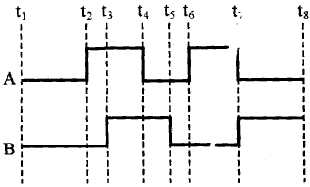
  2. Show the output waveforms (Y) for the following inputs A and B of
    1. OR gate.
    2. NAND gate.

Answer the following question:
Long distance radio broadcasts use short-wave bands. Why?
Two identical balls, each having a charge of 2.00 × 10-7C and a mass of 100g, are suspended from a common point by two insulating strings each 50cm long. The balls are held at a separation 5.0cm apart and then released. Find,
  1. The electric force on one of the charged balls.
  2. The components of the resultant force on it along and perpendicular to the string.
  3. The tension in the string.
  4. The acceleration of one of the balls. Answers are to be obtained only for the instant just after the release.
Consider the following very rough model of a beryllium atom. The nucleus has four protons and four neutrons confined to a small volume of radius 10-15m. The two 1s electrons make a spherical charge cloud at an average distance of 1.3 × 10⁻¹¹m from the nucleus, whereas the two 2s electrons make another spherical cloud at an average distance of 5.2 × 10⁻¹¹m from the nucleus. Find the electric field at:
  1. A point just inside the 1s cloud.
  2. A point just inside the 2s cloud.
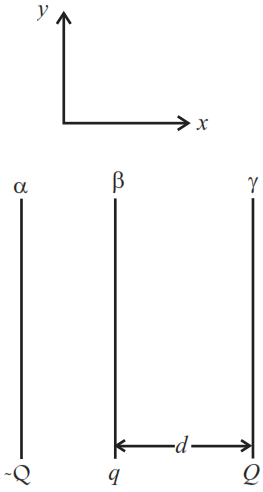
Two fixed, identical conducting plates $(\alpha\ \&\ \beta)$, each of surface area S are charged to -Q and q, respectively, where Q > q > 0. A third identical plate $(\gamma)$, free to move is located on the other side of the plate with charge q at a distance d (Fig.). The third plate is released and collides with the plate $\beta$. Assume the collision is elastic and the time of collision is sufficient to redistribute charge amongst $\beta\ \&\ \gamma$.

Find the velocity of the plate $\gamma$ after the collision and at a distance d from the plate $\beta$.
What will be the energy corresponding to the first excited state of a hydrogen atom if the potential energy of the atom is taken to be 10eV when the electron is widely separated from the proton? Can we still write $\text{E}_\text{n}=\frac{\text{E}_1}{\text{n}^2}?\text{ r}_\text{n}=\text{a}_0\text{n}^2?$