Question
What is the difference between cathode rays and beta rays? When the two are travelling in space, can you make out which is the cathode ray and which is the beta ray?

Answer

Cathode rays consist of electrons that are accelerated using electrodes. They do not carry high energy and do not harm human body. On the other hand, beta rays consist of highly energetic electrons that can even penetrate and damage human cells. Beta rays are produced by the decay of radioactive nuclei. If the two are travelling in space, they can be distinguished by the phenomenon named production of Bremsstrahlung radiation, which is produced by the deceleration of a high energy particle when deflected by another charged particle, leading to the emission of blue light. Only beta rays are capable of producing it.

Need a full question paper?

Generate a complete, print-ready paper with questions like this in minutes — across 16+ boards, with answer keys.

Start Generating Free

Similar questions

Consider an ideal gas with following distribution of speeds.
Speed m/s
200
400
600
800
1000
% of molecules
10
20
40
20
10
If all the molecules with speed 1000m/s escape from the system, calculate new Vrms and hence T.
(a) When a molecule (or an elastic ball) hits a ( massive) wall, it rebounds with the same speed. When a ball hits a massive bat held firmly, the same thing happens. However, when the bat is moving towards the ball, the ball rebounds with a different speed. Does the ball move faster or slower?
(b) When gas in a cylinder is compressed by pushing in a piston, its temperature rises. Guess at an explanation of this in terms of kinetic theory using (a) above.
(c) What happens when a compressed gas pushes a piston out and expands. What would you observe?
(d) Sachin Tendulkar used a heavy cricket bat while playing. Did it help him in anyway?
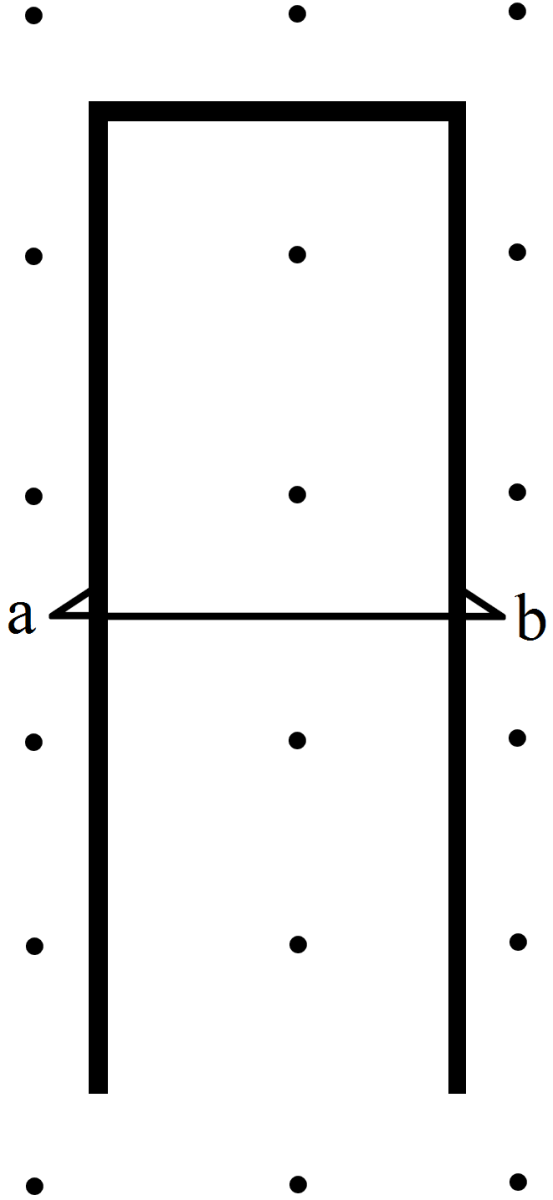
A conducting wire ab of length l, resistance r and mass m starts sliding at t = 0 down a smooth, vertical, thick pair of connected rails as shown in figure. A uniform magnetic field B exists in the space in a direction perpendicular to the plane of the rails.
  1. Write the induced emf in the loop at an instant t when the speed of the wire is v.
  2. What would be the magnitude and direction of the induced current in the wire?
  3. Find the downward acceleration of the wire at this instant.
  4. After sufficient time, the wire starts moving with a constant velocity. Find this velocity vm.
  5. Find the velocity of the wire as a function of time.
  6. Find the displacement of the wire as a function of time.
  7. Show that the rate of heat developed in the wire is equal to the rate at which the gravitational potential energy is decreased after steady state is reached.

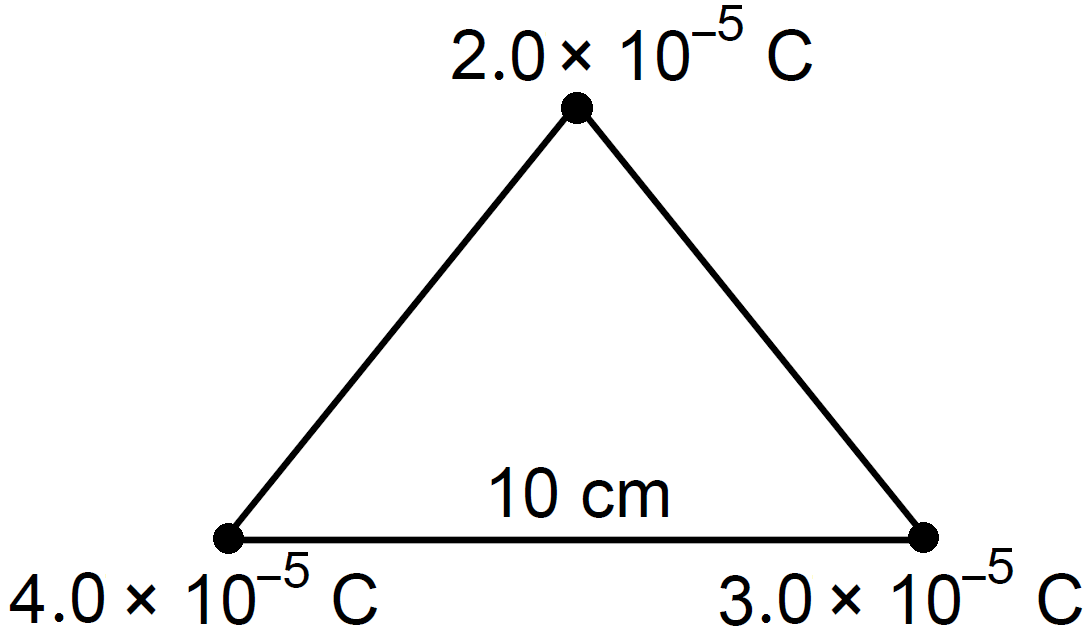
How much work has to be done in assembling three charged particles at the vertices of an equilateral triangle as shown in figure?

Figure shows a cylindrical tube with adiabatic walls and fitted with an adiabatic separator. The separator can be slid into the tube by an external mechanism. An ideal gas $(\gamma=1.5)$ is injected in the two sides at equal pressures and temperatures. The separator remains in equilibrium at the middle. It is now slid to a position where it divides the tube in the ratio 1 : 3. Find the ratio of the temperatures in the two parts of the vessel.

Two perfect gases at absolute temperature T1 and T2 are mixed. There is no loss of energy. Find the temperature of the mixture if masses of molecules are m1 and m2 and the number of molecules in the gases are n1 and n2 respectively.
Define velocity and acceleration. Draw a velocity time graph for uniformly accelerated motion and prove that the area between the curve of this graph and the time axis is equal to the displacement of the moving object
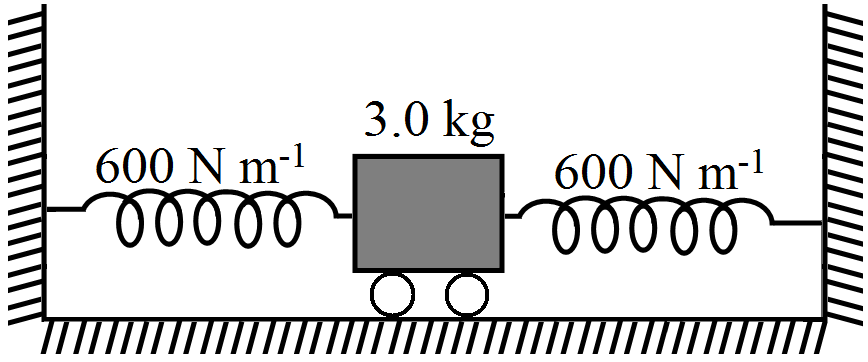
A trolley of mass 3.0kg, as shown in Figure, is connected to two springs, each of spring constant 600Nm-1. If the trolley is displaced from its equilibrium position by 5.0cm and released, what is (a) the period of ensuing oscillations, and (b) the maximum speed of the trolley? How much energy is dissipated as heat by the time trolley comes to rest due damping forces?

The heavier block in an Atwood machine has a mass twice that of the lighter one. The tension in the string is 16.0N when the system is set into motion. Find the decrease in the gravitational potential energy during the first second after the system is released from rest.
A narrow sound pulse (for example, a short pip by a whistle) is sent across a medium.
(a) Does the pulse have a definite,
  1. frequency,
  2. wavelength,
  3. speed of propagation?
(b) If the pulse rate is 1 after every 20s, (that is the whistle is blown for a split of second after every 20s), is the frequency of the note produced by the whistle equal to 1/20 or 0.05Hz?