Question
Define velocity and acceleration. Draw a velocity time graph for uniformly accelerated motion and prove that the area between the curve of this graph and the time axis is equal to the displacement of the moving object

Answer

self

Need a full question paper?

Generate a complete, print-ready paper with questions like this in minutes — across 16+ boards, with answer keys.
Start Generating Free

Similar questions

A particle of mass m is kept on the top of a smooth sphere of radius R. It is given a sharp impulse which imparts it a horizontal speed v.
  1. Find the normal force between the sphere and the particle just after the impulse.
  2. What should be the minimum value of v for which the particle does not slip on the sphere?
  3. Assuming the velocity v to be half the minimum calculated in part.
  4. Find the angle made by the radius through the particle with the vertical when it leaves the sphere.

A rocket is launched vertically from the surface of the earth with an initial speed of 10km/s. How far above the surface of the earth would it go? Ignore the atmospheric resistance. Radius of the earth = 6400km.
Taking an example of angular simple harmonic motion, establish an expression for the time period of the oscillator.
State and explain three different modes of transference of heat. Explain how the loss of heat due to these three modes are minimised in a thermos flask.
Suppose the rod with the balls A and B of the previous problem is clamped at the centre in such a way that it can rotate freely about a horizontal axis through the clamp. The system is kept at rest in the horizontal position. A particle P of the same mass m is dropped from a height h on the ball B. The particle collides with B and sticks to it:
  1. Find the angular momentum and the angular speed of the system just after the collision.
  2. What should be the minimum value of h so that the system makes a full rotation after the collision.
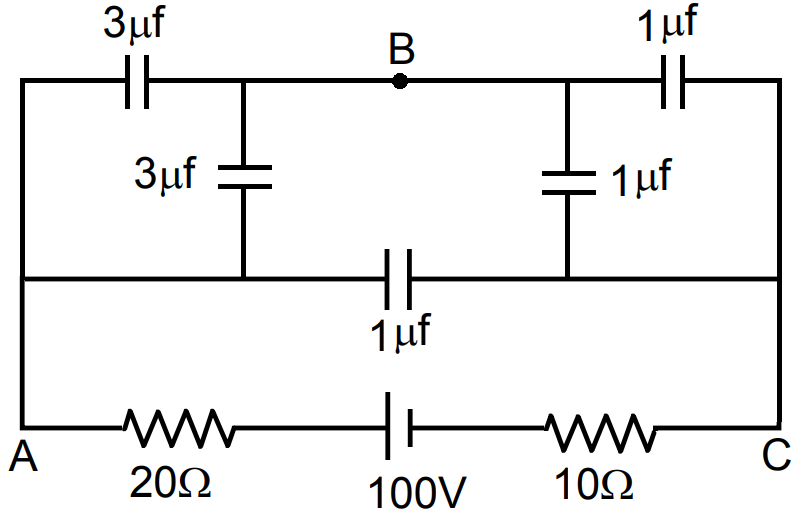
Find the potential difference between the points A and B and between the points B and C of the figure. in steady state.

A long cylindrical wire carries a positive charge of linear density 2.0 × 10⁻⁸Cm-1. An electron revolves around it in a circular path under the influence of the attractive electrostatic force. Find the kinetic energy of the electron. Note that it is independent of the radius.
A brass boiler has a base area of 0.15m2 and thickness 1.0cm. It boils water at the rate of 6.0kg/ min when placed on a gas stove. Estimate the temperature of the part of the flame in contact with the boiler. Thermal conductivity of brass = 109J s–1 m–1 K–1 ; Heat of vaporisation of water = 2256 × 103J kg–1.
Estimate the mean free path and collision frequency of nitrogen molecules in a cylinder of nitrogen gas at 2.0 atm pressure and $17^{\circ} C$ temperature take the radius of nitrogen molecule to be approximately 1.0. Compare the collision time with the time taken by the molecules to move freely between two collisions (Molecular mass of nitrogen $=28.0 u$ ).
The angle between the resultant contact force and the normal force exerted by a body on the other is called the angle of friction. Show that, if $\lambda$ be the angle of friction and la the coefficient of static friction, $\lambda\leq\tan^{-1}\mu.$