Question
What is the difference between lanthanoids and actinoids?

Answer

Difference between Lanthanoids and Actinoids:
LanthanoidsActinoids
1. Besides +3 oxidation state, they show +2 and +4 oxidation states only in few cases.1. Besides +3 oxidation state, they show higher oxidation states of +4 , $+5,+6$ and +7 also.
2. Most of their ions are colourless.2. Most of their ions are coloured.
3. They have less tendency towards complex forma-tion.3. They have greater ten-dency towards complex formation.
4. Lanthanoid compounds are less basic.4. Actinoid compounds are more basic.
5. Do not form oxocations.5. From oxocations e.g. $UO _2^{2+}, PuO _2^{2+}$ and $UO ^{+}$.
6. Except promethium, they are non-radioactive.6. They are radioactive.
7. Their magnetic properties can be explained easily.7. Their magnetic properties cannot be explained easily.

Need a full question paper?

Generate a complete, print-ready paper with questions like this in minutes — across 16+ boards, with answer keys.
Start Generating Free

Similar questions

Describe the structure of a fuel cell. Draw labelled diagram of a structure of fuel cell?
Classify carbohydrates and also give examples of each.
After watching a programme on $TV$ about the presence of carcinogens $($cancer causing agents$)$ Potassium bromate and Potassium iodate in bread and other bakery products, Veena, a class $XII$ student, decided to make others aware about the adverse effects of these carcinogens in foods. She consulted the school principal and requested him to instruct the canteen contractor to stop selling sandwiches, pizzas, burgers and other bakery products to the students. The principal took an immediate action and instructed the canteen contractor to replace the bakery products with some proteins and vitamins$-$rich food like fruits, salads, sprouts, etc. The decision was welcomed by the parents and students.
After reading the above passage, answer the following questions:
  1. What are the values $($at least two$)$ displayed by Veena?
  2. Which polysaccharide component of carbohydrates is commonly present in bread?
  3. Write the two types of secondary structures of proteins.
  4. Give two examples of water soluble vitamins.
i. Write structures of different isomeric amines corresponding to the molecular formula$, \ce{C4H11N}$.
ii. Write $\text{IUPAC}$ names of all the isomers.
iii. What type of isomerism is exhibited by different pairs of amines?
  1. How is the variability in oxidation states of transition metals different from that of the $p-$block elements?
  2. Out of $Cu^+$ and $Cu^{2+}$, which ion is unstable in aqueous solution and why?
  3. Orange colour of $Cr_2O_7^{2–}$ ion changes to yellow when treated with an alkali. Why?
  4. Chemistry of actinoids is complicated as compared to lanthanoids. Give two reasons.
  1. What are essential and non-essential amino acids? Give two examples of each.
  2. What are the two types of photosynthesis in green plants? Give the basic equations of photosynthesis.
  3. Mention the two products of glycolysis.
Write the $\text{IUPAC}$ names of the following coordination compounds:
$a.\ \left[ Pt \left( NH _3\right)_2 Cl \left( NO _2\right]\right.$
$b.\ K _3\left[ Cr \left( C _2 O _4\right)_3\right]$
$c.\ \left[ CoCl _2( en )_2\right] Cl$
$d.\ \left[ Co \left( NH _3\right)_5\left( CO _3\right)\right] Cl$
$e.\ Hg \left[ Co ( SCN )_4\right]$
In the reaction
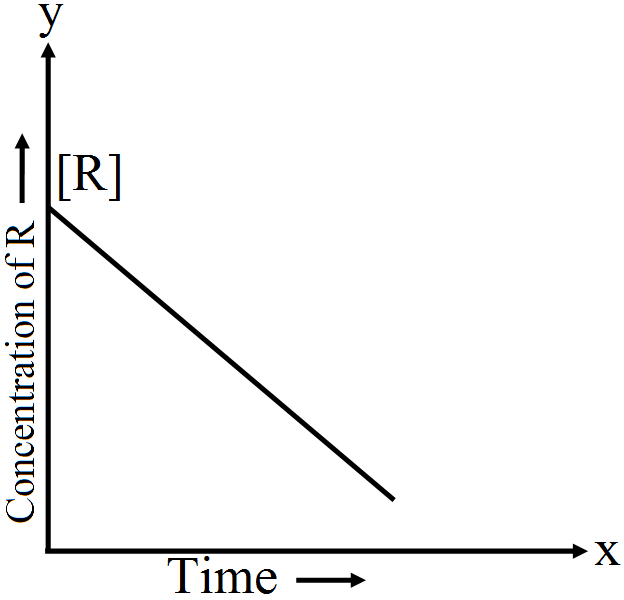
$Q + R \rightarrow$ Products
The time taken for $99\%$ reaction of $Q$ is twice the time taken for $90\%$ reaction of $R.$ The concentration of $R$ varies with time as shown in the figure given alongside.

What is the overall order of the reaction? Give the units of the rate constant for the same. Write the rate expression for the above reaction.
What are the similarities between lanthanoids and actinoids?
Explain different types of isomerism in amines.