Question
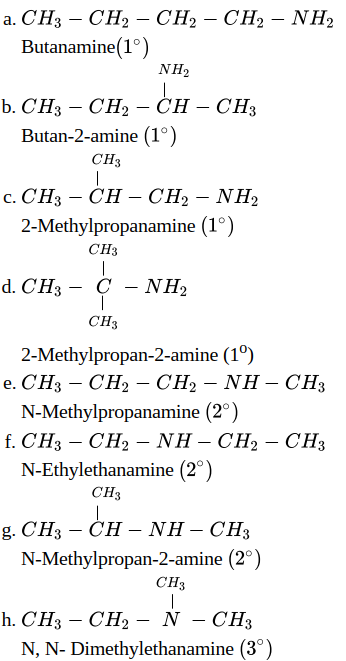
i. Write structures of different isomeric amines corresponding to the molecular formula$, \ce{C4H11N}$.
ii. Write $\text{IUPAC}$ names of all the isomers.
iii. What type of isomerism is exhibited by different pairs of amines?
Answer

$(i), (ii)$ The structures and $\text{IUPAC}$ names of different isomeric amines corresponding to the molecular formula$, \ce{C4H11N}$ are given
Image
below:
$(iii)$ The pairs $(a)$ and $(b)$ and $(e)$ and $(g)$ exhibit position isomerism.
The pairs $(a)$ and $(c); (a)$ and $(d); (b)$ and $(c); (b)$ and $(d)$ exhibit chain isomerism.
The pairs $(e)$ and $(f)$ and $(f)$ and $(g)$ exhibit metamerism.
All primary amines exhibit functional isomerism with secondary and tertiary amines and vice$-$versa.

Need a full question paper?

Generate a complete, print-ready paper with questions like this in minutes — across 16+ boards, with answer keys.

Start Generating Free

Similar questions

  1. Calculate the freezing point of solution when $1.9 g$ of $\ce{MgCl_2(M = 95 g mol^{–1})}$ was dissolved in $50 g$ of water, assuming $MgCl_2$ undergoes complete ionization. $(K_f$​​​​​​​ for water $= 1.86 K \ kg mol^{–1})$
  2. Out of $1 M$ glucose and $2 M$ glucose, which one has a higher boiling point and why?
  3. What happens when the external pressure applied becomes more than the osmotic pressure of solution?
What is polymerisation? Define the terms 'addition polymerisation' and Give one example.
How will you obtain the following compounds from ethyl alcohol? Explain with equation :
(i) Diethyl ether
(ii) Iodoform
(iii) Ethyl acetate
(iv) Acetaldehyde
(i). Write the structures of main products when benzene diazonium chloride $\left( C _6 H _5 N_2^{+} Cl ^{-}\right)$ reacts with the following reagents.
a. $HBF _4 / \Delta$
b. $Cu / HBr$
(ii). Write the structures of A, B and C in the following reactions:
a. $C _6 H _5 NO _2 \xrightarrow{ Sn / HCl } A \xrightarrow[\Delta]{ NaNO _2+ HCl } B \xrightarrow{273 K} H$
b. $CH _3 Cl \xrightarrow{ KCN } A \xrightarrow{ LiAlH _4} B \xrightarrow[273 K]{\stackrel{273 K}{ HNO }{ }_2} C$
$(a)$ Give plausible explanation for each of the following:
$i.$ Why are amines less acidic than alcohols of comparable molecular masses?
$ii.$ Why are primary amines highest boiling than tertiary amines?
$iii.$ Why are aliphatic amines stronger bases than aromatic amines?
$(b)$ Complete the following reactions:
$i. C _6 H _5 N_2 Cl + C _2 H _5 OH \rightarrow$
$ii. C _6 H _5 NH _2+\left( CH _3 CO \right)_2 O \rightarrow$
What is abnormal molar mass? Explain.
i. Write the structure of main products when aniline reacts with the following reagents :
a. $Br _2$ water
b. HCl
c. $\left( CH _3 CO \right)_2 O /$ pyridine
ii. Arrange the following in the increasing order of their boiling point:$C _2 H _5 NH _2, C _2 H _5 OH ,\left( CH _3\right)_3 N$
iii. Give a simple chemical test to distinguish between the following pair of compounds : $\left( CH _3\right)_2 NH$ and $\left( CH _3\right)_3 N$.
Explain the following terms with suitable examples:
(a) Cationic detergents, (b) Anionic detergents, (c) Neutral detergents.
What is vapour pressure? When a non- volatile solute is dissolved in any liquid, the vapour pressure of the liquid decreases. Give reason.
Attempt any five of the following:
$(a)$ Deficiency of which vitamin causes night-blindness.
$(b)$ Give two examples of reducing sugars.
$(c)$ Define the following terms:
$i.$ Glycosidic linkage
$ii.$ Native protein
$(d)$ Write function of carbohydrates in plants.
$(e)$ Differentiate between:
$i.$ Peptide linkage and Glycosidic linkage
$ii.$ Nucleoside and Nucleotide
$(f)$ What type of linkage holds together the monomers of $\text{DNA}$?
$(g)$ Write the product obtained when $D-$glucose reacts with $H_2N-OH.$