Question
What is the difference between soft and hard X-rays
|
(a) Velocity |
(b) Intensity |
(c) Frequency |
(d) Polarization |
What is the difference between soft and hard X-rays
|
(a) Velocity |
(b) Intensity |
(c) Frequency |
(d) Polarization |
(c) Frequency
Generate a complete, print-ready paper with questions like this in minutes — across 16+ boards, with answer keys.
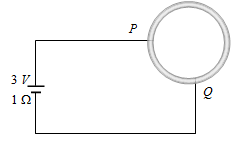
A wire of resistance 10 W is bent to form a circle. P and Q are points on the circumference of the circle dividing it into a quadrant and are connected to a Battery of 3 V and internal resistance 1 W as shown in the figure. The currents in the two parts of the circle are
|
(a) |
(b) |
|
(c) |
(d) |
The distance between charges 5 ×  and -2.7
  is 0.2 m. The distance at which a third charge should be placed in order that it will not experience any force along the line joining the two charges is
|
(a) 0.44 m |
(b) 0.65 m |
(c) 0.556 m |
(d) 0.350 m |
An electron (charge = 1.6  ) is accelerated through a potential of 100,000 V. The energy acquired by the electron is
|
(a) 1.6 |
(b) 1.6 |
(c) 0.53 |
(d) 1.6 |
The Avogadro's number is 6  per gm mole and electronic charge is 1.6
  . The Faraday's number is
|
(a) |
(b) |
|
(c) |
(d) |
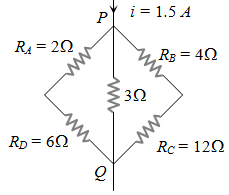
Potential difference between the points P and Q in the electric circuit shown is
|
(a) 4.5 V |
(b) 1.2 V |
(c) 2.4 V |
(d) 2.88 V |
Two charges each of 1 coulomb are at a distance 1 km apart, the force between them is
|
(a) |
(b) 9 |
|
(c) |
(d) |
In extrinsic P and N-type, semiconductor materials, the ratio of the impurity atoms to the pure semiconductor atoms is about
|
(a) 1 |
(b) |
(c) |
(d) |
The relation between Ip and Vp for a triode is  , Keeping the grid potential constant at 1V, the value of rp will be
|
(a) 8 kW |
(b) 4 kW |
(c) 2 kW |
(d) 8 kW |
A ray of light is incident at 50° on the middle of one of the two mirrors arranged at an angle of 60° between them. The ray then touches the second mirror, get reflected back to the first mirror, making an angle of incidence of
|
(a) 50° |
(b) 60° |
(c) 70° |
(d) 80° |