Question
What is the difference between static and dynamic equilibrium?

Answer

Equilibrium in any case requires the ? forces acting on an object = 0, i.e. that there is
Fnet = 0.
Static equilibrium is the situation where the object upon which the forces act is no moving.
The object is "static" hence the state of equilibrium gets its name.
Dynamic equilibrium is the situation where an object is in constant velocity motion.
{This object can't experience an acceleration which means Fnet >0}

Need a full question paper?

Generate a complete, print-ready paper with questions like this in minutes — across 16+ boards, with answer keys.
Start Generating Free

Similar questions

What is electric power? State and define its S.I. unit.
Draw a labelled diagram with necessary switch, regulator etc. to connect a bulb, a plug socket outlet and a fan with the mains. In what arrangement have you connected these to the mains?
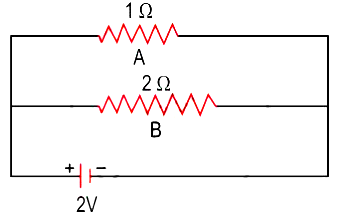
Calculate current flowing through each of the resistors A and B in the circuit shown in following figure?

A vibrating tuning fork is placed over the mouth of a burette filled with water. The tap is opened and the water level gradually falls. It is observed that the sound becomes the loudest for a particular length of the air column. What is the name of the phenomenon taking place when this happens? Why does the sound become the loudest?
The melting point of naphthalene is $80^{\circ} C$ and the room temperature is $30^{\circ} C$. A sample of liquid naphthalene at $100^{\circ} C$ is cooled down to the room temperature. Draw a temperature time graph to represent this cooling. In the graph, mark the region which corresponds to the freezing process.
A current of 2 A is passed through a coil of resistance $75 \Omega$ for $2$ minutes.
(a) How much heat energy is produced?
(b) How much charge is passed through the resistance?
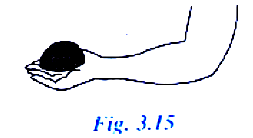
Indicate the positions of load, effort and fulcrum in the forearm shown below in Fig 3.15 Name class of lever.
Calculate the amount of heat given out while converting 100 g of water at 50°C into ice at -5°C. (refer Q.9 for data).
A current of 0.2 A flows through a wire whose ends are at a potential difference of 15 V. Calculate:
(i) The resistance of the wire, and
(ii) The heat energy produced in 1 minute.
In parallel combination of resistances:

  • P.D. is same across each resistance

  • Total resistance is increased

  • Current is same in each resistance

  • All of the above are true