Questions

[3 Mark Question Answer]

🎯

Test yourself on this topic

38 questions · timed · auto-graded

Question 13 Marks
The arms of a beam balance are 20 cm and 21 cm, but the pans are of equal weight. By the method of double weighing the weights are found to be 1000 g and 20 g. Find the actual weight of the body
Answer
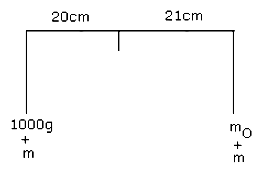
$m=$ mass of each pan
$\mathrm{m}_0=$ actual mass of the body
$ (100+m) 20=\left(m+m_0\right) 21 $
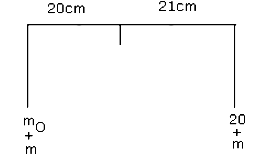

Dividing the two equations
$ \begin{aligned} & \frac{21}{20}=\frac{(100+m) 20}{(20+m) 21} \\ & 1.1(20+m)=(1000+m) \\ & 22+1.1 m=1000+m \\ & 0.1 m=978 \\ & m=9780 \mathrm{~g} \end{aligned} $
View full question & answer
Question 23 Marks
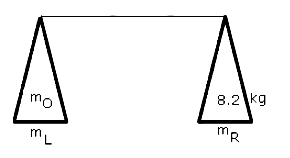
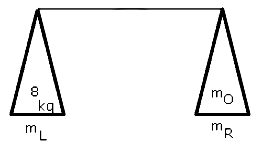
A faulty balance of equal arms but pans of unequal weight is used to find the weight of a body. By the method of double weighing the weights are found as $8 \ kg$ and $8.2 \ kg$ . Find the actual weight of the body.
Answer

$m_0=$ actual weight
$m_L =$ weight of leftpan
$m_R =$ weight of right pan
$m_L + 8 = m_0 + m_R$

$m_R + 8.2 kg = m_0 + m_2$​​​​​​​
adding the two equations
$m_L + m_R + 16.2kg = 2m_0 + m_2 +m_R$
$\Rightarrow 16.2 = 2m_0$
$m_0 = 8.1 kg$
View full question & answer
Question 33 Marks
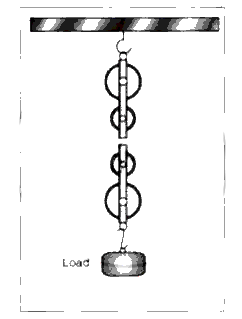
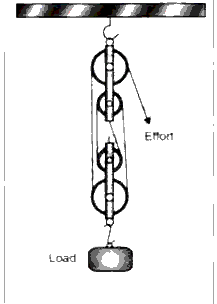
(a) Fig represents an incomplete diagram of a simple string pulley system. Copy this diagram on a new page and complete it and mark where the effort must be applied to lift the load.
(b) What is the velocity ratio of this system?
(c) If the pulley system is 80% efficient and the load is 720 N, then
(i) What effort must be applied to lift the load?
(ii) What work must be done must be done in lifting the load through a distance of 2 m using this machine?
Answer
(a) Corrert wínding ofrope around pulleys, load and effortis as shown

(b) Since there are four strings in the block and tackle system, therefore, the velocíty ratio ofthe systemís V. $R=n=4 c$ )
(i) Given load $L=720 \mathrm{~N}$
Let effort $=\mathrm{E}$
Efficiency $=\frac{\text { M.A }}{\text { V.R }}$
or, $80 \%=\frac{\mathrm{L} / \mathrm{E}}{4}$
or, $\frac{80}{100} \times 4=\frac{720}{E}$
or, $\mathrm{E}=\frac{720 \times 100}{80 \times 4}=225 \mathrm{~N}$
(ii) Given, Load L $=720 \mathrm{~N}$
Displacement - of - load, $d_L=2 \mathrm{~m}$
Efficiency $=\frac{\text { work }- \text { output }}{\text { work }- \text { input }}$
or work - input $=\frac{\text { work }- \text { output }}{\text { efficiency }}=\frac{\text { Load } \times \mathrm{d}_{\mathrm{L}}}{\mathrm{n}}$
or, Work - input $=\frac{720 \times 2}{0.8}=1800 \mathrm{~J}$
View full question & answer
Question 43 Marks
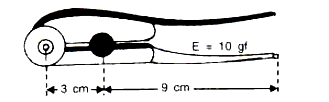
A pair of nut crackers is 12 cm long. An effort of 10 gf is required to crack a nut which is passed at a point 3 cm from the finger. Calculate the load Fig.
Answer
Let $L$ be the load.Given, load arm $=3 \mathrm{~cm}$
effort $\mathrm{arm}=12 \mathrm{~cm}$Effort, $E=10 \mathrm{gf}$Now, M.A $=\frac{\text { effort arm }}{\text { load arm }}=\frac{12}{3}=4$
Also $\mathrm{MA}=\frac{\mathrm{L}}{\mathrm{E}}$
$
4=\frac{L}{10}
$
or, $L=40 \mathrm{gf}$
View full question & answer
Question 53 Marks
A crowbar 4 m long has its fulcrum 50 cm from one end. What minimum effort is required to displace a weight of 500 kgf? Calculate the M.A. of the crowbar.
Answer
A crowbar is a class I lever, Thus its fulcrum lies in between the load and effort
Given, load, $L=500 \mathrm{kgf}$
Lenght of crowbar $=4 \mathrm{~m}=400 \mathrm{~cm}$
Therefore, load arm $=50 \mathrm{~cm}$
Effort arm $=400-50 \mathrm{~cm}=350 \mathrm{~cm}$
Let effort $=E$
Now, M.A $=\frac{\text { effort arm }}{\text { load arm }}=\frac{350}{50}=7$
Also, $M \cdot A=\frac{L}{E}$
$ 7=\frac{500}{E} $
or, $E=71.4 \mathrm{kgf}$
View full question & answer
Question 63 Marks
Identify the type of energy possessed by the body in each of the following:
(a) A coiled spring of the toy car
(b) A hammer which is raised
(c) A stone shot from a catapult
(d) Water stored in the overhead tank
(e) A tadpole moving in water.
Answer
(a) Potential energy
(b) Potential energy
(c) Kinetic energy
(d) Potential energy
(e) Kinetic energy
View full question & answer
Question 73 Marks
A bullet is of mass 'm' g and is moving with a velocity 'v' m/s. Find the kinetic energy of the bullet when
(a) The mass is doubled,
(b) The velocity is tripled.
Answer
K.E of the bullet $=\frac{1}{2} \mathrm{mv}^2$ (a) If the mass is doubled,
$ \begin{aligned} & \mathrm{K} \cdot \mathrm{E}^{\prime}=\frac{1}{2}(2 \mathrm{~m}) v^2=2 \times \frac{1}{2} m v^2=2 \mathrm{~K} \cdot \mathrm{E} \\ & \frac{\mathrm{K} \cdot \mathrm{E}}{\mathrm{K} \cdot \mathrm{E}}=\frac{2}{1} \end{aligned} $
(b) If the velocity is tripled,
$ \begin{aligned} & \text { K.E }=\frac{1}{2} m(3 v)^2=9 \times \frac{1}{2} m^2 \\ & \frac{\text { K.E }}{\text { K.E }}=\frac{9}{1} \end{aligned} $

View full question & answer
Question 83 Marks
What do you understand by 'potential energy' and 'Kinetic energy'? Give three examples of each to illustrate your answer.
Answer
The energy possessed by a body by virtue of its position, shape or change of configuration is called potential energy.
Examples of potential energy:
(i) Water stored at a height in a reservoir.
(ii) A stretched spring.
(iii) A bent bow.
The energy possessed by a body by virtue of its motion is called kinetic energy.
Examples of kinetic energy:
(i) Air in motion has kinetic energy.
(ii) A swinging pendulum.
(iii) Moving hands of a clock.
View full question & answer
Question 93 Marks
Define energy and state the unit of energy and the law of conservation of energy.
Answer
The energy of a body is its capacity to do work.
The SI unit of work is 'joules' and the CGS unit is 'erg'.
According to the law of conservation of energy, energy can neither be created nor be destroyed but can be transformed from one form to another. In other words, energy can be transformed from one form to another but the total amount of all the energies remain the same.
View full question & answer
Question 103 Marks
The truck has to apply a force of $3000 \ N$ to overcome friction while moving with a uniform speed of $36 kmhr^{-1}.$ What is the power developed by the truck?
Answer
We know that, power = forcew x velocityHere, force $= 3000 N,$
velocity $= 36 kmhr^{-1}= 10 m/s$
Power $= 3000 x 10 = 3000$ watt
View full question & answer
Question 113 Marks
A water pump raises 80 kg of water through a height of 20 m in 10 s. Calculate the power of the pump.
Answer
$\begin{aligned} & \text { Given, mass of water }=80 \mathrm{~kg} \\ & \text { height }=20 \mathrm{~m} \\ & \mathrm{~g}=10 \mathrm{~ms}^{-2} \\ & \text { time taken }=10 \mathrm{~s} \\ & \text { Work done }=\mathrm{mgh}=80 \times 10 \times 20=16000 \mathrm{~J} \\ & \text { Power }=\frac{\text { work done }}{\text { time taken }}=\frac{16000}{10}=1600 \text { watt }\end{aligned}$
View full question & answer
Question 123 Marks
A girl of mass $50 kg$ runs up a flight of $40$ steps in $20$ seconds. If each step in $20$ cm high, calculate the power developed by the girl. $(g= 10 ms^{-2}).$
Answer
Given, mass $=50 \mathrm{~kg}$
Total height traveled $=40 \times 20 \mathrm{~cm}=800 \mathrm{~cm}=8 \mathrm{~m}$
$ g=10 \mathrm{~ms}^{-2} $ time taken $=20$ s
work done $=\mathrm{mgh}=50 \times 10 \times 8=4000 \mathrm{~J}$
power $=\frac{\text { work done }}{\text { time taken }}=\frac{4000}{20}=200$ watt
 
View full question & answer
Question 133 Marks
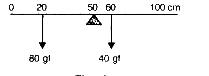
Fig. shows a uniform meter scale weighing 100 N pivoted at its centre. Two weights of 500 N and 300 N are hung from the ruler as shown in fig.

(i) Calculate total clockwise and anticlockwise moments.
(ii) Calculate difference in clockwise moment and anticlockwise moment.
(iii) Calculate the distance from O where a 100 N weight should be suspended to balance the meter scale.

Answer
Let the weight 500 N be hung from the 40cm mark and the weight 300N be hung from the 80 cm mark

(i) Then, total clockwise moment = 500 x (50 - 40) = 500 x 10 = 5000 Nm

Total anticlockwise moment = 300 x (80 - 50) = 300 x 30 = 9000 Nm

(ii) Difference in clockwise and anticlockwise moment = 9000 - 5000 = 4000Nm

(iii) Let the 100 N weight be hung at a distance 'd' from the point 'o' to its left

Then,total clockwise moment = 5000 + 100 d

In balanced condition, sum of clockwise moments = sum of anticlockwise moments

5000 + 100 d = 9000

or 100 d = 4000

or d = 40cm

the weight 100 N should be a hung from the 40cm mark so as to balance the scale.

View full question & answer
Question 143 Marks
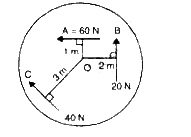
Three forces A, B and C are acting on a rigid body which can turn about O in fig.9. If all the three forces are applied simultaneously, in which direction will the body move? Explain.
Answer
The body will move in the direction of net torque

Net torque = sum of clockwise moments - sum of anticlockwise moments

In the given figure, force 40N is acting clockwise and forces 20N and 60N are acting anticlockwise

Net torque = (40 x 3) - [(20 x 2) + (60 x 1)}

= 120 - 100

= 20 Nm

Hence the body will move in clockwise direction about 'O

View full question & answer
Question 153 Marks
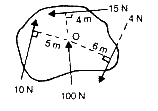
Calculate the resultant moment of forces about O and state its direction in fig.
Answer
In the given figure, forces 10 N and 100 N act clockwise and the forces 15 N and 4 N act anticlockwise

MOment of force = sum of clockwise moments - sum of anti clockwise moments

Moments of force = (10 x 5 + 100 x 0 + 4 x 6) - ( 15 x 4) = 74 - 60 = 14 Nm

or 14 Nm in clockwise direction.

View full question & answer
Question 163 Marks
State the conditions of a stable equilibrium of a body.
Answer
When the centre of gravity is nearer to the base of a body, the body is in stable equilibrium.
Conditions for stable equilibrium:
(a) The body should have a broad base.
(b) Centre of gravity of the body should be as low as possible.
(c) Vertical line drawn from the centre of gravity should fall within the base of the support.
View full question & answer
Question 173 Marks
What is the difference between static and dynamic equilibrium?
Answer
Equilibrium in any case requires the ? forces acting on an object = 0, i.e. that there is
Fnet = 0.
Static equilibrium is the situation where the object upon which the forces act is no moving.
The object is "static" hence the state of equilibrium gets its name.
Dynamic equilibrium is the situation where an object is in constant velocity motion.
{This object can't experience an acceleration which means Fnet >0}
View full question & answer
Question 183 Marks
What is meant by the turning effect of force? Give two examples.
Answer
The turning effect produced by a force on a rigid body about a point, pivot or fulcrum is called the moment of force or torque. It is measured by the product of force and the perpendicular distance of the pivot from the line of action of force.
Examples of turning effect of force:
(i) Turning a steering wheel
(ii) Tightening a cap
View full question & answer
Question 193 Marks
What is meant by a centripetal force? Is it same as centrifugal force?
Answer
Centripetal force: Whenever a body is moving in a circular path with a uniform speed, its velocity is continuously changing due to change in its direction. The body thus possesses acceleration and this acceleration is called centripetal acceleration. The force which produces this acceleration is called centripetal force. It acts along the radius towards the centre of the circular path.
It is not the same as the centrifugal force.
View full question & answer
Question 203 Marks
What do you mean by the state of equilibrium? What are the conditions for stable equilibrium?
Answer
A body is said to be in equilibrium under the action of a number of forces, if the forces are not able to produce any change in the state of rest or of uniform motion or uniform rotation.
Conditions for stable equilibrium:
(a) The body should have a broad base.
(b) Centre of gravity of the body should be as low as possible.
(c) Vertical line drawn from the centre of gravity should fall within the base of the support.
View full question & answer
Question 213 Marks
A meter scale is pivoted at its mid point and a 50 g mass suspended from the 20 cm mark. What mass balances the ruler when suspended from 65 cm mark?
Answer
Let mass 'm' be suspended from $65 \mathrm{~cm}$ mark so as to balance the metre scale.
In balanced condition.
sum of clockwise moments $=$ sum of anticlockwise moments $ 50 \times(50-20)=m \times(65-50) $ or, $50 \times 30=m \times 15$
or, $m=\frac{1500}{15}=100 \mathrm{~g}$
View full question & answer
Question 223 Marks
State the principle of moments. A meter scale is pivoted at 30 cm mark and it is in equilibrium when a mass of 40 g is suspended from 10 cm mark. Calculate the mass of the ruler.
Answer
Let the mass of 50 g be situated at distance 'd' from the mid-point i.e. at 50cm,

80 x 30 = (40 x 10) + (50 x d)

2400 = 400 + 50d

or 50d = 2000

or d = 40cm to the right of the mid-point.

View full question & answer
Question 233 Marks
State the principle of moments. A meter scale is pivoted at 30 cm mark and it is in equilibrium when a mass of 40 g is suspended from 10 cm mark. Calculate the mass of the ruler.
Answer
Principle of moments : If a body is in equilibrium under the action of number of force, then the sum of clockwise moments is equal to the sum of anticlockwise moments.
Sum of clockwise moments $=$ sum of anticlockwise moments
$40 \times 20 \mathrm{~cm}=$ mass of scale $\times 30 \mathrm{~cm}$
or Mass of scale $=\frac{800}{30}=26.7 \mathrm{~g}$
View full question & answer
Question 243 Marks
If the speed of a body is doubled, what happens to its kinetic energy?
Answer
$ \mathrm{K} . \mathrm{E}, \mathrm{K}=\frac{1}{2} \mathrm{mv}^2 $
If speed is doubled
$ \text { K.E, } K^{\prime}=\frac{1}{2} m\left(2 v^2\right) $
or $\mathrm{K}^{\prime}=4 \times \frac{1}{2} \mathrm{mv}^2=4 \mathrm{~K}$
Thus K.E becomes four times.
View full question & answer
Question 253 Marks
An object is dropped from a height H. when is its
(i) P.E. maximum,
(ii) K.E. maximum,
(iii) P.E. = K.E.?
Answer
(i) At the height H because the height is maximum.
(ii) At the ground level because the velocity is maximum.
(iii) At half distance of the total path i.e. at height H/2, the P.E. is equal to the K.E.
View full question & answer
Question 263 Marks
Name the type of energy possessed by a
(i) stretched catapult (ii) hot iron
(iii) wound up clock
Answer
(i) Potential energy
(ii) Heat energy
(iii) Potential energy
View full question & answer
Question 273 Marks
What are the factors on which P.E. of a body depends?
Answer
Potential energy of a body depends upon:
(i) Mass of the body
(ii) Acceleration due to gravity
(iii) Height of the body
View full question & answer
Question 283 Marks
The K.E. of a body is 5 J. What will be its K.E. when its speed is doubled?
Answer
$ \mathrm{K} . \mathrm{E}, \mathrm{K}=\frac{1}{2} \mathrm{mv}^2 $
If speed is doubled; $ \text { K.E }, K=\frac{1}{2} m(2 v)^2 $
or $\mathrm{K}^{\prime}=4 \times \frac{1}{2} \mathrm{mv}^2=4 \mathrm{~K}$
Thus K.E becomes four times
Thus if initially the K.E is $5 \mathrm{~J}$ after increasing the speed twice, its k.E will become 4 x5 = $20 \mathrm{~J}$.
View full question & answer
Question 293 Marks
What change should be effected in the velocity of a body to maintain the same K.E., if its mass is increased four times?
Answer
$ \mathrm{K} . \mathrm{E}, \mathrm{K}=\frac{1}{2} \mathrm{mv}^2 $
If mass is increased four times
$ K . E, K^{\prime}=\frac{1}{2}(4 m)(v)^2 $
or $\mathrm{K}^{\prime}=4 \times \frac{1}{2} \mathrm{mv}^2$
to maintain the same kinetic energy the velocity should be made half.
Then, $\mathrm{K}^{\prime \prime}=4 \times \frac{1}{2} \mathrm{~m}\left(\frac{\mathrm{v}}{2}\right)^2=\mathrm{K}$
View full question & answer
Question 303 Marks
An electric motor drives a machine which lifts a mass of $4 \ kg$ through a height of $10 \ m$ in $5 \ s$ at a constant speed. Assuming $g =10 ms^{-2}$, calculate
(i) the amount of work done, (ii) the power of the machine.
Answer
Given mass $m=4 \mathrm{~kg}$, height $\mathrm{h}=10 \mathrm{~m}$, time $\mathrm{t}=5 \mathrm{~s}$
(i) work done $=m g h=4 \times 10 \times 10=400 j$
(ii) power $=\frac{\text { work done }}{\text { time taken }}=\frac{400}{5}=80 \mathrm{w}$
View full question & answer
Question 313 Marks
A weight lifted a load of 200 kgf to a height of $2.5$ m in $5 s$. calculate: $(i)$ the work done, and $(ii)$ the power developed by him. Take $g= 10 N kg^{-1}.$
Answer
Given load $\mathrm{m}=200 \mathrm{kgf}$, displacement $\mathrm{h}=25 \mathrm{~m}$, time $=5 \mathrm{~s}, \mathrm{~g}=10 \mathrm{~N} \mathrm{~kg}^{-1}$
Now work done $=200 \mathrm{kgf} \times 25=50000 \mathrm{~J}$
or power $=\frac{\text { work done }}{\text { time taken }}=\frac{5000}{5}=1000$ watt
View full question & answer
Question 323 Marks
Give reason for the following:

In case of a block and tackle arrangement, the mechanical advantage increases with the increase in the number of pulleys.

Answer
In a block and tackle system, if the total number of pulleys used in both the blocks is ' $n$ ' and the effort is being applied in the downward direction, then the tension in and segments of string support the load. therefore
$ L=n T \text { and } E=T $
$ M \cdot A=\frac{\text { load }}{\text { effort }}=\frac{n T}{T}=n $
Thus in a block and tackle system, the M.A is equal to the number of pulleys and it increases with the increase in the number of pulley.
View full question & answer
Question 333 Marks
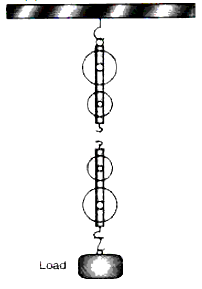
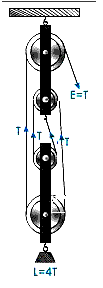
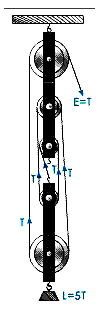
Fig show a system of four pulleys. The upper two pulleys are fixed and the lower two are movable.


(i) Draw a string around the pulleys. Also show the place and direction in which the effort is applied.
(ii) What is the velocity ratio of the system?
(iii) What is the mechanical advantage of the system?
(iv) What assumption do you make in arriving at your answer in part (iii)?

Answer
(i) Correct winding of rope around pulleys, load and effort is as shown:


(ii) Since there are four strings in the block and tackle system,therefore, velocity ratio of the system is V. $\mathrm{R}=\mathrm{n}=4$.
(iii) $M . A=L / E$ here, $\mathrm{L}=4 \mathrm{~T}, \mathrm{E}=\mathrm{T}$ $\mathrm{M} \cdot \mathrm{A}=\frac{4 \mathrm{~T}}{\mathrm{~T}}=4$
(iv) The assumptions made are movable pulleys are weightless and efficiency of the system is $100 \%$.
View full question & answer
Question 343 Marks
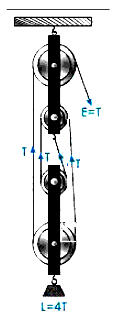
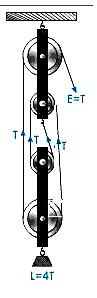
Fig shown a block and tackles system of pulleys used to lift a load.

(i) How many strands of tackle are supporting the load?

(ii) Draw arrows to represent tension in each stand.

(iii) What is the mechanical advantage of the system?

(iv) When load is pulled up by a distance 1 m how far does the effort end move?

Answer
(I) 4 stands of tackle are supporting the load.
(ii) correct winding of rope around pulleys, load and effort is as shown


$ \begin{aligned} & \text { (iii) } M \cdot A=L / E \\ & \text { here, } L=4 T, E=T \\ & M \cdot A=\frac{4 T}{T}=4 \end{aligned} $
(iv) since there are four strings in the block and tackle system, therefore, the velocity ratio of the system is $V . R=n=4$
Now, V.R $\frac{\mathrm{d}_{\mathrm{E}}}{\mathrm{d}_{\mathrm{L}}}$
or, $\mathrm{d}_{\mathrm{E}}=4 \times \mathrm{d}_{\mathrm{L}}=4 \times 1=4 \mathrm{~m}$
View full question & answer
Question 353 Marks
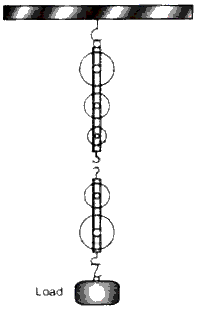
In the fig draw a tackle to lit a load by applying the torce in a convinient direction. Mark the position of load and effort.

(i) If the load is raised by 1 m, Through what distance will the effort move?
(ii) State how many strands of tackle are supporting the load?
(iii) What is the mechanical advantage of the sysytem?

Answer
correct winding of rope around pulleys, load and effort is as shown:


(i) Since there are five strings in the block and tackle system, therefore, the elocity ratio of the system is $V \cdot R=n 5$
Now, V.R $=\frac{\mathrm{d}_{\mathrm{E}}}{\mathrm{d}_{\mathrm{L}}}$ or, $\mathrm{d}_{\mathrm{E}}=5 \times \mathrm{d}_{\mathrm{L}}=5 \times 1=5 \mathrm{~m}$
(ii) 5 strands of tackle are supporting the load.
(iii) $\mathrm{M} \cdot \mathrm{A}=\mathrm{L} / \mathrm{E}$
Here, $\mathrm{L}=5 \mathrm{~T}, \mathrm{E}=\mathrm{T}$ $ M \cdot A=\frac{5 T}{T}=5 $

View full question & answer
Question 363 Marks
State the condition when a body is in (i) static, (ii) dynamic, equilibrium. Give one example each of static and dynamic equilibrium.
Answer
(i) The conditions for static equilibrium are:
(a) The sum of the (vector) forces must equal zero, i.e. ? F = 0
(b) The sum of the torques must equal zero; i.e. ? ? = 0.
(ii) The conditions for dynamic equilibrium are:
(a) The body should have a broad base.
(b) Centre of gravity of the body should be as low as possible.
(c) Vertical line drawn from the centre of gravity should fall within the base of the support.
Examples:
Static equilibrium: a box at rest on a floor; there is a gravitational force pulling the object to the earth, but there is also an equal and opposite force applied by the floor to the box (pushing up).
Dynamic equilibrium: A rock travelling across the cosmos, far enough away from any other object (so as not to be affected by gravity - in other words, in zero gravity conditions); the rock continues to travel in a straight line at uniform velocity either for eternity, or until acted upon by an external unbalanced force.
View full question & answer
Question 373 Marks
State the conditions of equilibrium for a rigid body.
Answer
Conditions of equilibrium for a rigid body:
1. The body should have a broad base.
2. Center of gravity of the body should be as low as possible.
3. Vertical line drawn from the center of gravity should fall within the base of
support.
4. Vector sum of forces acting on the body should be zero.
5. Algebraic sum of moments acting on the body should be zero.
View full question & answer
Question 383 Marks
A mechanic can open a nut by applying a force of 200 N while using a lever handle of 50 cm length. How long handle is required if he wants to open it by applying a force of only 50 N?
Answer
Given force applied by a mechanic, $F=200 \mathrm{~N}$
length of ever, $d=50 \mathrm{~cm}=0.5 \mathrm{~m}$
Torque, $\tau$ F x d $=200 \times 0.5=100 \mathrm{Nm}$
Now, if the mechanic applies a force, $F^{\prime}=50 \mathrm{~N}$
let $d$ 'be the length of the lever to produce the same torque.
the, $\tau=F^{\prime} x d^{\prime}$
$ \Rightarrow d^{\prime}=\frac{100}{50}=2 \mathrm{~m} $ 
View full question & answer
[3 Mark Question Answer] - Physics STD 10 Questions - Vidyadip