Question
What is the difference between :
Strong electrolyte and weak electrolyte

Answer

Strong Electrolytes Weak Electrolytes
Electrolytes which allow a large amount of electricity to flow through them. Electrolytes which allow small amounts of electricity to flow through them.
These are good conductors of electricity. These are poor conductors of electricity.
These almost completely dissociate in the fused or aqueous solution state. These are partially dissociated in the fused or aqueous solution state.
These solutions contain only free mobile ions. These solutions contain ions as well as molecules.

Need a full question paper?

Generate a complete, print-ready paper with questions like this in minutes — across 16+ boards, with answer keys.

Start Generating Free

Similar questions

Describe the theory of manufacture of sulphuric acid by contact process, with all the necessary conditions (No technical details are required but equations should be given for each stage of process).
Choosing only substances from the list given in the box below, write equations for the reactions which you would use in the laboratory to obtain:
(i) Sodium sulphate
(ii) Copper sulphate
(iii) Iron (II) sulphate
(iv) Zinc carbonate
Dilute sulphuric acidCopper, Iron,
Sodium, Zinc
Copper carbonate,
Sodium carbonate
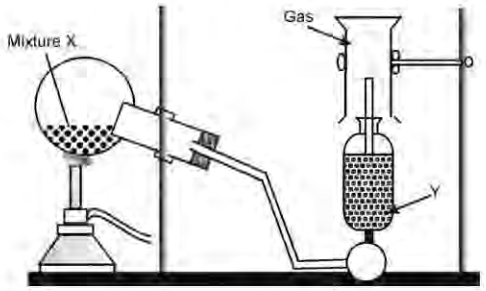
The diagram shows an experimental set-up for the laboratory preparation of a pungent smelling gas. The gas is alkaline in nature.
Image
(i) Name the gas collected in the jar.
(ii) Identify mixture X with ratio and compound Y.
(iii) Write the balanced equation for the above preparation.
(iv) How is the gas being collected?
The following is an extract from Metals in the service of Man, Alexander and street /Pelican 1976:
Alumina (aluminium oxide) has a very high melting point of over $2000^oC $so that it cannot readily be liquefied. However, conversion of alumina to aluminium and oxygen, by electrolysis, can occur when it is dissolved in some other substance.
(a) Which solution is used to react with bauxite as a first step in obtaining pure aluminium oxide?
(b) The aluminium oxide for the electrolytic extraction of aluminium is obtained by heating aluminium hydroxide. Write the balanced chemical equation for this reaction.
(c) Name the element which serves both as the anode and the cathode in the extraction of aluminium.
(d) Write the balanced chemical equation for the reaction that occurs at the cathode during the extraction of aluminium by electrolysis.
(e) Give the balanced chemical equation for the reaction which occurs at the anode when aluminium is purified by electrolysis.
A metal article is to be electroplated with silver. The electrolyte selected is sodium argentocyanide.
(a) What kind of salt is sodium argento cyanide?
(b) Why is it preferred to silver nitrate as an electrolyte?
(c) State one condition to ensure that the deposit is smooth, firm and long lasting.
(d) Write the reaction taking place at the cathode.
(e) Write the reaction taking place at the anode.
M is a metal above hydrogen in the activity series and its oxide has the formula $M_2O$. The oxide when dissolved in water forms the corresponding hydroxide which is a good conductor of electricity. In the above context answer the following:
(i) What kind of combination exists between $M$ and $O$?
(ii) How many electrons and there in the outermost shell of $M$?
(iii) Name the group to which M belongs
(iv) State the reaction taking place in the cathode
(v) Name the product at the anode
$O_2$ is evolved by heating $\text{KCIO}_3$ using $\text{MnO}_2$​​​​​​​ as a catalyst.
$2 KCI _3 \xrightarrow{ Mno _2} 2 KCl +3 O _2$
$(i)$ Calculate the mass of $\text{KClO}_3$ required to produce $6.72$ litre of $O_2$​​​​​​​ at $\text{STP}$.
$(ii)$ Calculate the number of moles of oxygen present in the above volume and also the number of molecules
$(iii)$ Calculate the volume occupied by $0.01\  mole$ of $CO_2$​​​​​​​ at $\text{STP}$
Four elements A, B, C, D and E have the following electron arrangements in their atoms:
A2, 8, 6
B2, 8, 8
C2, 8, 8, 1
D2,7
E2, 8, 2
(i) What type of bond is formed when 'A' combines with 'C'?
(ii) Which two elements will combine to form a covalent bond?
(iii) Which element is not able to form any type of bond?
(iv) Draw electron dot structure of bond formation of 'A' molecule.
(v) Which ion will be formed by 'D' to attain stability? Justify with the chemical equation.
State differences between the properties of ionic compounds and covalent compounds.
Compare the properties of a typical metal and a non- metal on the basis of the following:
(a) electronic configuration
(b) nature of oxides
(c) oxidizing or reducing action
(d) conductivity of heat and electricity