MCQ
What is the dimensions of impedance?
  • $M{L^2}{T^{ - 3}}{I^{ - 2}}$
  • B
    ${M^{ - 1}}{L^{ - 2}}{T^3}{I^2}$
  • C
    $M{L^3}{T^{ - 3}}{I^{ - 2}}$
  • D
    ${M^{ - 1}}{L^{ - 3}}{T^3}{I^2}$

Answer

Correct option: A.
$M{L^2}{T^{ - 3}}{I^{ - 2}}$
a
$\begin{array}{l}
impedance\,is\,same\,as\,{\rm{resistance}}\,but\,in\,ac\,circuit\\
\therefore \,Dimension\,of\,impedance\\
 = \frac{{dimension\,of\,voltage}}{{dimension\,of\,current\,}}\\
\frac{{\left[ V \right]}}{{\left[ T \right]}} = \frac{{\left[ {M{L^2}{T^{ - 3}}{I^{ - 1}}} \right]}}{I} = \left[ {M{L^2}{T^{ - 3}}{I^{ - 2}}} \right]
\end{array}$

Need a full question paper?

Generate a complete, print-ready paper with questions like this in minutes — across 16+ boards, with answer keys.

Start Generating Free

Similar questions

Two sources of sound placed close to each other, are emitting progressive waves given by
 $y_1 = 4\,\,sin\,\,600\pi t$ and  $y_2 = 5\,\,sin\,\,608\pi t.$

An observer located near these two sources of sound will hear

A point particle is acted upon by a restoring force $-k x^{3}$. The time-period of oscillation is $T$, when the amplitude is $A$. The time-period for an amplitude $2 A$ will be
The amplitude of an oscillating simple pendulum is $10\,cm$ and its period is $4\, sec$. Its speed after $1\, sec$ after it passes its equilibrium position, is ... $m/s$
A crew of scientists has built a new space station. The space station is shaped like a wheel of radius $R,$ with essentially all its mass $M$ at the rim. When the crew arrives, the station will be set rotating at a rate that causes an object at the rim to have radial acceleration $g,$ thereby simulating Earth's surface gravity. This is accomplished by two small rockets, each with thrust $T$ newtons, mounted on the station's rim. How long a time $t$ does one need to fire the rockets to achieve the desired condition?
Match Column $- I$ and Column $- II$ and choose the correct match from the given choices.
Column $- I$ Column $- II$
$(A)$ Root mean square speed of gas molecules $(P)$ $\frac{1}{3} \mathrm{n} m \bar{v}^{2}$
$(B)$ Pressure exerted by ideal gas $(Q)$ $\sqrt{\frac{3 \mathrm{RT}}{\mathrm{M}}}$
$(C)$ Average kinetic energy of a molecule $(R)$ $\frac{5}{2} \mathrm{RT}$
$(D)$ Total internal energy  of $1$ mole of a diatomic gas $(S)$ $\frac{3}{2} \mathrm{k}_{\mathrm{B}} \mathrm{T}$
According to Newtonl's law of cooling, the rate of cooling is :
The relation between time ' $t$ ' and distance ' $x$ ' is $t=$ $\alpha x^2+\beta x$, where $\alpha$ and $\beta$ are constants. The relation between acceleration $(a)$ and velocity $(v)$ is:
An engine pumps water continuously through a hose. Water leaves the hose with velocity $v$ and $m$ is mass per unit length of the water jet. If this jet hits a surface and came to rest instantaneously, the force on the surface is
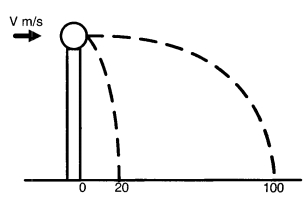
A ball of mass $0.2 \ kg$ rests on a vertical post of height $5 m$. A bullet of mass $0.01 \ kg$, traveling with a velocity $V / s$ in a horizontal direction, hits the centre of the ball. After the collision, the ball and bullet travel independently. The ball hits the ground at a distance of $20 \ m$ and the bullet at a distance of $100 \ m$ from the foot of the post. The initial velocity $V$ of the bullet is
which of the following is not an unit of Length?