Question
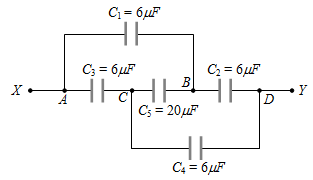
What is the effective capacitance between points X and Y
|
(a) 24 μF |
(b) 18 μF |
(c) 12 μF |
(d) 6 μF |
What is the effective capacitance between points X and Y
|
(a) 24 μF |
(b) 18 μF |
(c) 12 μF |
(d) 6 μF |
(d) 6 μF
Generate a complete, print-ready paper with questions like this in minutes — across 16+ boards, with answer keys.
The plates of a parallel plate condenser are pulled apart with a velocity v. If at any instant their mutual distance of separation is d, then the magnitude of the time of rate of change of capacity depends on d as follows
|
(a) |
(b) |
(c) |
(d) d |
The de-Broglie wavelength associated with the particle of mass m moving with velocity v is
|
(a) h/mv |
(b) mv/h |
(c) mh/v |
(d) m/hv |
The distance between the extreme points on the periphery of the mirror is called:
A double convex thin lens made of glass (refractive index μ = 1.5) has both radii of curvature of magnitude 20 cm. Incident light rays parallel to the axis of the lens will converge at a distance L such that
|
(a) L = 20 cm |
(b) L = 10 cm |
(c) L = 40 cm |
(d) L = 20 / 3 cm |
Two thin wire rings each having a radius R are placed at a distance d apart with their axes coinciding. The charges on the two rings are +q and -q. The potential difference between the centres of the two rings is
|
(a) Zero |
(b) |
|
(c) |
(d) |
The relation among u, v and f for a mirror is:
Which of the following is used to produce radio waves of constant amplitude
|
(a) Oscillator |
(b) FET |
(c) Rectifier |
(d) Amplifier |
In a PN-junction diode
|
(a) The current in the reverse biased condition is generally very small |
|
(b) The current in the reverse biased condition is small but the forward biased current is independent of the bias voltage |
|
(c) The reverse biased current is strongly dependent on the applied bias voltage |
|
(d) The forward biased current is very small in comparison to reverse biased current |
In the given nuclear reaction A, B, C, D, E represents 


|
(a) A = 234, B = 90, C = 234, D = 91, E = β |
|
(b) A = 234, B = 90, C = 238, D = 94, E = α |
|
(c) A = 238, B = 93, C = 234, D = 91, E = β |
|
(d) A = 234, B = 90, C = 234, D = 93, E = α |
The phenomena of total internal reflection is seen when angle of incidence is
|
(a) 90° |
(b) Greater than critical angle |
|
(c) Equal to critical angle |
(d) 0° |