MCQ
The relation among u, v and f for a mirror is:
- A$\text{f}=\frac{\text{uv}}{\text{u+v}}$
- B$\text{v}=\frac{\text{fu}}{\text{u+f}}$
- C$\text{u}=\frac{\text{fv}}{\text{f+v}}$
- DAll of these
The relation among u, v and f for a mirror is:
Explanation:
As we know,
$\frac{1}{\text{f}}=\frac{1}{\text{v}}+\frac{1}{\text{u}}$
$\frac{1}{\text{f}}=\frac{\text{u+v}}{\text{uv}}$
$\text{f}=\frac{\text{uv}}{\text{u+v}}$
Generate a complete, print-ready paper with questions like this in minutes — across 16+ boards, with answer keys.
In the above question, potential difference across the 40Ω resistance will be
|
(a) Zero |
(b) 80 V |
(c) 40 V |
(d) 120 V |
We have two wires A and B of same mass and same material. The diameter of the wire A is half of that B. If the resistance of wire A is 24 ohm then the resistance of wire B will be
|
(a) 12 Ohm |
(b) 3.0 Ohm |
(c) 1.5 Ohm |
(d) None of the above |
 and
and  represent mass of neutron and proton respectively. If an element having atomic mass M has N-neutron and Z-proton, then the correct relation will be
|
(a) |
(b) |
(c) |
(d) |
In hydrogen atom, if the difference in the energy of the electron in n = 2 and n = 3 orbits is E, the ionization energy of hydrogen atom is
|
(a) 13.2 E |
(b) 7.2 E |
(c) 5.6 E |
(d) 3.2 E |
Due to the flow of current in a circular loop of radius R, the magnetic induction produced at the centre of the loop is B. The magnetic moment of the loop is (
|
(a) |
(b) |
(c) |
(d) |
The galaxies are moving away from each other. It is explained by
|
(a) White dwarf star |
(b) Red shift |
(c) Neutron star |
(d) None of these |
The points resembling equal potentials are
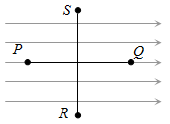
|
(a) P and Q |
(b) S and Q |
(c) S and R |
(d) P and R |






