Question
What is the electric resistance and resistivity ?

Answer

$\rightarrow $ "The electrical resistance of any object is directly proportional to its length. $1,$ and inversely proportional to its area of cross section $, A."$
$\rightarrow R \propto \frac{l}{A}$
$\therefore R =\rho \cdot \frac{l}{A}$
Where, $\rho=$ Resistivity $(Or)$ specfic resistance
$\rightarrow$ The electrical resistance is represented by the symbol $'R\ '$ and it is measured in ohm $(\Omega)$
$\rightarrow SI$ unit is $kgm ^2 / s ^3 \cdot A ^2$
$\rightarrow$ It can be measured with the help of awheatstone bridge.
$\rightarrow$ "The resistivity for a substance is its resistance when it is one metre long and its area of cross section is one $m^2."$
$\therefore \rho= R \left(\frac{ A }{l}\right) $
$\rightarrow$ Its $SI$ units are ohm metre $(\Omega M )$ and quite often its submultiple. ohm centimetre
$( \Omega \  \ cm )$ is also used.
$1 \Omega\ m =100 \ \ \Omega \ cm$ or $1 \Omega \ cm =0.01 \ \Omega \ m$

Need a full question paper?

Generate a complete, print-ready paper with questions like this in minutes — across 16+ boards, with answer keys.

Start Generating Free

Similar questions

Find the oxidation number of Cu in the complex ion: $[Cu(NH_{3})_{4}]^{2+}$
Answer the following:
$(a)\ a.$ Write the mathematical relation between rate constant and half-life of a first order reaction.
$b.$ What is collision frequency?
$(b)$ If the rate equation is given below:
Rate $= k[A]^2[B]$
then what will be the unit of its rate and rate constant?
List the reactions of glucose which cannot be explained by its open chain structure.
Match the items of Column I and Column II.
 
Column I
 
Column II
(i)
Diamond.
(a)
Short interval of time.
(ii)
Instantaneous rate.
(b)
Ordinarily rate of conversion is imperceptible.
(iii)
Average rate.
(c)
Long duration of time.
Explain solubility of haloalkane.
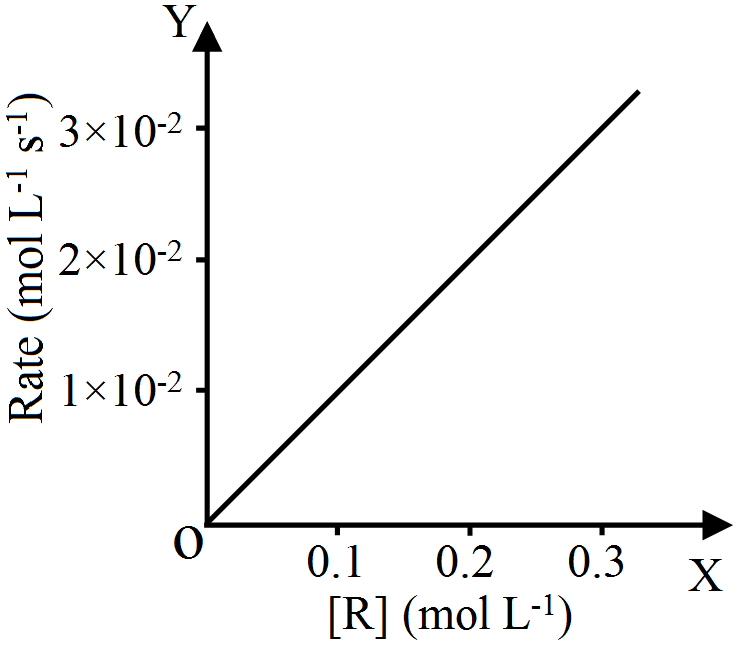
The rate for the reaction $R\rightarrow P$ is rate $= k[R]$. It has been shown graphically below. What is rate constant for the reaction?
Explain (% W/V) Mass by volume Percentage with examples.
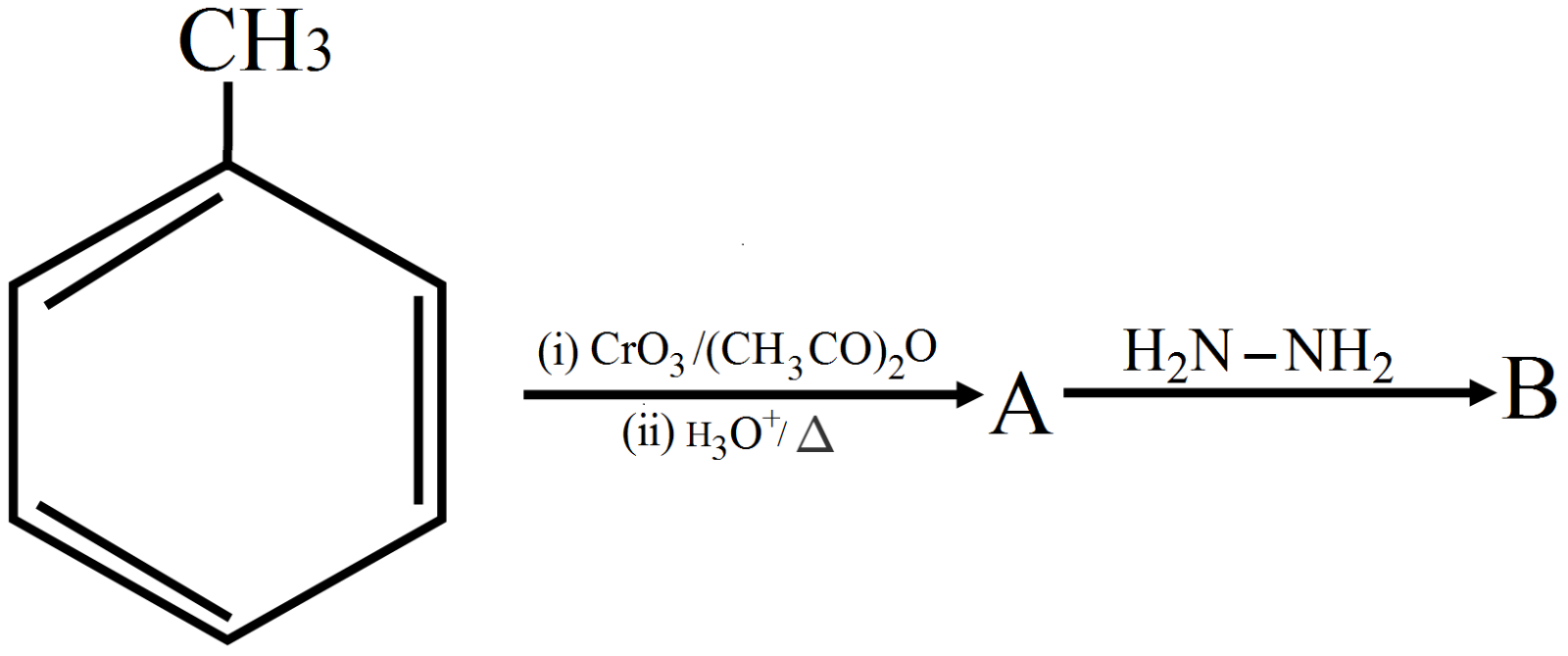
Give the structures of $A$ and $B$ in the following sequence of reactions :
(a) $CH _3 COOH \xrightarrow[\Delta]{ NH _3} A \xrightarrow{ NaOBr } B$
(b) $C _6 H _5 NO _2 \xrightarrow{ Fe / HCl } A \xrightarrow[0^{\circ}-5^{\circ} C ]{ NaNO _2+ HCl } B$
(c) $C _6 H _5 N_2^{+} Cl ^{-} \xrightarrow[\Delta]{ CuCN } A \xrightarrow{ H _2 O / H ^{+}} B$
Write structures of main compounds $A$ and $B$ in each of the following reactions:
  1. $\text{CH}_3\text{CH}_2\text{CH}\xrightarrow{\ \ \ {\text{CH}_3\text{MgBr/H}_3\text{O}^+}\ \ \ \ }\text{A}\xrightarrow{\ \ {\text{LiAlH}_4}\ \ }\text{B}$
Answer the following question:Although phenoxide ion has more number of resonating structures than carboxylate ion, carboxylic acid is a stronger acid than phenol. Give two reasons.