Questions

2 Marks Questions

Take a timed test

18 questions · self-marked practice — reveal the answer and mark yourself.

Question 12 Marks
What is the electric resistance and resistivity ?
Answer
$\rightarrow $ "The electrical resistance of any object is directly proportional to its length. $1,$ and inversely proportional to its area of cross section $, A."$
$\rightarrow R \propto \frac{l}{A}$
$\therefore R =\rho \cdot \frac{l}{A}$
Where, $\rho=$ Resistivity $(Or)$ specfic resistance
$\rightarrow$ The electrical resistance is represented by the symbol $'R\ '$ and it is measured in ohm $(\Omega)$
$\rightarrow SI$ unit is $kgm ^2 / s ^3 \cdot A ^2$
$\rightarrow$ It can be measured with the help of awheatstone bridge.
$\rightarrow$ "The resistivity for a substance is its resistance when it is one metre long and its area of cross section is one $m^2."$
$\therefore \rho= R \left(\frac{ A }{l}\right) $
$\rightarrow$ Its $SI$ units are ohm metre $(\Omega M )$ and quite often its submultiple. ohm centimetre
$( \Omega \  \ cm )$ is also used.
$1 \Omega\ m =100 \ \ \Omega \ cm$ or $1 \Omega \ cm =0.01 \ \Omega \ m$
View full question & answer
Question 22 Marks
What is conductance and conductivity $($specific conductance$)$?
Answer
$\rightarrow$ "The inverse of resistance$, R$ is called conductance$, G"G =\frac{1}{ R }=\frac{ A }{\rho \cdot l}$
$G = K \left(\frac{ A }{l}\right)(\because K \text { conductivity }=\frac{1}{\text { resistivity } \rho})$
$\rightarrow$ The $SI$ unit of conductance is siemens, represented by the symbol $'S\ '$ and is equal to ohm $^{-1}\ ($also known as mho$)$ or $\Omega^{-1}$
$\rightarrow$ "The inverse of resistivity, called conductivity $($specific conductors$)$ is represented by the symbol$, k ($greek, kappa$)$"
$\rightarrow$ The $SI$ unit of conductivity are $S\ m ^{-1}$ but quite often$, k$ is expressed in $S\ cm ^{-1}$
$\rightarrow$ Conductivity of a material in $S\ cm ^{-1}$is its conductance when it is $1 m$ long and its area of crosss sections $1
m^2$.
$1S\ cm ^{-1}=100\ Sm ^{-1}$
View full question & answer
Question 32 Marks
Explain construction and uses of conductivity cell.
View full question & answer
Question 42 Marks
Prevention of Iron.
Answer
→ Prevention of corrosion is of prime importance.
→ One of the simplest methods of preventing corrosion is to prevent the surface of the metallic object to come in contact with atmosphere.
→ This can be done by covering the surface with paint or by some chemicals (e.g. bisphenol) Another simple method is to cover the surface by other metals (Sn, Zn, etc.) that are inert or react to save the object.
→ An electrochemical method is to provide a sacrificial electrode of another metal (like Mg, Zn, etc.) which corrodes itselt but saves the object.
View full question & answer
Question 52 Marks
Write down Faradays law
Answer
(1) First Law:
→ The amount of chemical reaction which occurs at any electrode during electrolysis by a current is proportional to the quantity of electricity passed through the electrolyte (solution or melt).
→ If W is amount of matter and Q is electricity then $W \propto Q$
(2) Second Law:
→ The amounts of different substances liberated by the same quantity of electricity passing through the electrolytic solution are proportional to their chemical equivalent weights (Atomic Mass of Metal ÷ Number of electrons required to reduce the cation).
→ If W is amount of matter and Eq. is Equivalent weight then$W \propto$ Eq.wt
View full question & answer
Question 62 Marks
Which problems are face during measurement of resistance of lonic solution and how to solve it ?
Answer
→ Accurate measurement of an unknown resistance can be performed on a wheatstone bridge.
→ However, for measuring the resistance of an ionic solution we face two problems.
→ Firstly, passing direct current (DC) changes the composition of the solution.
→ Secondly, a solution cannot be connected to the bridge like a metallic wire or other solid conductor.
→ The first difficulty is resolved by using an alternating current (AC) source of power.
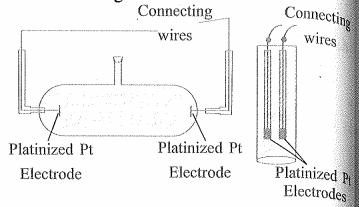
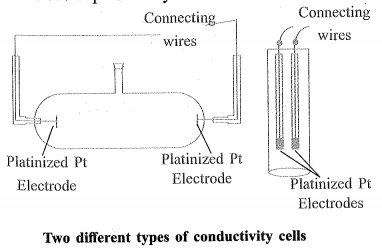
→ The second problem is solved by using a specially designed vessel called condutivity cell. It is available in several designs and two simple ones are shown in Fig
Image
View full question & answer
Question 72 Marks
Write a note on reaction between Gibbs free energy and cell potential for cell reaction.
Answer
$\rightarrow$ Electrical work done in one second is equal to electrical potential multiplied by total charge passed.
$\rightarrow$ If we want to obtain maximum work from a galvanic cell then charge has to be passed reversibly.
$\rightarrow$ The reversible work done by a galvanic cell is equal to decrease in its Gibbs energy.
$\rightarrow$ If the $\text{EMF}$ of the cell is $E$ and $nF$ is the amount of charge passed and $\Delta_{ r } G$ is the Gibbs energy of the reaction, $\Delta_{ r } G =- nF E_{\text {cell }}$
$\rightarrow E ($cell$)$ is an intensive parameter but $\Delta_{ r } G$ is an extensive thermodynamic property and the value depends on $n$ .
$Zn ( s )+ Cu ^{2+}( aq ) \rightarrow Zn ^{2+}( aq )+ Cu ( s )$
$\Delta_{ r } G =-2 FE _{\text {(cell) }}$
but when we write the reaction
$2 Zn ( s )+2 Cu ^{2+}( aq ) \rightarrow 2 Zn ^{2+}( aq )+2 Cu ( s )$
$\Delta_{ r } G =-4 FE _{\text {(cell) }}$
$\rightarrow$ If the concentration of all the reacting species is unity
$\Delta_{ r } G ^{\ominus}=- nF E _{\text {(cell) }}^{\ominus}$
$\rightarrow$ We can calculate Equilibrium constant from the value of $\Delta_r G^{\ominus}$
Where, $ \Delta_{ r } G ^{\ominus}=- RT \ln K =-2.303 RT \log K$
$\Delta G ^{\ominus}=$ Change in gibbs free energy
$R =$ Gas constant
$T =$ Temperature
$K =$ Equilibrium constant
View full question & answer
Question 82 Marks
Calculate standard cell potential for the following cell $Al ( s )\left| Al ^{+3}(1 M )\right|\left| Ag ^{+}(1 M )\right| Ag ( s )$
Answer
$\begin{aligned}→ E _{\text {cell }}^0 & = E _{ R }^0- E _{ L }^0 \\ & =0.80-(-1.66) \\ & =0.80+1.66 \\ & =2.46 V\end{aligned}$
View full question & answer
Question 92 Marks
Calculate the $Zn-Cu$ cell potential. $\#\#\#$ Calculate standard cell potential of Daniell cell.
Answer
$\rightarrow$ In Daniell cell $Zn$ act as anode and $Cu$ act as cathode so the half reaction of cell is written as
Left electrode : $\ce{Zn(s) \rightarrow Zn^{2+}(aq, 1 M) + 2e^{-}}$
Right electrode $:\mathrm{Cu}^{2+}(\mathrm{aq}, 1 \mathrm{M})+2 e^{-} \rightarrow \mathrm{Cu}(\mathrm{s})$
$\rightarrow$ The overall reaction of the cell is the sum of above two reactions and we obtain the equation $:$
$\mathrm{Zn}(\mathrm{~s})+\mathrm{Cu}^{2+}(\mathrm{aq}) \rightarrow \mathrm{Zn}^{2+}(\mathrm{aq})+\mathrm{Cu}(\mathrm{~s})$
$ \ce{EMF} \text { of the cell }=E_{\text {cell }}^0=E_R^0-E_L^0$
$ =0.34 \mathrm{~V}-(-0.76) \mathrm{V}$
$ =1.10 \mathrm{~V}$
View full question & answer
Question 102 Marks
What is fuel cell.
Answer
→ We know that a galvanic cell directly converts chemical energy into electricity and is highly efficient.
→ It is now possible to make such cells in which reactants are fed continuoulsy to the electrodes and products are removed continuously from the electrolyte compartment.
→ "Galvanic cells that are designed to convert the energy of combustion of fuels like hydrogen. methane, methanol. etc. directly into electrical energy are called fuel cells."
→ Fuel cells are pollution free. Fuel cells produce electricity with an efficiency of about 70% compared to thermal plants whose efficiency is about 40%.
View full question & answer
Question 112 Marks
Write note on Mercury cell (Zn-Hg)
Answer
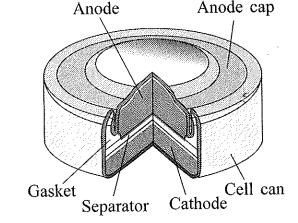
→ Mercury cell, suitable for low current devices like hearing aids, watches, etc.
→ It consists of zinc - mercury amalgam as anode and a paste of HgO and carbon as the cathode.
Image
→ The electrolyte is a paste of KOH and ZnO . The electrode reactions for the cell are given below.
Anode : $Zn ( Hg )+2 OH ^{-} \rightarrow ZnO ( s )+ H _2 O +2 e ^{-}$
Cathode : $HgO + H _2 O +2 e ^{-} \rightarrow Hg (l)+2 OH ^{-}$
→ The overall reaction is represented by $Zn ( Hg )+ HgO ( s ) \rightarrow ZnO ( s )+ Hg (l)$
→ The cell potential is approximately 1.35V and remains constant during its life as the overall reaction does not involve any ion in solution whose concentration can change during its life time.
View full question & answer
Question 122 Marks
What is battery? Give it's types.
Answer
→ "Battery is a galvanic cell in which chemical energy converted into electrical energy."
→ There are two types of battery.
(1) Primary cell: In the primary batteries, the reaction occurs only once and after use over a period of time battery becomes dead and cannot be reuse again.
e.g. Dry cell, Mercury cell
(2) Secondary cell: A secondary cell after use can be recharged by passing current through it in the opposite direction so that it can be used again.
e.g. lead storage cell, Ni-Cd cell.
View full question & answer
Question 132 Marks
Explain electrolysis of sulphuric acid.
Answer
$\rightarrow $ In the electrolysis of dilute Sulphuric acid only electrolysis of water occurs.
$\ce{2 H _2 O ( l ) \rightarrow O _2(g)+4 H ^{+}( aq )+4 e ^{-}} E _{\text {(cell) }}^{\ominus}=$
$+1.23 V$
$\rightarrow$ Electrolysis of concentrated sulphuric acid oxidise $\ce{SO _4^{-2}}$ ion $\ce{S _2 O _8^{-2}}$
$\ce{2 SO _4^{2-}( aq ) \rightarrow S _2 O _8^{2-}( aq )+2 e ^{-} } E _{(\text {cell })}^{\ominus}=1.96 V$
View full question & answer
Question 142 Marks
Explain Electrolysis of molten NaCl
Answer
→ We use molten NaCl , the products of electrolysis are sodium metal and $Cl _2$ gas.
→ Here, we have only one cation $\left( Na ^{+}\right)$which is reduced at the cathode
Cathode : $Na ^{+}$(aq) $+ e ^{-} \rightarrow Na$ (s) (reduction)
→ One anion $( Cl )$ which is oxidised at the anode
Anode $: 2 Cl ^{-}( aq ) \rightarrow Cl _2(g)+2 e ^{-}$(oxidation)
View full question & answer
Question 152 Marks
What is ionic conductivity? It depends on which factor?
Answer
→ "The conductance of electricity by ions present in the solutions is called electrolytic or ionic conductance"
→ When electrolytes are dissolved in water, they furnish their own ions in the solution hence its conductivity also increases.
→The conductivity of electrolytic (ionic) solution depends on:
(i) The nature of the electrolyte added
(ii) The size of the ions produced and their solvation
(iii) The nature of the solvent and its viscosity
(iv) Concentration of the electrolyte
(v) Temperature (it increases with the increase of temperature)
View full question & answer
Question 162 Marks
What is metallic conductivity which factor affect metallic conductivity ### What is electronic conductivity? Explain
Answer
→ "Electric conductance through metals is called metallic or electronic conductance and is due to the movement of electrons."
→ The electronic conductance depends on
(i) The nature and structure of the metal
(ii) The number of valence electrons per atom
(iii) Temperature (it decrease with increase of temperature)
→ As the electrons enter at one end and exit through the other end, the composition of the metallic conductor remains unchanged of constant.
View full question & answer
Question 172 Marks
Write Nernst equation for the following cell. $N i (s)\left| N i ^{2+}(a q)\right|\left| A g ^{+}(a q)\right| A g _{(s)}$
Answer
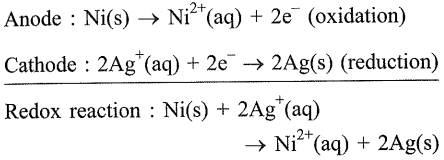
$\rightarrow Ni ( s )\left| Ni ^{2+}( aq )\right|\left| Ag ^{+}( aq )\right| Ag _{( s )}$
$Ni ( s )\left| Ni ^{2+}( aq )\right|\left| Ag ^{+}( aq )\right| Ag _{( s )}$
$\text { $\quad$ Anode $\quad \quad \quad \quad$ Cathode }$
Image
$ E_{\text {cell }}=E_{\text {cell }}^0-\frac{R T_2}{2 F} \ln \frac{\left[\mathrm{Ni}^{2+}(a q)\right]}{\left[\mathrm{Ag}^{+}(a q)\right]^2}$
$ \quad=E_{\text {cell }}^0-\frac{0.059}{2} \log \frac{\left[\mathrm{Ni}^{2+}(a q)\right]}{\left[\mathrm{Ag}^{+}(a q)\right]^2}$
View full question & answer
Question 182 Marks
Derive nernst equation for general reaction $a A+b B \rightarrow c C+d D$
Answer
$→ aA + bB \xrightarrow{ ne ^{-}} cC + dD
$
Nernst equation can be written as :
$
\begin{aligned}
E _{\text {(cell) }} & = E _{\text {(cell) }}^{\ominus}-\frac{ RT }{ nF } \ln Q \\
& = E _{\text {(cell) }}^{\ominus}-\frac{ RT }{ nF } \ ln \frac{[ C ]^{ c }[ D ]^d}{[A]^{ a }[ B ]^{ b }} \\
& = E _{\text {(cell) }}^0-\frac{0.059}{ n } \ log \frac{[ C ]^c[ D ]^d}{[A]^{ a }[ B ]^{ b }}
\end{aligned}$
View full question & answer