Question
What is the electronic configuration of phosphorus?

Answer

  1. 2, 8, 5
Explanation:
Phosphorus has atomic no-17. so its k shell has 2 electron, L shell has 8 electron and M shell has 5 electron.

Need a full question paper?

Generate a complete, print-ready paper with questions like this in minutes — across 16+ boards, with answer keys.
Start Generating Free

Similar questions

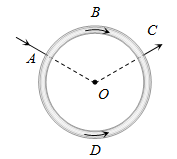
A uniform wire is bent in the form of a circle of radius $R. A$ current $I$ enters at $A$ and leaves at $C$ as shown in the figure : If the length $ABC$ is half of the length $ADC,$ the magnetic field at the centre $O$ will be
Assertion :   The threshold frequency of photoelectric effect supports the particle nature of sunlight.
Reason      : If frequency of incident light is less than the threshold frequency, electrons are not emitted from metal surface.(a) If both assertion and reason are true and the reason is the correct explanation of the assertion.(b) If both assertion and reason are true but reason is not the correct explanation of the assertion.(c) If assertion is true but reason is false.(d) If the assertion and reason both are false.


If a positive charge is shifted from a low-potential region to a high-potential region, the electric potential energy.
The graph of ln$\Big(\frac{\text{R}}{\text{R}_{\text{0}}}\Big)$ versus In A (R = radius of a nucleus and A - its mass number) is:
If the phase difference between Alternating Voltage and Alternating Current is $\frac{\pi}{6}$​ and the resistance in the circuit is $\sqrt{300}\Omega,$ then the impedance of the circuit will be.
In a transistor, a change of 8.0 mA in the emitter current produces a change of 7.8 mA in the collector current. What change in the base current is necessary to produce the same change in the collector current(a) 50 mA(b) 100 mA(c) 150 mA(d) 200 mA
       
The relation between electric field (E) and electric potential (V) is :
A convex lens(a) Converges light rays(b) Diverges light rays(c) Form real images always(d) Always forms virtual images
   
   
The SI unit of resistivity is:
A heating coil is labelled 100 W, 220 V. The coil is cut in half and the two pieces are joined in parallel to the same source. The energy now liberated per second is(a) 200 J(b) 400 J(c) 25 J(d) 50 J